Why So Many CRM Projects Fail: A Quick Test to See If You're Ready
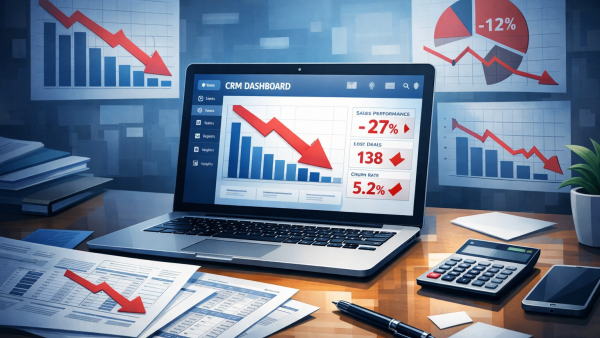
65% of CRM projects miss their targets. The problem isn't the software chosen, but organizational preparation. A free assessment in 4 minutes to understand if you're ready or about to waste money.

In Brief: Why CRM Projects Fail
CRM projects fail mainly due to 5 organizational causes, not technological ones:
- No clear project owner - 67% of companies lack a clear responsibility holder
- Undocumented sales processes - 73% have no standardized processes
- Undefined KPIs - Only 25% define metrics before implementation
- No CAC/LTV measurement - 58% don't track acquisition costs
- Insufficient training - One-shot training without follow-up
The result? 65% of CRM projects miss their objectives (Gartner). Average cost of failure for an SME: 15,000-50,000 euros.
The solution: Do a CRM Readiness Assessment before choosing the software.
"We bought HubSpot, but after six months the sales team still uses Excel."
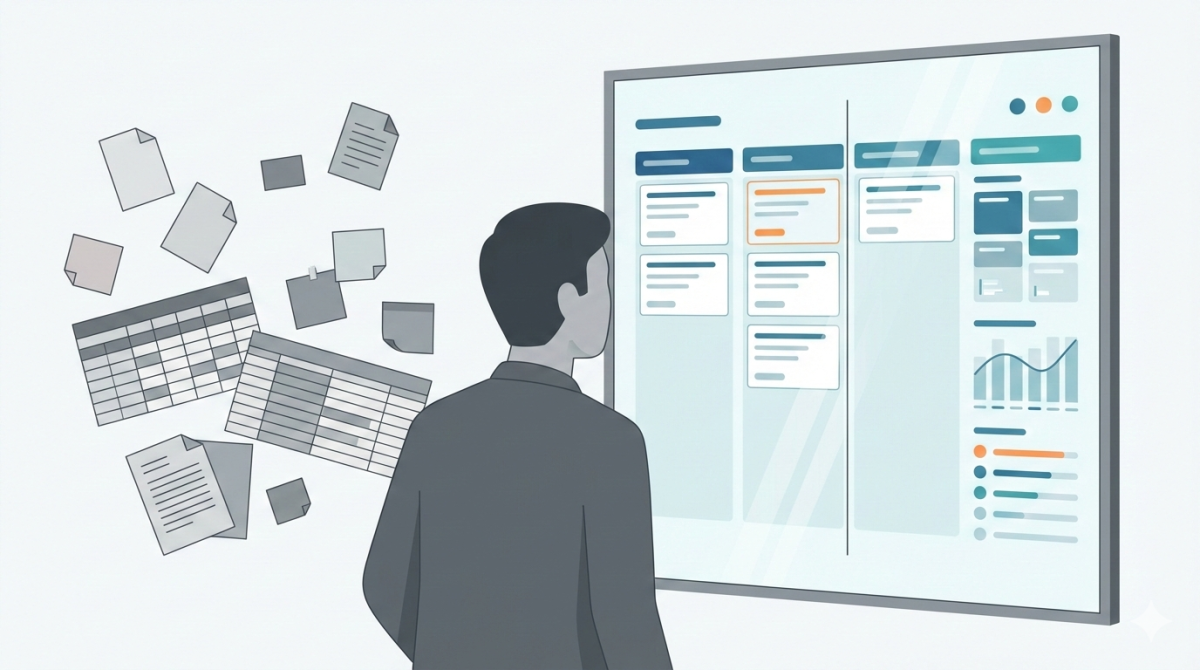
That's how it came through, blunt, from an entrepreneur who called me a few weeks back. Licenses paid, onboarding done, a few calls with the partner, interfaces pretty modern overall. Yet in daily practice, nothing had changed: quotes on shared files, scattered notes, pipeline kept from memory.
Asking a few more questions, the picture became clear quickly: no project owner, no clear responsibility for commercial governance, undocumented sales processes, no forecasting. In this scenario, the CRM wasn't the solution: it was just a multiplier of confusion. The problem wasn't "that" CRM, but the organization's readiness to use one.
A pattern that repeats: assessment numbers
Situations like this, with different names and logos, happen often. Over the last three months we conducted 12 CRM assessments with client companies - SMEs between 20 and 150 employees, different sectors (manufacturing, B2B services, retail) - and the results tell a recurring story:
- 73% of companies had no documented sales process
- 67% had no clear CRM project owner
- 58% didn't measure customer acquisition cost (CAC) or lifetime value (LTV)
- Only 25% had defined clear KPIs before implementation
Companies investing 15, 30, 50 thousand euros in powerful platforms, but who haven't yet done the basic work: clarifying how they sell, how they manage customers, who sets the rules between Sales, Marketing, Customer Service and IT. What's missing isn't technology, it's an honest preliminary check-up.
A concrete case: 20,000 euros in licenses, 31% adoption
One of the most recent assessments involved a B2B services company with 45 employees. They had implemented HubSpot 10 months prior with a total investment of about 20,000 euros (annual licenses + setup + initial training).
Numbers we measured:
- Adoption rate: 31% (only 4 out of 13 salespeople used CRM daily)
- Pipeline data: updated on average every 12 days (vs. best practice of 2-3 days)
- Forecast accuracy: not measurable (no one used it for predictions)
- Estimated ROI: negative in first 18 months
The problem? Zero governance, no standardized process, training done "once and for all" without follow-up. The CRM had become a contact repository, not a working tool.
CRM Readiness Assessment: the question no vendor asks
From here comes the idea of the CRM Readiness Assessment: before signing a contract or switching platforms, take four minutes to answer the question no vendor explicitly asks: "Is my organization really ready for a CRM or am I about to waste money?"
The tool is designed as a small strategic self-examination. In about four minutes, through twenty quantitative questions based on benchmarks and international research, it guides entrepreneurs and C-level executives to think about the metrics that matter before a CRM investment.
The 4 critical evaluation areas
It doesn't just ask "what software do you use", but measures maturity across four critical areas:
- Sales - Documented sales processes? Structured pipeline? Reliable forecasts?
- Customer Service - Ticket management? Defined SLAs? Knowledge base?
- Marketing - Lead scoring? Automated nurturing? Sales alignment?
- IT - Necessary integrations? Data quality? Technical governance?
These are the functions that will need to coexist in the same system. If today they work in silos, the CRM won't solve the problem: it will amplify it.
What you get: a report, not a marketing gimmick
At the end of the questionnaire, the company receives a PDF report that isn't a marketing gimmick, but a concrete summary:
- Readiness Score (0-100) with sector benchmarks
- Risk assessment: where are the main failure risks
- Opportunity map: what opportunities you could unlock
- Priority list: what actions to take BEFORE implementing a CRM
The score doesn't just say "go" or "stop", but helps you understand if you're in a "green light" zone, where it makes sense to proceed immediately, or if you need to first address governance, processes and change management.
The core thesis: organization matters more than software
Behind this is a very simple thesis: the success of a CRM project depends much more on the organization than on the software chosen.
The assessment focuses precisely on this: leadership gaps, lack of shared rules, absence of ownership structures that, if ignored, transform even a well-designed investment into an announced failure.
Market numbers confirm it
- 65% of CRM projects miss their targets (Gartner)
- 43% of companies report adoption problems in first 12 months (Forrester)
- Average cost of failed CRM project for an SME is between 15,000 and 50,000 euros (time + licenses + lost opportunities)
Changing the conversation
The beauty of this approach is that it shifts the conversation. It's no longer "what's the best CRM on the market?", but "how ready are we, today, to work differently?"
It's a subtle but decisive shift: instead of delegating the result to a vendor's promise, you look in the mirror and decide how much to invest first in readiness - processes, roles, culture, training - and only then in licenses, integrations and customizations.
In practice, the CRM Readiness Assessment doesn't just tell you "buy" or "don't buy", but helps you see where to act to maximize return:
- Sales processes to standardize
- Marketing-Sales collaboration to implement
- Governance roles to define
- Skills to strengthen
And it does so in a way that's anonymous, without request for corporate data, precisely to allow free answers without filters.
First the check-up, then the cure
At a time when the CRM market promises quick solutions to complex problems, stopping for four minutes might seem like a luxury. Actually it's the opposite: it's the simplest way to prevent the next 20-30 thousand euro investment from meeting the same fate as so many others, with a dormant CRM and Excel always open.
First the check-up, then the cure. It's a rule of common sense in medicine.
In the world of CRM, it would have already saved quite a few budgets.
If you're looking for support to do exactly this preparation work, our CRM consulting for SMEs starts right here: readiness first, platform choice after.
Do you already have a CRM no one uses? If the system is already implemented but the team continues to work in Excel, the problem isn't readiness: it's adoption. Read the 5 mistakes that cause 70% of CRM projects to fail and how to fix them.
Find out if your company is ready: Free CRM Readiness Assessment
4 minutes today could save you 20,000 euros in investment with no return. Start with readiness, not software.
Frequently Asked Questions
What is a CRM readiness assessment? A CRM readiness assessment is a short evaluation that measures whether your organization is ready to adopt a CRM, before you buy one. It scores your maturity across Sales, Marketing, Customer Service and IT, so you fix processes and ownership first instead of amplifying confusion with new software.
How do you conduct a CRM readiness assessment? You answer about twenty quantitative questions across four areas (Sales, Customer Service, Marketing, IT), based on benchmarks. It takes around four minutes and returns a readiness score (0-100), a risk map and a priority list of what to fix before implementation. You can run a free CRM readiness assessment online.
Why do companies need a CRM readiness assessment? Because 65% of CRM projects miss their targets (Gartner), and the cause is organizational, not technological. A readiness check done before signing prevents a typical 15,000 to 50,000 euro investment from turning into a dormant CRM while the team keeps working in Excel.