AI Adoption Consulting for SMEs

The 4-phase path that brings artificial intelligence into your departments: assessment, training, field-tested proof of concept and production. With measurable results in 90 days.

What is AI adoption consulting

AI adoption consulting is the service that brings a company to actually use artificial intelligence in its processes: it starts from how departments work, trains the people, field-tests the solutions and connects them to the real systems. It does not install a tool: it changes the way of working, with measured results.

It is the right path for an SME where the owner decides: it involves departments one at a time, without stopping operations.

The AI adoption path, in 4 phases

The same method on every engagement: we start from how you work, we finish with AI connected to your real systems. Every phase produces something that stays.

Typical duration for an SME: 2 to 4 months. It depends on how many people and departments are involved, and on whether a trained internal AI Leader already exists.
Phase 01

Assessment

We go into the departments: who already uses AI and how, which managers are experimenting with it, which processes lend themselves. What comes out is the real picture of the company, not the declared one.

What you keep: The map of departments, referents and candidate processes
Phase 02

Training

Classroom sessions for everyone and working groups per department, or per cluster of similar departments. Together we analyze one or more real procedures and choose the ones to turn into skills, meaning AI assistants with precise working instructions.

What you keep: Trained people and selected procedures to turn into skills
Phase 03

Proof of Concept

We build up to 3 skills and install them in the departments. We test them together with the people who will use them, noting every deviation from how we assumed they would work: it is the moment the project corrects itself, before it costs.

What you keep: Up to 3 field-tested skills, with the log of corrections
Phase 04

Production

We install skills and connectors on the department workstations, together with your IT, and connect the real systems (ERP, CRM, email) to the agents that need them. AI stops being an experiment: it is in the workflow.

What you keep: Skills in production, connected to company systems, with internal IT autonomous

AI Adoption: The Numbers Speak

Data-driven insights from leading research institutions and Fortune 500 companies

40%
Productivity Increase

Performance boost for highly skilled workers using GenAI

MIT Sloan
3.7x
Return on Investment

ROI per dollar spent on GenAI implementation

Microsoft-IDC
18%
Quality Enhancement

Improvement in output quality with AI assistance

MIT Sloan
75%
Enterprise Adoption

Organizations using AI in 2024 (up from 55% in 2023)

Microsoft IDC
30%
Skills Gap Challenge

Organizations lack specialized AI skills in-house

Microsoft IDC
92%
Productivity Focus

AI users leverage technology primarily for productivity improvements

Microsoft-IDC
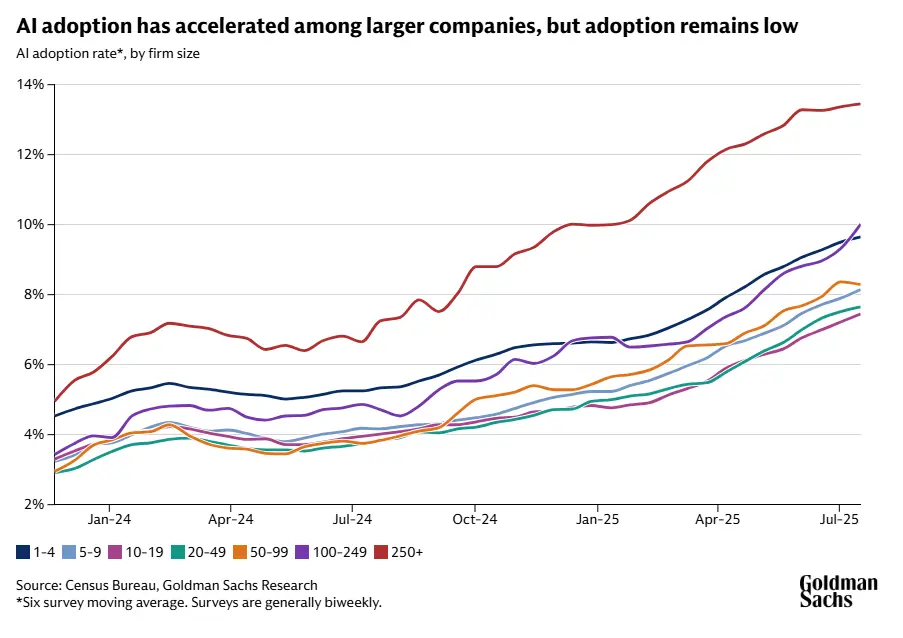
Goldman Sachs AI Research
Research Sources:

What Does This Mean for Your Company?

The data is clear: companies that have not yet defined a roadmap for AI adoption are already falling competitively behind. In a rapidly evolving market, this inertia can become a fatal strategic risk. Don't get left behind.
AI Adoption Challenges? We Have Solutions.

Based on market research and our proven experience, we address every barrier to successful AI implementation

Limited Internal Expertise / Knowledge Gap

Market Insight:
Many SMEs lack internal AI expertise at both management and operational levels; they struggle to choose tools or use cases and have little direct experience.

Our Solution

We offer an end-to-end training path: board workshops + team training, coaching with external experts, and hands-on mentoring on use cases. In parallel, we develop a "custom AI roadmap" to help the company identify where to invest first, who to train, and how to progressively grow skills.

Output Quality & Reliability / Bias / Scarce or Unstructured Data

Market Insight:
Current analyses show that data is often incomplete, poorly structured, and siloed; AI outputs are not always reliable or interpretable; bias and accuracy issues erode trust.

Our Solution

We conduct a Corporate Assessment: auditing existing data, analyzing quality, structure, and cleanliness; identifying and removing silos; defining policies for bias detection and validation frameworks. We provide interpretable models or dashboards that show accuracy metrics, making AI output transparent and understandable.

Data Structure Limitations / Legacy IT Infrastructure

Market Insight:
In many SMEs, existing systems do not communicate with each other, leading to data silos, incompatible or obsolete infrastructure, and a lack of interoperability. These technical barriers make it difficult to integrate new AI tools.

Our Solution

We offer a Low-Code and Open Source technology integration service: auditing the IT infrastructure, designing APIs/microservices to connect legacy systems, developing a modular architecture, and using cloud/hybrid solutions when needed. We can support you in upgrading systems to ensure every new AI tool can easily "talk" to existing data and processes.

Cost / Limited Financial Resources

Market Insight:
The cost of licenses, infrastructure, and specialized personnel is perceived as high; many SMEs state they cannot afford significant investments in AI.

Our Solution

We propose phased implementation models ("pilot phase," "proof-of-concept") to limit initial spending, with measurable results. We explore partnerships with suppliers, use of low-cost SaaS solutions, and no-code/low-code where possible. Through our Il Sole 24 Ore Business Partner network, we can access trusted partners specializing in hybrid and subsidized finance for AI adoption.

Cultural Resistance to Change / Distrust / Risk Perception

Market Insight:
Market research shows that employees may be fearful (job loss, errors, not understanding how to use AI), and management may be skeptical; lack of trust reduces adoption.

Source: Nordic SMEs; MDPI

Our Solution

We work with teams on Change Management: internal communication workshops to explain what AI will do, its real benefits, and "safe" pilot cases with visible impact. We create internal champions who use AI and testify to its value, incentivize (even symbolically) those who experiment, and hold feedback sessions to listen to fears and adapt the model.

Lack of Clear Business Case / ROI Metrics / Scalability

Market Insight:
Initiatives often remain isolated, lacking clear metrics to demonstrate return on investment; there is poor planning to scale from a pilot to a company-wide system.

Our Solution

We help define specific KPI metrics before the project: time saved, error frequency, internal/customer satisfaction, costs avoided, and revenue increase where applicable. We design a roadmap that includes scaling steps: when and how to move from pilot solutions to company-wide deployment, with cost/benefit estimates for each phase.

Ready to Transform Your Organization?

Our proven methodology has helped dozens of companies successfully implement AI

Get your personalized AI roadmap
Business Story

An SME that put AI into its real processes

Appkeep started an AI adoption journey with us by analyzing its processes first. The result: streamlined timelines, better performance and fewer non-conformities.

The results have been remarkable: we streamlined our timelines, improved business performance and reduced non-conformities thanks to an additional layer of control. We used artificial intelligence as a tool to verify and support the work of our team.
Appkeep
David Montagna
CEO of Appkeep
appkeep.it
Read the full case

Adoption or targeted consulting?

AI adoption is the path that brings the whole company to work with AI, department by department. If instead you are looking for help on a specific project (an integration, a single agent, a compliance check), the right service is AI consulting.

Frequently Asked Questions - AI Adoption

AI Adoption is a comprehensive business transformation journey that systematically involves people, data, processes, and systems. It's not simply about installing an AI tool, but about integrating AI logic, culture, and processes throughout the entire organization. The goal is to ensure that decisions, operational workflows, and strategies are sustainably and scalably enhanced by AI, creating genuine cultural change alongside technological advancement.
For an SME the complete path typically runs from 2 to 4 months. Duration depends on the number of people and departments involved, and on whether an internal AI Leader already exists: if so, it shortens; if one needs to be trained, that training becomes part of the path. The 4 phases (assessment, training, proof of concept, production) each have their own scope: training alone is about one month of workshops segmented by employees, managers and executives. To see where you start from, use the free AI Readiness Assessment.
Success is measured through concrete business impact metrics and ROI. Use our AI ROI Calculator to calculate expected return on investment based on real parameters: operational cost reduction, hours saved, productivity increase, error reduction, and customer experience improvement. Beyond financial metrics, we also monitor qualitative KPIs such as team AI literacy, decision-making speed, and user adoption rates of implemented tools.
Start with our free AI Readiness Assessment to understand your organization's current situation in terms of data, skills, infrastructure, and governance. After the assessment, the ideal path includes a 1-month AI Adoption program with dedicated workshops to build culture and competencies. Subsequently, using the CompanyTech BattlePlan methodology, we define a complete strategic digital transformation plan, identifying quick wins, roadmap, and priority investments.
Through transparency and active involvement. 70% of AI project failures stem from people, not technology. That's why we create customized Change Management programs with training sessions, co-design workshops, and practical sessions where employees see AI as an ally, not a threat. We concretely demonstrate how artificial intelligence can eliminate repetitive tasks, enhance creativity, and improve daily work. Change only works when it's perceived as a skills upgrade, not a replacement.
Not necessarily. The goal isn't to train everyone as data scientists, but to build widespread AI literacy culture. At Castaldo Solutions, we distinguish three training levels: (1) Technical for IT/data teams on models, low-code workflows, and governance; (2) Strategic for managers on ROI, AI ethics, and process integration; (3) Experiential for end users on how to effectively collaborate with AI. The real advantage is when people understand how to "dialogue" with AI, not necessarily how to program it.
Three fundamental pillars: (1) Data Awareness – knowing how to read, clean, and leverage company data to fuel effective AI models; (2) AI Thinking – thinking in terms of automation and continuous process optimization; (3) Digital Governance – defining ethical rules, supervision processes, and control metrics. We often help companies create hybrid roles like AI Champion or Digital Strategy Officer, who bridge business and technology. This ensures sustainability: not depending on external vendors, but building widespread internal competencies.
It's the heart of our approach. Every AI project starts with the question: "Does this support the company's strategic objectives or is it just technological experimentation?" We use the CompanyTech BattlePlan framework to align every AI initiative on three levels: (1) Strategic – where AI creates sustainable competitive advantage; (2) Tactical – how it integrates into key processes and value streams; (3) Operational – how it measures concrete results and ROI. We don't simply bring AI into companies, but transform the company into an AI-ready organization, ensuring every technology investment generates real, measurable, and sustainable value.
Four things, in sequence. First they map the departments: who already uses AI, how, and which processes lend themselves. Then they train the people, in classroom sessions and department working groups, choosing together the procedures to turn into AI skills. Then they build up to 3 skills and field-test them with the people who will use them, correcting course. Finally they bring them to production: installing connectors on workstations and linking the company's real systems, together with internal IT. At the end the consultant leaves, the skills and competencies stay.
It depends on three factors: how many departments are involved, the starting state of your processes and data, and how many skills you want to bring all the way to production. The path is phased and each phase has its own scope and value, so a one-size price list would make no sense: what exists is a quote after seeing the company. The first step is the free Pre-Assessment: you come out with priorities and an investment estimate, before committing to any figure.
It's the most common starting point, and also the most delicate one: individual, ungoverned use of AI tools (so-called shadow AI) means company data leaving without control and results that depend on whoever writes the prompt. The adoption path starts exactly there: the assessment photographs who uses what, training turns individual use into shared procedures, and production brings the tools inside a perimeter with rules, permissions and supervision. It's not about banning: it's about governing.

Have more questions about AI Adoption?

Send us your question