Appkeep case study: how AI streamlines processes and cuts non-conformities in an SME
Appkeep shares its AI adoption journey with Castaldo Solutions: faster timelines, better performance and fewer non-conformities. Here is what actually happened.

TL;DR
Appkeep started a digitalization and artificial intelligence journey with Castaldo Solutions, bringing AI into its business processes. The results shared by management are concrete:
- streamlined timelines;
- better business performance;
- fewer non-conformities, thanks to an AI-based layer of control;
- AI used to verify and support people's work, not to replace it.
The starting point was not the tool. It was process analysis, department by department. That is where every real result comes from.
What "AI adoption" really means for an SME
When people talk about artificial intelligence in business, they immediately picture the tool: the model, the assistant, the software to buy.
In the real world of an SME it works the other way around.
AI adoption is not "installing AI". It is bringing artificial intelligence into processes that already exist, with one goal: making them work better. Less wasted time, fewer errors, more control.
The Appkeep case shows it clearly. The journey did not start from a technology to adopt, but from a different question: where, exactly, does the company lose time, quality or margin?
It is a distinction that changes everything. AI applied to a messy process amplifies the mess. AI applied to a process you actually understand makes it more solid.

Who Appkeep is
Appkeep is an Italian integrated facility and property management company, based in Terni with a network of technicians across the country. It handles building and plant maintenance, property and project management, energy efficiency and sustainability, working to preserve and increase the value of its clients' real estate over time. Official website: appkeep.it.
Where an AI adoption journey starts: process analysis
The first phase of the work produced no automation at all. It produced clarity.
As Appkeep's management explains, the first step was to analyze every area of the company in detail, understanding needs, critical points and opportunities for improvement. Only then came the work on each process.
This is the core of the method, and it is also the part companies tend to skip. They buy the tool, start with enthusiasm, and realize months later that AI is automating a process that did not work well in the first place.
The right order is this:
- map the real process, not the one "on paper";
- find where waiting time, rework and errors are born;
- decide where AI adds value and where reorganizing is enough;
- introduce automation only where a control can hold it.
The aspect Appkeep focused on the most was exactly this: the analysis and optimization of processes. Because that, they say, is where every real path of innovation and growth begins. It is precisely the approach I bring to every project.
What results Appkeep achieved with AI
The journey began a few months ago and continues over time. Yet the results, shared directly by the company, are already visible and tangible.
Streamlined timelines. Tasks that used to require manual, repetitive steps became leaner, freeing up time for what really matters.
Better business performance. Process optimization had measurable effects on efficiency, both for management and administration and for operational departments.
Fewer non-conformities. This is the most interesting result. AI introduced an additional layer of control, a second pair of eyes that checks and reduces errors before they become a problem.
Support for people, not replacement. Artificial intelligence was used as a tool to verify and support the team's work, not to replace it.
This last point deserves attention, because it dismantles the most common fear in SMEs.
Appkeep's story, in their words
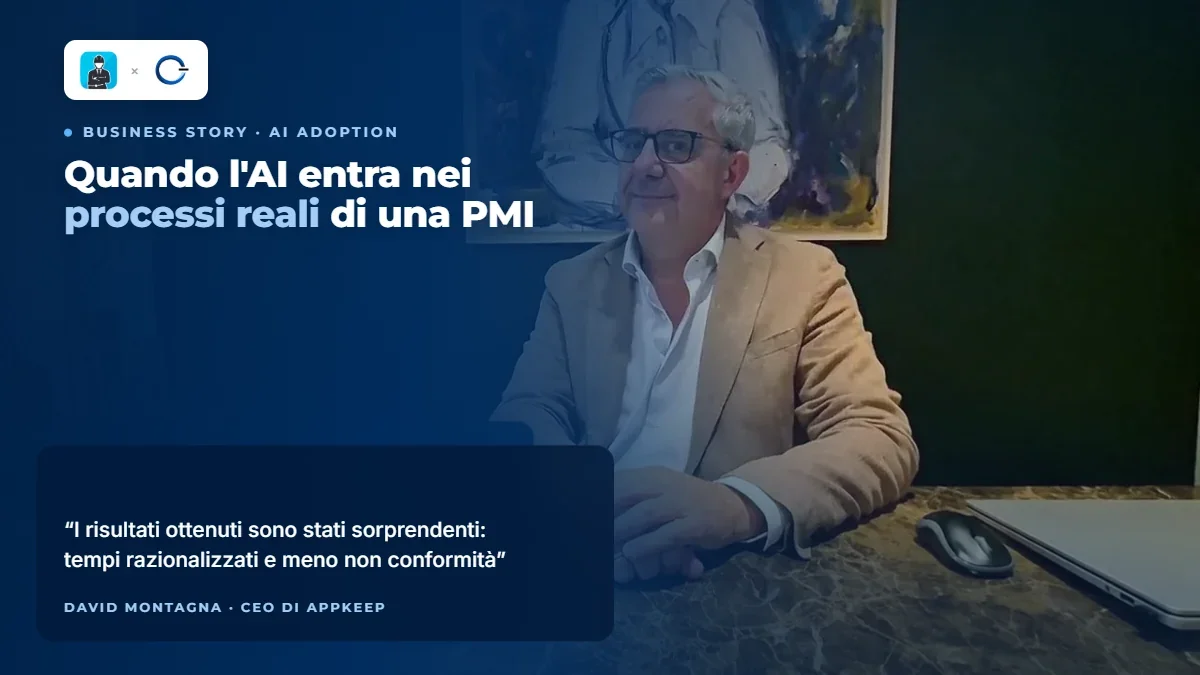
"Over the past few months we have undertaken this journey of digitalization and of developing and applying artificial intelligence to our business processes, and we made some incredible discoveries, because we streamlined our timelines, we improved our business performance and above all considerably simplified our procedures, and above all we reduced non-conformities, because we had a second check: we also used artificial intelligence to run a check on what our employees were doing.
It is certainly a journey that started a few months ago and will continue, but with astonishing results both for me, for management, and for the various company departments.
We first analyzed every single area of the company and understood what was needed to act effectively and efficiently on each process. The most important thing we devoted time to was the analysis of processes and the improvement of processes."
David Montagna, CEO of Appkeep (translated from the Italian video)
Why AI as a "second layer of control" changes things
In SMEs, quality control has a natural limit: it depends on people, on the time they have and on their focus in that moment.
An experienced team member catches almost everything. But "almost" is exactly where non-conformities are born: the skipped line, the inconsistent data point, the step forgotten at the end of the day.
AI placed as a layer of control works differently. It does not get tired, it does not skip steps, it always applies the same criteria. It does not replace the person's judgment, it reinforces it: it flags, verifies and highlights what is worth double-checking.
The result is not "AI deciding". It is a person deciding better, with one more piece of information and one less error.
For an SME this means more consistent quality without having to hire an entire control department.
What your company can learn from the Appkeep case
The value of this story is not "you should buy AI too". It is the method behind it.
If you want to repeat a similar journey, these are the principles that make the difference:
- Start from processes, not tools. Understand where you lose time and quality before choosing any technology.
- Analyze department by department. Management, administration and operations have different needs: one solution for all does not work.
- Use AI to control, not just to produce. The fastest value often comes from an extra verification layer, not from aggressive automation.
- Involve people. AI as support, not as a threat, is what makes change accepted.
- Think in journeys, not one-off projects. Appkeep talks about a journey meant to continue over time. That is how compounding results arrive.
- Put a number on the return before starting. The fastest way to see if your case holds is the AI ROI calculator: payback period and projection on your own numbers, in minutes.
FAQ
How long does it take to see the first results of an AI adoption journey?
It depends on process complexity, but the first tangible effects (streamlined timelines, fewer errors) can show up within a few weeks if you start from a serious process analysis. Appkeep reports results already visible after a few months, in a journey meant to continue.
Does AI replace employees?
In the Appkeep case, no, and that is the approach I apply. AI was used as a tool to verify and support people's work, adding a layer of control. The goal is to help the people already there work better, not to cut headcount.
How do you reduce non-conformities with artificial intelligence?
By placing AI as an automatic control layer at the critical points of the process. It checks data consistency, flags anomalies and highlights what needs a second look, before the error spreads and becomes a costly non-conformity.
Does this approach also work for a small company?
Yes. In fact, it is designed for SMEs: it does not require revolutionizing everything, but acting precisely on the processes that generate the most wasted time and errors. The first step is always analysis, not buying software.
In short
The Appkeep journey proves something simple: AI adoption works when it starts from processes, not from the tool.
Leaner timelines, better performance and fewer non-conformities did not come from buying artificial intelligence. They came from first understanding where the company needed to act, and using AI as a layer of control and support for people.
This is exactly what we do with the AI Adoption for SMEs journey: process analysis, targeted interventions and measurable results.
Want to find out where AI can cut time and errors in your company? Book a free call and we will start from analyzing your processes.