ImpulsoFuturo case study: AI learned on the job, not in a course
Isabella Flecchia, CEO of ImpulsoFuturo, on her journey with Castaldo Solutions: training to get to the bottom of AI, AI coaching to bring agentic AI into her everyday work, the website, the webinars and a talk together at DevFest Modena.

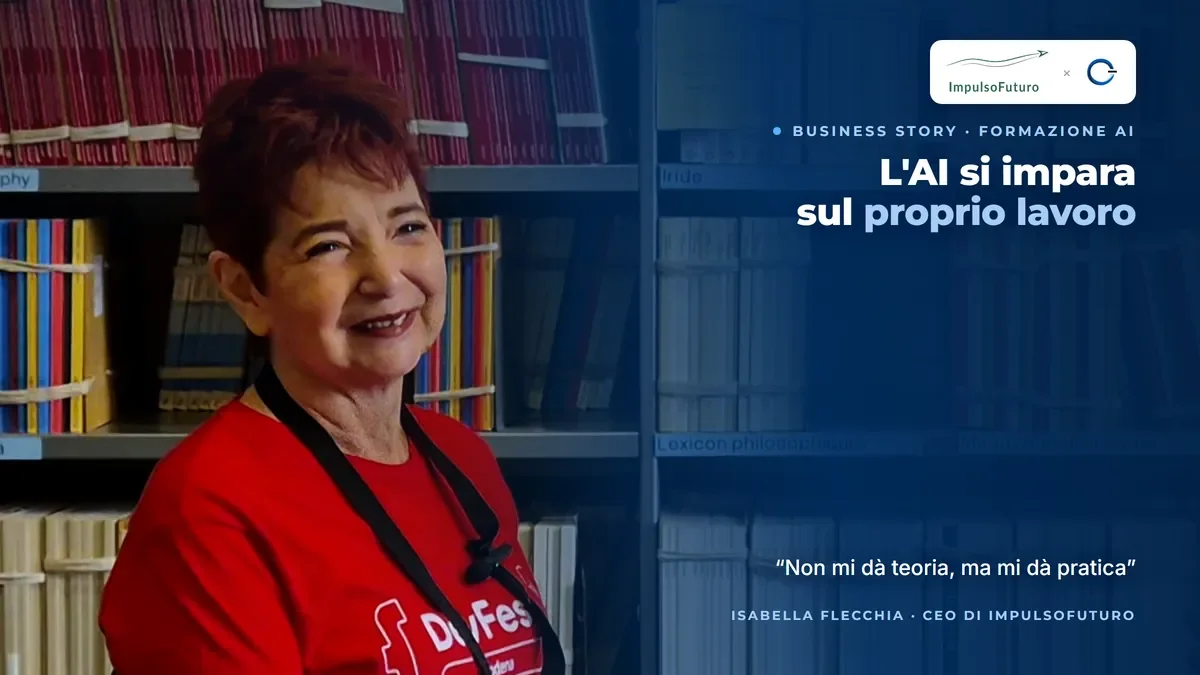
ImpulsoFuturo, the coaching and organisational change practice founded by Isabella Flecchia, learned artificial intelligence by working with it: first training to get to the bottom of AI, then an AI coaching programme to bring agentic AI into everyday work. The CEO's verdict fits in one sentence: "It's not theory, it's practice."
The thesis this case supports: for a professional, a generic course is not enough, because it teaches the tool's features, while what they need is to start from the tasks they do every week. Skills are exactly the bottleneck: according to ISTAT, Italy's national statistics institute, almost 60% of the companies that considered AI and then did not invest point to a lack of adequate skills (ICT usage in enterprises, 2025, in Italian).
Three words sum up how Isabella describes our work together: "reliable, concrete, practical".
In short
- We met at networking events. Working together came later, and grew.
- The journey started with training: getting to the bottom of AI, which Isabella needs, in her words, both to use it and to do her job.
- Today it is AI coaching: monitoring tasks handed to the scheduling features of ChatGPT and Claude, Claude Cowork for video editing, Claude Code for reviewing slides.
- Castaldo Solutions also built the ImpulsoFuturo website.
- Beyond the operational side: webinars together and a talk at DevFest Modena 2026, "Il codice che ti cambia" (The code that changes you).
- The case reports no measured results: the figures you will find come from third-party sources, cited next to each one.
The video testimonial is below, under two minutes, in Italian, filmed at DevFest Modena on 4 October 2026. The questions are asked by Gloria Mocci, Marketing Director at Castaldo Solutions.
Why is a generic AI course not enough for a professional?
Because a course teaches the tool, while a professional needs to learn their own job with the tool inside it. These are two different things. A course starts from the features and gets, at best, to a few examples. Someone who works alone or with a handful of people needs the opposite route: start from what they do every week and find out where AI fits in.
That is the thesis of this article, and it is mine. Isabella puts it in her own words:
"He helped me with training to get to the bottom of AI, which I need both to use it and, really, to do my job."
The skills issue is not hers alone. According to ISTAT, in 2025 16.4% of Italian companies with at least 10 employees use at least one artificial intelligence technology, twice the 8.2% of 2024; and among the companies that considered AI and then did not invest, almost 60% name the lack of adequate skills as the obstacle (ISTAT, ICT usage in enterprises, 2025, 15 December 2025, in Italian). Micro-enterprises below 10 employees, which is where most professionals sit, are not in that survey.
Buying licences and sending people on a course does not close that gap: we covered it in You bought the licences and nobody uses them. The law points the same way. Article 4 of the AI Act has applied since 2 February 2025 to anyone who develops or uses AI systems and, since 27 July 2026, it requires measures to support the AI literacy of the people who use them (Regulation (EU) 2026/1744): measures tailored to role, experience and context of use, not a one-size-fits-all certificate. We wrote about it in AI literacy in SMEs: why buying AI tools is no longer enough.

Who ImpulsoFuturo is
As its website states, ImpulsoFuturo is a brand of Percorsi di Crescita SAS, based in Biassono, in the province of Monza and Brianza: for forty years it has supported companies, teams and people through change, and over the last two years it has added AI adoption, keeping people at the centre. Its founder, Isabella Flecchia, holds a degree in Work Psychology and is an ICF PCC certified coach. Official website: impulsofuturo.it (in Italian).
What is AI coaching and how is it different from a course?
AI coaching is individual, ongoing support: instead of following the same programme as everyone else, you take the tasks a person actually does and bring AI into each of them, one at a time, until they can run it on their own. A course gives you the basics. Coaching turns them into working habits.
In ImpulsoFuturo's journey it is the step that came after the training:
"Now he is giving me AI coaching to bring a bit of agentic AI into my daily work too, which is fascinating."
Agentic AI means AI that does not just answer a question but carries out a multi-step task on its own: it reads, checks, produces, sometimes at a set time and without you sitting in front of the screen. If the term is new to you, we explain it in AI agents: what they are, how they work and what they are really for in an SME.
| AI course | AI coaching | |
|---|---|---|
| Starting point | The tool's features | The tasks you do every week |
| Programme | The same for everyone | Built around your work |
| Duration | A cycle of lessons | Ongoing support, one task at a time |
| What it leaves you | The basics | Working habits |
That you need someone at your side after the training is not just my impression. In the 2025 edition of BCG's AI at Work survey, regular AI use was sharply higher among people who had received at least five hours of training and had access to in-person training and coaching (BCG, AI at Work 2025: Momentum Builds, but Gaps Remain, June 2025). A year later the gap has not closed: in the 2026 edition, covering 11,749 leaders, managers and frontline employees in 14 markets including Italy, 88% believe they will need major upskilling in the next five years, but only 36% feel properly trained, the same share as in 2025 (BCG, AI at Work 2026: Strategy Matters More Than Tools, June 2026).
What do you learn to do with AI when you start from your own work?
You learn to do with AI the things you already do, not the ones a syllabus has planned. In ImpulsoFuturo's case, the AI coaching currently works on three fronts:
- Scheduled monitoring tasks. We are handing some of the monitoring tasks in her work to the scheduling features of ChatGPT and Claude, which run a task at a set time and deliver the result. It is the most "agentic" part of the journey: the AI works even when Isabella is not there.
- Video editing with Claude Cowork. Cowork is the Claude mode that works directly on the files on your computer. Isabella is learning it to edit videos, a job that usually takes dedicated software and someone who knows how to use it.
- Reviewing slides with Claude Code. Claude Code was built for developers, but you drive it with instructions in plain language. Isabella is learning it to review slides and other work materials.
None of these three tasks is in the syllabus of a basic AI course. They come from her work: they are not exercises to remember, they are pieces of her week that, one at a time, she is learning to do differently.
The third one says something else too: the "developer" tool is not reserved for developers. The limit is not technical, it is knowing what to ask and how to check the result, and that is exactly what coaching trains. If you want to see what is inside Claude Code, start from Claude Code: skills, CLAUDE.md and MCP, the complete guide to getting started.
Why does it matter that whoever supports you knows your work?
Because choosing which task to start from is half the job, and only someone who knows your trade can do it. A trainer who does not know what you do offers you the examples from their course. Someone who knows your business offers you the check you repeat every week.
Isabella puts it like this:
"He helped me create my website, so we have worked together a great deal, and he knows me, he knows ImpulsoFuturo like the back of his hand."
A website is built by writing its content together: the services, the clients it speaks to, the way you tell the story of your work. That knowledge does not stay in the website. When the time came to choose where to bring AI, it was already there: we started from what we knew about her work.
What changed for ImpulsoFuturo?
She tells the result herself, in her own words. Asked whether she sees Castaldo Solutions as a reliable partner to build her projects, her answer is:
"Absolutely. Reliable, concrete, practical. He really helps me get things done. It's not theory, it's practice."
"He really helps me get things done" is the point: the training does not stay theory, it turns into things that get done. That is the difference between training you remember and training you use.
And then there is what goes beyond the operational work. With Isabella we have run the webinars on the fear of AI in teams, the first of which is covered in Is your company afraid of AI? A framework to read your teams, and on 4 October 2026 we took the talk "Il codice che ti cambia. Come l'AI trasforma chi la costruisce" (The code that changes you: how AI transforms those who build it) to DevFest Modena together: we covered it in You gave your team AI? Productivity will not double, and you can watch it on YouTube (in Italian). She points to where it all comes from:
"And all of this comes from the almost daily exchange we have."
Isabella Flecchia's testimonial
Asked how her experience with Castaldo Solutions has been:
"Incredibly rich. We met at events, actually, networking events, and then with Gaetano and with Castaldo Solutions we have done practically everything, because he helped me with training to get to the bottom of AI, which I need both to use it and, really, to do my job. So very, very strong as a training journey. Now he is giving me AI coaching to bring a bit of agentic AI into my daily work too, which is fascinating. He helped me create my website, so we have worked together a great deal, and he knows me, he knows ImpulsoFuturo like the back of his hand."
Asked whether she sees Castaldo Solutions as a reliable partner to build her projects:
"Absolutely. Reliable, concrete, practical. He really helps me get things done. It's not theory, it's practice. And on top of that he goes beyond the operational side, because together we have created moments, events, online meetings, online webinars. Today we are here at the developers' AI festival in Modena, giving a talk together. And all of this comes from the almost daily exchange we have."
Isabella Flecchia, CEO of ImpulsoFuturo
What your company can learn from the ImpulsoFuturo case
You do not need to be a coach by trade to follow the same order of moves.
- Start from a task you do every week, not from the feature list. The first thing to bring into AI is the one that eats your time on a regular basis.
- After the training, keep someone at your side. A course gives you the basics, but the habit forms when someone follows you while you work.
- Choose someone who knows your work. Someone who knows what you do gets you started at the right point; someone who does not gets you started on their syllabus.
- Do not rule out a tool because it looks technical. You drive Claude Code with words: what counts is knowing what to ask and how to check the result.
- Let AI work when you are not there, and check what it did. Scheduled tasks only save time if you actually look at their output.
Frequently asked questions
What is the difference between an AI course and AI coaching?
A course follows the same programme for everyone and teaches what the tools can do. AI coaching starts from the tasks a person actually performs and brings AI into each of them, one at a time, with someone following the work over time. In ImpulsoFuturo's case the coaching came after the training and works on concrete tasks: scheduled checks in ChatGPT and Claude, video editing with Claude Cowork and slide reviews with Claude Code.
Do you need to know how to code to use Claude Code or Claude Cowork?
No, not for uses like the ones in this case. Claude Code was built for developers and Claude Cowork works on the files on your computer, but both are driven by instructions in plain language. Isabella Flecchia, CEO of ImpulsoFuturo, is learning them to edit videos and review slides. What you really need is to be able to describe the task and check the result, and, at the start, someone to show you how to set up the work.
How much training does it take to really use AI at work?
There is no number that fits everyone, but there is a pointer. In BCG's AI at Work 2025 survey, regular AI use was sharply higher among people who had received at least five hours of training and had access to in-person training and coaching. In the 2026 edition, covering 11,749 people in 14 markets, only 36% feel properly trained, the same share as the year before. In my experience, more than the hours, what counts is that the training lands on your own work.
Who is ImpulsoFuturo and what does it do?
As its website states, ImpulsoFuturo is a brand of Percorsi di Crescita SAS based in Biassono (MB), Italy, founded by Isabella Flecchia, who holds a degree in Work Psychology and is an ICF PCC certified coach: for forty years it has supported companies, teams and people through change, and over the last two years it has added AI adoption, keeping people at the centre. With Castaldo Solutions it has followed an AI training and AI coaching journey, and together they run webinars and talks on the impact of AI on people.
In summary
My view after this case: you do not learn AI in a course, you learn it on the job. Training shows you what can be done; coaching gets it done, one task at a time, with someone who knows your trade.
It is the work we do in our AI training: starting from the tasks you do every week, not from a programme that is the same for everyone.
Want to work out which part of your work to start from? The first step is a free Pre-Assessment: an hour on your business, no strings attached.
The other cases we have told in the client's own voice: LidIA, a startup, Planex, an engineering firm, Sicurcond, a construction company, and Appkeep. They all sit in the ROI and investments hub, alongside the articles on what an AI project actually returns.