Sicurcond case study: how a construction company brought AI into its processes by starting with people
Stefano Faita, founder of Sicurcond, on his AI adoption journey with Castaldo Solutions: technical office processes mapped, the whole team trained in a classroom, more time for the people who do the work.

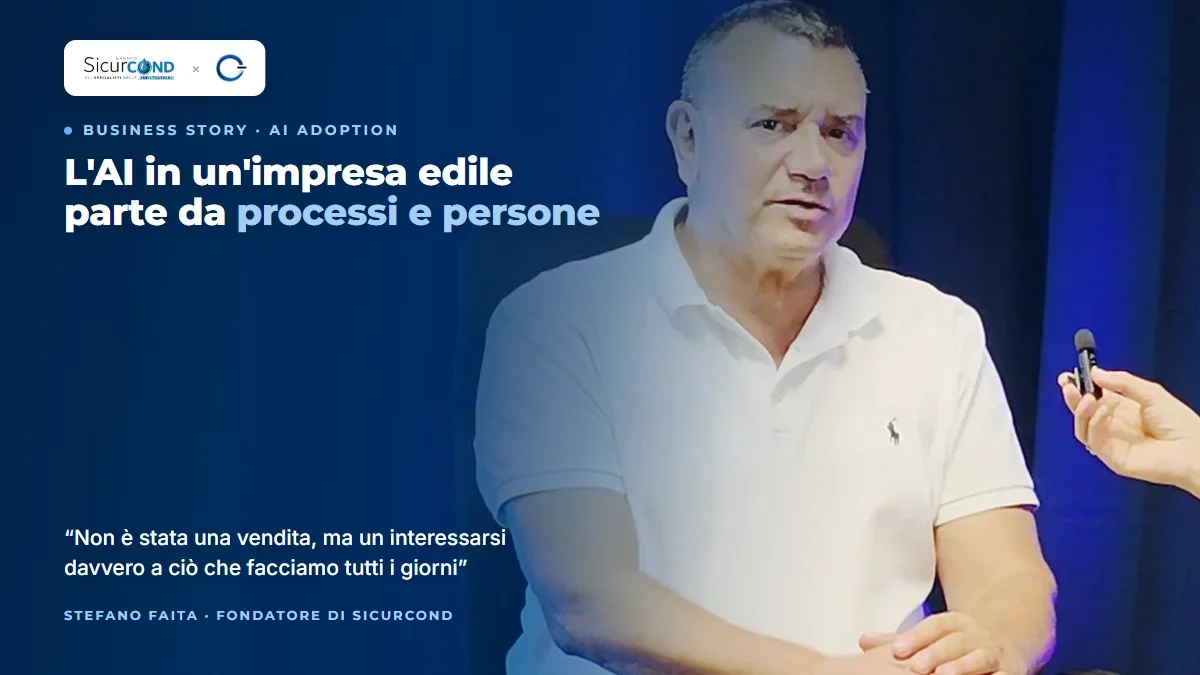
Sicurcond, a construction company specialised in water infiltration in apartment buildings, brought artificial intelligence into the business in two moves: first a map of the technical office processes, then classroom training for everyone who works at a computer. The outcome, in the words of founder Stefano Faita: faster processes and more time for his staff, without anyone losing their job.
In short
- The journey started from a doubt, not from a tool: "I did not know who to turn to".
- First step, mapping the technical office processes: who does what, when, with which tool.
- Second step, classroom training for a dozen people, that is the whole office staff.
- The programme was fully funded through subsidised training schemes.
- The client's verdict: "it was not a sale, it was genuine interest in what we do every day".
Below is the two-minute video testimonial, in Italian. The questions are asked by Gloria Mocci, Marketing Director at Castaldo Solutions.
Why should a construction company care about artificial intelligence?
Because the part of the business that slows down is almost never the building site. It is the office: quotes to write, requests from property managers to sort, site surveys to turn into documents, corrective works to manage. Head and keyboard work, which is exactly where AI makes the biggest difference today.
And yet construction is not the sector that comes to mind when people talk about AI. In Italy, 16.4% of companies with at least 10 employees use at least one AI technology, and among SMEs the share drops to 15.7% (Istat, Imprese e ICT, anno 2025, December 2025). Sicurcond sits on the other side of that chart: a company doing construction work for apartment buildings that chose to look into AI before its competitors did.
The starting point, as Stefano Faita tells it, was not trust in the technology. It was doubt:
"I had many doubts and I did not know who to turn to, so I looked at a wide range of options. Then, certainly, with all the information I was given, with a good relationship of trust, we decided to start this journey."
About Sicurcond
Gruppo Sicurcond S.r.l. is a construction company based in Settala, just outside Milan, specialised in diagnosing and fixing water infiltration in apartment buildings: resin injections, waterproofing, 3D laser scanning and BIM modelling. It works with property management firms and, as stated on its website, has over 35 years of experience, more than 8,000 jobs completed and more than 600 property management firms served, with in-house teams and no subcontracting. Official website: sicurcond.it.
How do you find an AI consultant when you do not know who to turn to?
Sicurcond found us by searching on ChatGPT. No introduction, no word of mouth: a question asked to an AI assistant, and our name among the answers.
I mention it because it is not a coincidence. In the months before, we had worked hard on how our website and blog are read by AI systems, not only by Google: content that answers one precise question, a source next to every number, a structure a machine can extract. We explained how it works in When an AI is reading your website and, on the technical side, in Showing up on ChatGPT in 2026.
For a business owner who "does not know who to turn to", the lesson is practical: AI assistants now recommend suppliers, and they recommend the ones who have explained in writing how they work. That applies to us, and it applies to your company.
Where do you start to bring AI into a construction SME?
With the map, not with the spending. The first piece of work with Sicurcond produced no automation at all: it produced a picture of the technical office processes, showing who does what, when, and through which tool.
"The journey basically allowed us first of all to gain important experience in mapping our processes and checking how efficient they were. That was the first important step for us."
The sequence is the one we apply in every assessment, and it is the same one you can follow on your own:
- Interview the people who do the work, not the people who describe it: technicians, administration, whoever answers the property managers.
- Draw the real process, with its handovers, waiting times and the points where information gets lost. The method is in How to map business processes with AI.
- Measure the efficiency of each step: how long it takes, how often it is redone, who waits for whom.
- Decide where AI adds value and where reorganising is enough. An automated messy process is still messy, only faster.
On that map we built a few small example automations, to show the team what a process becomes once it is understood. One of them: a Telegram assistant that, from the field, opens a quote in the management system starting from the client code and the job details, and sends it to the owner for approval with one tap. It is not the heart of the project, but it is concrete proof that the map is good for something.
Why does classroom training matter more than the tool?
Because a tool is used by a person, and if the person does not understand it the tool stays in a drawer. With Sicurcond we trained a dozen people in a classroom, that is everyone in the company who works at a computer: technical office, administration and marketing.
"What I found most interesting was also the combination with classroom training courses, because in some way it also helped my staff become literate in AI, and so it created awareness and involvement."
Not theory lessons. Exercises on their own cases: how to write a request to an AI assistant so that the answer is useful, how to give context, how to check what comes out. One of those exercises produced the result the client recognises most as his own: a brand identity document built in dialogue with AI, which the marketing office now uses as its starting context. Every later request starts from there, and comes out better for it.
Two things are worth saying plainly. First: AI literacy for staff who use AI systems is no longer a matter of style, it has been an obligation for European companies since 2 February 2025 (Regulation EU 2024/1689, Article 4); we covered it in AI literacy: what the AI Act asks of SMEs. Second: Sicurcond's programme was fully funded through subsidised training schemes, at no cost to the company. How to access those funds is explained in Mandatory AI training: how to fund it.
What results did Sicurcond get from AI?
The results are told by the client, and we report them in his words. We did not measure a percentage of time saved, so we do not write one.
"What then happened over time was realising that some processes were getting faster and better. Of course this was not used to get rid of staff, but to create faster processes and give my staff more time and more efficiency."
Three changes emerge from Stefano Faita's words.
Faster processes. "Faster and better" are his words, and they refer to the technical office processes that had been worked on with the map.
More time for staff. The time recovered did not leave the company, it went back to the people, for the work that needs a technician rather than a form.
No jobs cut. It is the fear that blocks more AI projects in SMEs than any other, and here the owner dismantles it himself: AI was used to work better with the same people.
Stefano Faita's testimonial
"I am Stefano Faita, founder of Sicurcond, a company specialised in construction work for apartment buildings.
The journey basically allowed us first of all to gain important experience in mapping our processes and checking how efficient they were. That was the first important step for us. What I found most interesting was also the combination with classroom training courses, because in some way it also helped my staff become literate in AI, and so it created awareness and involvement. What then happened over time was realising that some processes were getting faster and better. Of course this was not used to get rid of staff, but to create faster processes and give my staff more time and more efficiency.
Would you choose us again? Well, I must say absolutely yes, because the experience was positive. I saw attention to detail: it was not a sale, it was genuine interest in what we do every day, so that was precious."
Stefano Faita, founder of Sicurcond (translated from the Italian video)
What your company can learn from the Sicurcond case
The value of this story is not "you should get AI too". It is the order of the moves, which you can copy even if your company does something completely different.
- Start from the doubt, not from the tool. Stefano did not know who to turn to and compared several providers before choosing. That is the right way: whoever sells you the tool before seeing your processes is selling, not advising.
- Map before you spend. A picture of who does what and when costs a few weeks and decides everything else. Without it, AI speeds up the mistakes too.
- Train everyone who sits at a computer, not a single point of contact. A dozen AI-literate people change how the office works. One "AI expert" becomes a bottleneck.
- Turn exercises into assets. The brand identity document born in the classroom is now the marketing team's working tool. Every training exercise can leave something behind that stays in the company.
- Tell people what it is for. AI "to give staff more time" gets adopted; AI "to cut" gets sabotaged, and rightly so.
- Use the funds that exist. Sicurcond's programme was fully funded. If cost is what holds you back, the first step is finding out which training schemes you can access.
Frequently asked questions
Is artificial intelligence useful for a construction company too?
Yes, but not on the building site: in the office. Quotes, requests from property managers, site surveys to turn into documents, corrective works and communications are head and keyboard work, and that is where AI cuts time. Sicurcond, a company specialised in water infiltration in apartment buildings, worked on its technical office processes and trained the whole office staff. Processes got faster and staff recovered time for the work that needs a technician.
Where do you start to bring AI into an SME with no digital skills?
With a process map and a classroom, in that order. First you interview the people who do the work and draw who does what, when and with which tool, measuring where time is lost. Then you train everyone who works at a computer, with exercises on their real cases rather than theory lessons. Only after that do you choose tools and automate, and only where the process has been understood. Buying the software first is the most common mistake.
Can AI training in a company be funded?
Yes. Sicurcond's programme, process mapping included, was fully funded through subsidised training schemes, at no cost to the company. Since 2 February 2025, moreover, the European AI Regulation requires companies to take measures to support the AI literacy of staff who use AI systems, an obligation of effort since 27 July 2026, so training is also a compliance matter. The first step is checking which funds your company can access, before deciding the programme.
Does AI take work away from staff?
Not in the Sicurcond case, and the owner says so himself: faster processes were used "not to get rid of staff, but to give my staff more time and more efficiency". It is the approach we follow in every project: AI removes the repetitive steps and gives time back to the people who are already there. A project presented to the team as a tool to cut jobs gets sabotaged; presented as a tool to work better, it gets adopted.
In summary
Sicurcond shows that AI enters a construction company through the office door, and that it enters in two moves: the process map and the training of people. Tools come after, and they come out better.
It is the same order we follow in our AI Adoption programme for SMEs: first understand how your company works, then train the people who work there, then automate where the numbers add up.
Want to know where to start in your company? The first step is the free Pre-Assessment: an hour on your processes, no strings attached. If you would rather get a first idea on your own, the AI Readiness Assessment tells you in ten minutes how ready your company is.