When an AI Reads Your Website: Zero-Click, AI Overviews and How to Get Cited
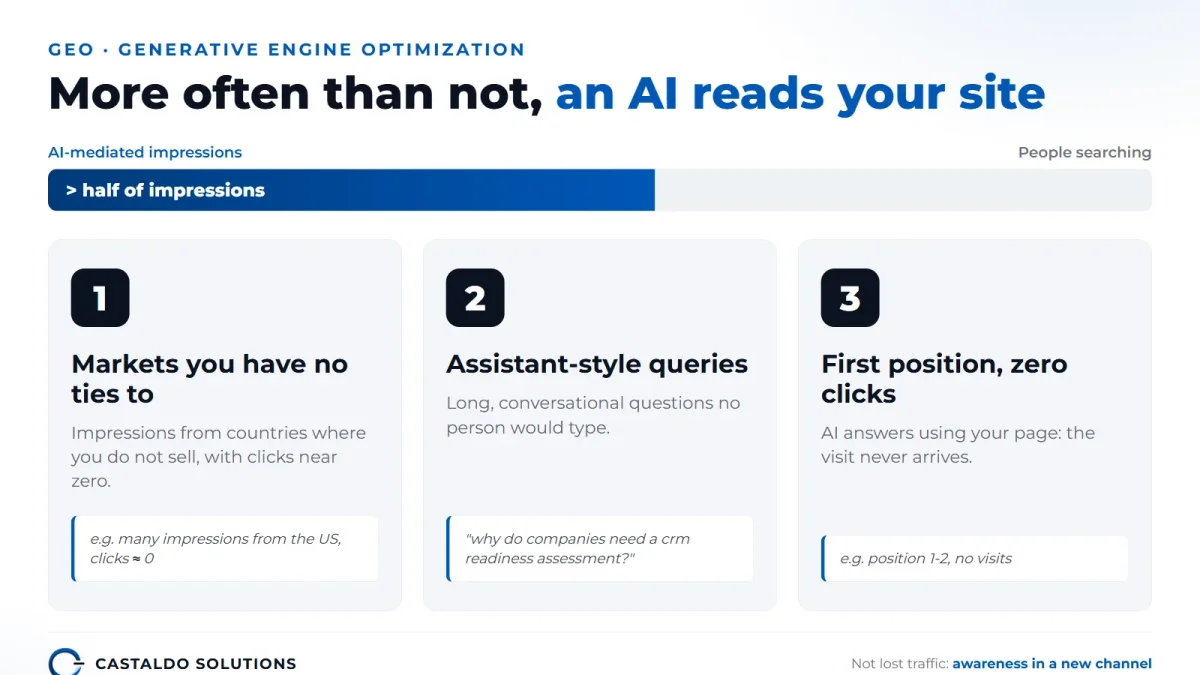
We looked at our website's search data and found something that changes how you think about SEO: more than half the time we appear on Google, it is not a person reading us, it is an AI. Sky-high impressions with zero clicks, searches no human would type, top positions that bring no visits. Here are the signals that you already have this phenomenon in your data, what it means, and how to turn it from lost traffic into awareness by getting cited by AI instead of ignored.

In short
We looked at our website's search data and found something that changes how you think about online visibility: more than half the time we appear on Google, it is not a person reading us, it is an AI. Sky-high impressions from markets where we do not sell, searches no human would type, top positions that bring not a single click. It is not a technical problem: it is the signal that the way people search has changed, and that a huge share of your visibility today passes through AI assistants that read your site instead of the users. Here you will find the three signals to recognize the phenomenon in your data, what it really means for an SME, and how to turn it from lost traffic into awareness by getting cited by AI instead of ignored.
What it means that "an AI is reading you"
When you search for something on Google, more and more often the answer is given by a box at the top of the page (AI Overview) without you clicking any site. That same box, to build the answer, has read and summarized some pages. The same happens when you ask ChatGPT or Perplexity a question: the assistant browses, reads sites and cites sources. In all these cases your site can be read and used without receiving a single visit.
This is the zero-click traffic phenomenon: your page appears (an impression), contributes to the answer, but the user never reaches you. For years SEO chased one thing only, the click. Now a growing share of the value plays out before the click, inside the AI's answer. And most companies do not notice, because they only look at visits and not impressions.
The three signals that AI is already in your data
You do not need an expensive tool to spot it: Google Search Console and knowing what to look for are enough. In our data these three signals are obvious, and almost certainly they are in yours too.
A note on the data. The patterns we report here come from our own site's Google Search Console, over a three-month period (April-July 2026). They are percentages and proportions, not absolute numbers: they serve to show the phenomenon, not to boast metrics.
1. Impressions from markets you have nothing to do with, with zero clicks
In our case, more than half of our impressions come from outside Italy, especially from the United States: a market where we do not sell. And there the click rate is about thirty times lower than on the Italian market, that is, practically zero. A local company that appears a lot in a distant market without getting visits is not "breaking through abroad": it is being read by automated systems that aggregate content regardless of geography.
2. Searches no person would type
Look at the queries. Alongside the normal ones appear long, conversational ones, phrased the way you would ask an assistant out loud: "why do companies need a crm readiness assessment?", "what is a crm readiness assessment framework?", "roi levers and quantification methods for ai". No one writes them like that in the Google bar. They are the questions people ask an AI, which the AI in turn passes to search engines to build the answer. Seeing them in your data means your content is feeding those answers.
3. First position, zero clicks
The third signal is the most counterintuitive: pages in first or second position that bring not a single click. In traditional SEO it is a paradox. In AI-mediated search it is normal: if the box at the top answers the question using your page, the user already has what they need and does not click. You are the source of the answer, but Google keeps the visit.
Why it is happening (and there is no going back)
It is not a passing fad, it is a structural shift. AI Overviews now appear in a huge share of searches, and tools like ChatGPT and Perplexity have become, for many, the first place to ask a question. The result is that the center of gravity moves: from search traffic to discovery traffic. Fewer people arriving by clicking, more people meeting you already inside an answer, often without knowing the name of the site it comes from.
For those whose goal is to sell right away, it is uncomfortable news: clicks drop. For those whose goal is awareness, that is, getting known, it is a huge opportunity: you can be present in thousands of answers without spending a euro on advertising, if the AI chooses to cite you.
What changes for an SME
The temptation is to read this data as a loss: "so many impressions and so few clicks, what a waste". That is the wrong lens. Those impressions are awareness in a new channel. Every time an AI uses your content to answer, your point of view, your expertise, your name enter someone's mind, even without a visit.
The point is not to recover the click at all costs. It is to decide to be one of the sources AI chooses, instead of remaining content no AI considers clear or trustworthy enough to cite. And this, unlike Google's algorithm, can be influenced directly.
How to get cited by AI
Getting chosen as a source by an AI is not magic, it is structure and authority. They are the same principles we apply to the articles on this blog, and it is what in how to appear on ChatGPT and generative engines we call generative search optimization. In short:
- Answer in an extractable way. Put the direct answer at the start of each section, in sentences that work even detached from context. AI extracts passages, not whole pages.
- Use verifiable data and sources. A statement with a number and a citable source is worth, for an AI, far more than a generic opinion. Original data (like this) is what gets cited most often: Princeton University's GEO research measured that citing sources and adding statistics boosts visibility in generative answers by up to 40%.
- Structure by questions. Question-form headings, FAQ sections, comparison tables: these are the formats AI finds easiest to reuse.
- Show who you are. Author with name and credentials, first-hand experience, real cases. AI, like Google, rewards demonstrated expertise (what is called E-E-A-T).
- Help machines understand you. Structured data (schema markup) tells the AI what you are and what the page contains, increasing the chance it uses you as a source.
None of these steps requires an advertising budget. They require a different way of writing: designed as much for people as for the AI that, more and more often, reads in their place.
Want to know how AI sees (and cites) you? Start here
The first step is simple and you can do it yourself: open Google Search Console and look for the three signals above. If you find them, it is not a problem to fix, it is an opportunity to cultivate.
If you want to go deeper, in our free Pre-Assessment we look together at how AI reads your site today and what it takes to get cited more often. And if you would rather first understand how other SMEs are moving on this topic, in the Solutions Hub community it is one of the things we discuss every week.