Planex case study: AI in an engineering firm, from amateur use to a governed method
Filippo Belviglieri, CEO of Planex, on the AI adoption journey with Castaldo Solutions: from occasional use to a governed method, and a skill that reviews a BIM project in less than a day instead of a week.
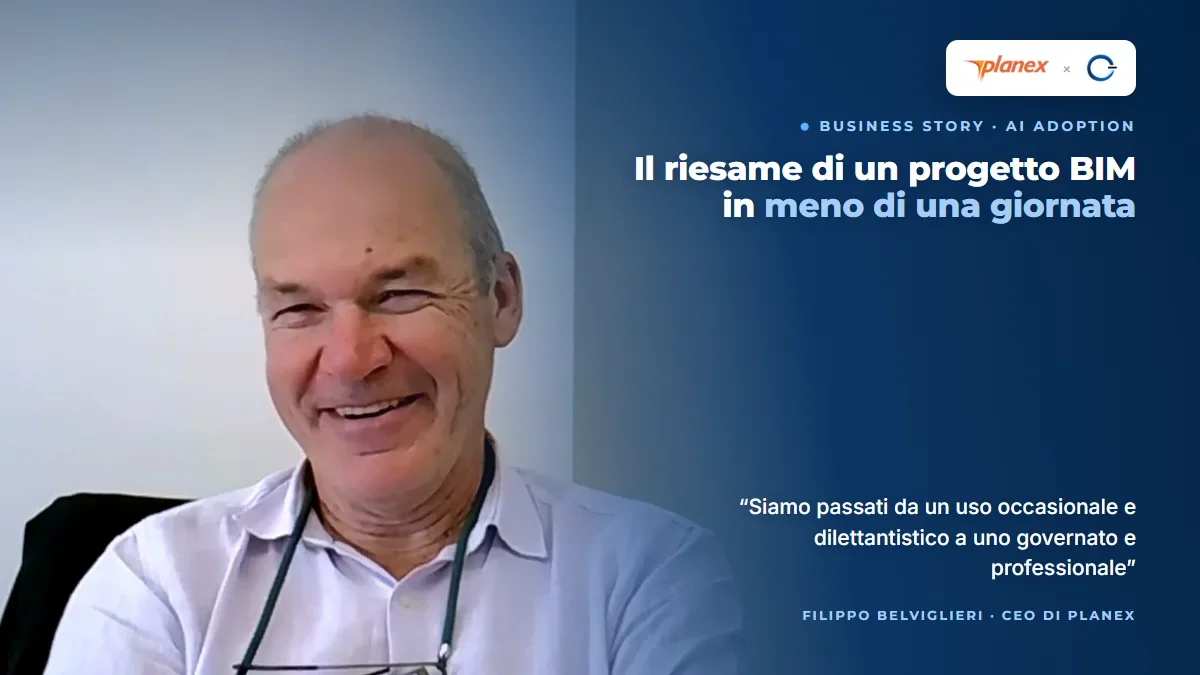
Planex, an engineering firm with more than 30 people and over 30 different service types, was already using artificial intelligence before it called us. It was using it badly. The first result of the journey was not a saving, it was a method: in the words of CEO Filippo Belviglieri, the move "from occasional, amateur use to more governed and therefore more professional use". The saving came later, and it is measurable.
In short
- The starting point was not a blank page: AI was already in the company, but with no rules and no method.
- The first result the client names is the adoption method, not the tool.
- The first skills delivered efficiencies in two areas: administration (checking staff hours) and document management (standardising and formatting documents).
- The strongest case is BIM: a skill that monitors the quality of IFC files produced in Revit modelling. Reviewing a project drops from at least a week of one person's work to less than a day.
- That skill was built by his own colleagues, not by us.
- Asked whether he would choose us again, his answer was: "I have already chosen you again."
The video interview is below, four minutes, in Italian. The questions are asked by Gloria Mocci, Marketing Director at Castaldo Solutions.
Why is the first result of an AI journey not a saving?
Because in most companies AI has already walked in on its own, through the back door. Someone opened an account, someone else pasted a document into an assistant, a third person found a shortcut and told nobody. That is not adoption: it is occasional use, and it carries the problem we described in Shadow AI: what your company does when nobody is watching.
Filippo Belviglieri sums it up in a single word, and it is the most honest word in the whole interview:
"Essentially it gave us a method, a method of adoption. So we moved from occasional, amateur use to more governed and therefore more professional use."
Amateur does not mean wrong. It means without shared rules, without a place where the things that work end up, without anyone saying which data may leave the company. It is the state most of the SMEs that call us are in, and the reason buying more licences changes nothing: we covered that in The AI licences nobody uses.
It is worth placing Planex in its market. In Italy, 16.4% of companies with at least 10 employees use at least one artificial intelligence technology, and among SMEs the share drops to 15.7% (Istat, Enterprises and ICT, year 2025, December 2025). Planex sits in that minority, and within the minority it sits in the part that has stopped improvising.

About Planex
Planex Srl is an engineering company based in Verona, Italy, specialised in building services engineering for complex buildings and organised into three divisions: LifeScience Engineering, Greening Lab and Commission Lab. As Filippo Belviglieri says in the video interview, it has more than 30 people and offers over 30 different service types, which makes it, in his words, "fairly complex". Official website: planex.it.
What were the first concrete benefits?
The first skills: operating instructions written once and reused by everyone inside an AI assistant. Not new software to buy and roll out, but company procedures put into a form the machine executes the same way every time. How they are built is explained in What Claude skills are.
"It was the use and development of the first skills in Claude, which are starting to give us operational efficiencies both in administration and in management: from checking staff hours to standardising and formatting documents."
Two areas, chosen because they are where mistakes cost and repetition is daily:
- Administration. Checking staff hours, the data that job costing and the margin on every project depend on.
- Document management. Standardising and formatting: reports, specifications and annexes that come out consistent regardless of who wrote them.
Neither is spectacular. They are exactly the kind of work an engineering firm does every day and never counts, which is why they matter.
How do you go from a week to less than a day on a BIM review?
With a skill that checks the quality of the model's IFC files: the review drops from at least a week of one person's work to less than a day. It is the number that makes the Planex case different, and the client states it unprompted.
The BIM method (Building Information Modeling) produces models that must be reviewed before moving to the next stage: you check that the model is consistent, complete and compliant with what was asked for. The exchange format is IFC, the file that comes out of a model built in Revit. Reviewing it by hand means opening, comparing, annotating, redoing.
Filippo's colleagues built a skill that monitors the quality of those files. At the time of the interview it was in testing, and this is how he announces it: "it is a feature we will present at a conference in early October".
"Consider that a review of a BIM project without AI takes one person at least a week. With AI, less than a day."
BIM project review, without AI
at least 1 week
of one person's work
With the AI skill
less than 1 day
source: Filippo Belviglieri, CEO of Planex, in the video interview above
The part the numbers do not show is the one that matters most to anyone running projects, and Filippo adds it straight after:
"But above all this will let us run these reviews far more frequently, and therefore manage the process more effectively."
This is the point Gaetano Castaldo, founder of Castaldo Solutions, repeats on every project and that almost nobody factors into the return calculation: when a check costs a week, you do it at the end. When it costs half a day, you do it whenever you need to, and you find the mistakes while fixing them is still cheap. The hours saved are the small part of the benefit. The large part is that it changes how often you can afford to check, and with the frequency the project risk changes too. We told the same story about bills of quantities in When a project dies before it starts.
Why does it matter that his colleagues wrote that skill?
Because it is the difference between a supplier and a journey that ended well, and you can hear it in Filippo's words:
"Just yesterday, with two of my colleagues, we saw a first application on a very important topic, which is project management with the BIM method. My colleagues have been developing, in fact they have now developed and it is in a testing stage, a skill they use to monitor the quality of IFC files."
"My colleagues have been developing." Not "you delivered".
An external consultant could not have designed that IFC review: it requires knowing what makes a model acceptable in that specific firm, for that type of job, in front of that client. That knowledge lives in the people who do the work, and no interview extracts all of it. Our job was to build the conditions for them to write it themselves: the method, the place where skills live, the way to test them before trusting them.
It is the same principle behind the company memory we describe in The company brain: the value is not the document the consultant hands over, it is the company's ability to write more of them once he is gone. That is how you recognise a successful adoption journey, not by the number of automations delivered.
Filippo Belviglieri's testimonial
"Essentially it gave us a method, a method of adoption. So we moved from occasional, amateur use to more governed and therefore more professional use.
It is a journey that is at the beginning, because we are an engineering firm with more than 30 people, and therefore fairly complex, with over 30 different service types. Concrete benefits so far: it was the use and development of the first skills in Claude, which are starting to give us operational efficiencies both in administration and in management, from checking staff hours to standardising and formatting documents.
Just yesterday, with two of my colleagues, we saw a first application on a very important topic, which is project management with the BIM method. My colleagues have developed a skill they use to monitor the quality of IFC files, the files produced in Revit modelling. We trust it will give us far more precise control over the progress of the BIM project, with a considerable saving of time: consider that a review of a BIM project without AI takes one person at least a week, with AI less than a day. But above all this will let us run these reviews far more frequently and therefore manage the process more effectively.
Would you choose us again? I have already chosen you again. Absolutely, yes, I would recommend you. I have not sugar-coated anything: it is definitely a step up in quality that we made thanks to you."
Filippo Belviglieri, CEO of Planex
What your company can learn from the Planex case
The order of the moves is repeatable even if your company does not design buildings.
- Assume AI is already in the company. The right question is not "should we adopt it?", it is "who is already using it, on which data, under which rules?".
- The first objective is the method, not the saving. Put the saving first and you buy tools. Put the method first and the saving arrives later and stays.
- Pick the boring daily work as the first test field. Hours to check, documents to standardise. Getting it wrong is cheap and you see immediately whether it works.
- Let the people who do the work write the automations. Quality control on an IFC file can only be designed by whoever opens those files every day, not by someone arriving from outside.
- Measure the benefit on frequency, not only on hours. A check that costs half a day instead of a week does not just save time: it lets you run it more often, and that is where you stop discovering problems too late.
- Accept that this is the beginning. "It is a journey that is at the beginning" is what the client says at the very moment he describes the best result. Companies expecting transformation in a quarter are the ones that give up in month two.
Frequently asked questions
Is artificial intelligence useful to an engineering firm?
Yes, and not in design work: in the checks and the document work that surround every job. Planex, an engineering firm with more than 30 people, got its first results on three fronts: checking staff hours, standardising documents, and monitoring the quality of the IFC files of a BIM project. On the last one, the review went from at least a week of one person's work to less than a day.
How much time does AI save on a BIM review?
In the Planex case, reviewing a BIM project used to take one person at least a week and with AI takes less than a day. CEO Filippo Belviglieri states this in the video interview, referring to a skill developed by his colleagues that monitors the quality of IFC files produced in Revit modelling. The bigger benefit, in his view, is not the time saved but the ability to run reviews far more often.
Who should build AI automations in a company, the consultant or internal staff?
Internal staff, with the consultant building the method. An automation on a technical process requires knowing what makes a result acceptable in that specific company, and that knowledge sits with the people doing the work. At Planex the BIM skill was developed by the CEO's colleagues. The job of whoever guides the journey is to provide rules, a place and a way to test things, not to hand over closed automations.
What does moving from "amateur" to "governed" AI use mean?
It means no longer letting everyone use AI as they see fit. Governed use has written rules on which data may leave the company, a single place where reusable instructions live, a way to test an automation before trusting it, and someone accountable for how it goes. It is the first result Planex credits to the journey, ahead of any number.
In summary
Planex shows something business cases rarely admit: the result the client names first is not the number, it is the method. The number comes later, and it comes from a skill his own people wrote.
It is the order we follow in our AI Adoption path for SMEs: first understand how the company works and give it rules, then put in people's hands the tools to build their own automations.
Want to know where to start? The first step is a free Pre-Assessment: an hour on your processes, no strings attached. If you would rather form your own view first, the AI Readiness Assessment tells you in ten minutes how ready your company is.
The other cases we have told in the client's own voice: Sicurcond, a construction company, and Appkeep. They all sit in the ROI and investments hub, alongside the articles on what an AI project actually returns.
Tags

Founder & CEO · Castaldo Solutions
Sono un consulente di trasformazione digitale con esperienza enterprise. Aiuto le PMI italiane ad adottare AI, CRM e architetture IT con risultati misurabili in 90 giorni.