Company Brain: Giving Your Company a Memory That AI Can Read
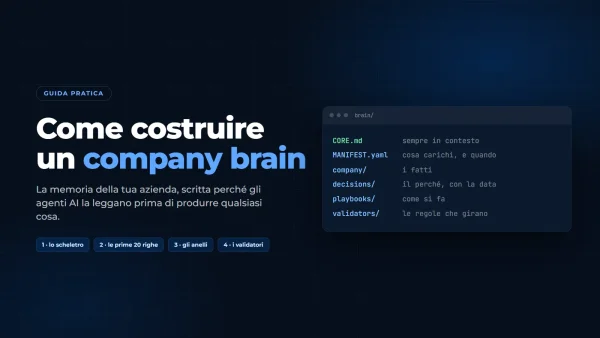
The bottleneck for AI in a company is not the model: it is that your company never wrote down what it knows. A company brain is business knowledge written so agents read it before producing anything. How ours came out of four diverging copies of the same brand identity, how you build one from artefacts you already have, and where a small business starts.

The bottleneck for AI in a company is not the model. It is that your company never wrote down what it knows.
Every session with an AI assistant starts from zero. The model does not know who you sell to, at what price, under which rules, what you already tried and why it failed. So it answers with the average of the internet: plausible, tidy, unusable. The instinctive reaction is to blame the tool, when the real problem is that nobody told it where it is.
A company brain is the answer to that.
In short: a company brain is a company's single source of knowledge, written in a format AI assistants read before producing anything: who you are, what you sell, to whom, under which rules. It is not documentation to consult, it is the context that makes every output specific instead of generic.
Here is how ours came about, what it taught us, and how you build one without writing a single document from scratch.
Why AI Gives Your Company Generic Answers
Take a trivial request: "write the follow-up email for this client". Without context, the assistant does not know your tone, the words you never use, that this client was already in a negotiation two years ago, that your positioning is not price. It produces a correct, anonymous email that you rewrite from the top. You saved nothing.
The point is that this knowledge does exist. It just lives in three places no agent can see: your head, your inbox, and scattered files nobody has opened in months. As long as it stays there, every AI session restarts from the world's average instead of your company.
How One Brand Identity Became Four Diverging Versions
Our brain did not start from a strategy. It started from a problem that landed on me.
Our brand identity had been copied into four different repositories: the website, two products, a client project. Nobody duplicated it on purpose. It was copied once for convenience, then corrected only where it mattered at that moment. A few months later we had four versions drifting apart: four slightly different tones of voice, four sets of rules that were not quite the same. Four agents working well, each according to a brand of its own.
I see the exact same mechanism in every small business, with no AI involved: the updated price list lives in the sales rep's spreadsheet and not in the one accounting uses, the installation procedure is whatever the senior technician does his own way, the standard contract exists in three versions and nobody knows which one is good.
On 28 July 2026 we merged the four copies into one and set a criterion, which is really the only rule worth remembering: if something serves one project it stays there, if it serves the company it goes into the brain.
What a Company Brain Is, and How It Differs From a Wiki
A wiki is written for people and gets read when somebody remembers it exists. A company brain is written to be read by whoever is doing the work, human or agent, before every output. That is the difference between an archive and a tool.
| Company wiki | Project file (CLAUDE.md) | Company brain | |
|---|---|---|---|
| What it is for | consulting when needed | working well on one project | working well across the company |
| Who reads it | people, rarely | the agent on that repository | agents, skills, automations and people |
| What it holds | everything ever written | stack, critical files, conventions | company facts, decisions, playbooks |
| When it updates | when someone remembers | when the project changes | on every corrected output |
| How it ages | badly and silently | with the project | each file carries a verification date |
The rule for deciding where something belongs is a single one: if it serves one project it stays there, if it serves the company it goes into the brain.
The structure that survives over time keeps three kinds of knowledge separate, and never mixes them:
- Facts state what is true right now: who we are, what we sell, to whom, at what price. They change and must be kept fresh.
- Decisions state why we chose this way, with a date. They are never rewritten: if a decision changes, you write a new one that supersedes it.
- Playbooks state how something is done: a proposal, a project kickoff, an incident.
Mixing the three is exactly how a knowledge base rots. If the pricing document also contains the story of how you got there and half a sales procedure, nobody will ever update it, because updating it means reopening everything else.
How to Build One Without Writing Documents From Scratch
This is the part that stops most people: the idea of freezing three weeks to document the company. You do not need to, and it would be the worst possible route.
Our brain was initialised by collecting what already existed: 22 real proposals from 2025 and 2026, and 63 published articles. Six months of proposals tell you far more about your ideal client than any dedicated workshop: they show who you actually sold to, what they asked for, what you agreed to do and what you turned down. Published articles are the only place where your writing exists at scale, which makes them the material you use to teach an agent to write like you, instead of describing your tone in words.
Your company knowledge already exists. It sits inside the artefacts you produced: quotes, contracts, the reply you wrote to a difficult client, the minutes of the meeting where you decided to stop doing a certain kind of job. The work is not writing. It is extracting.
One safeguard that saved us: anything inferred from past material and not stated by a person is marked as a hypothesis, not as truth. A fact derived from three similar proposals is a probability, not a company rule, and it has to be confirmed by whoever decides.
How to Organise It So AI Does Not Get Lost Inside
Here is the technical constraint that shapes the whole project: a model's context is limited and expensive. Loading your entire company knowledge into every session is not just impossible, it is counterproductive. The more material you load up front, the sooner the session degrades.
This is not a hunch. On 14 July 2025 Chroma published a study across 18 models, including Claude 4, GPT-4.1 and Gemini 2.5, measuring the effect: performance drops as input length grows, even on simple tasks, and the drop starts well before the model's stated limit (Context Rot: How Increasing Input Tokens Impacts LLM Performance, Hong, Troynikov and Huber). In decision-maker terms: an assistant you give everything to performs worse than one you give the right thing to.
The approach we use organises knowledge into rings:
- Ring 0: one single file, always in context. Ten lines on who we are, the non negotiable rules, and the map of where everything else lives. Every line here costs every agent in every session, so it gets defended like expensive real estate.
- Ring 1: files loaded on demand, based on the type of work. Pricing loads when you write a proposal, editorial strategy when you write an article. Never together.
- Ring 2: material that never enters context and gets searched only when needed.
Holding it together is a routing file that declares, for each document, when it should be loaded. An agent decides what to read by consulting that contract, not by digging blindly through folders.
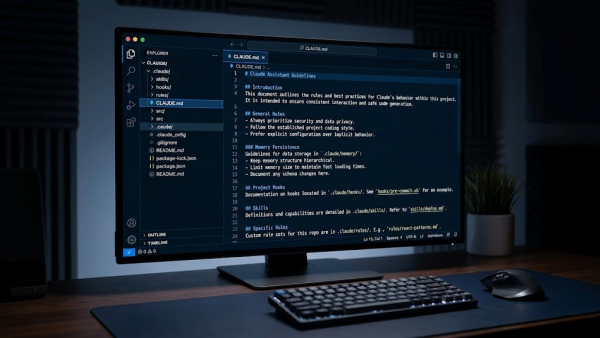
It is the natural evolution of the reasoning I had already applied to the instruction file of a single project, described in my complete guide to CLAUDE.md. There the problem was one project, here it is the whole company: the same knowledge was needed by four repositories and by the automation agents, and none of them could see it. If you are just starting with these tools, the wider picture is in the Claude Code guide.
Is a Company Brain a New Method, or Does It Build on Existing Practice?
That is the question I would ask in your place, so let me answer it head on: we invented almost nothing. A company brain is a composition of patterns that have been around for years, some for decades, applied to a use case almost nobody was covering.
| Part of the model | Where it comes from, and what kind of thing it is | What breaks without it |
|---|---|---|
| Getting knowledge out of people's heads and making it explicit | Nonaka and Takeuchi, The Knowledge-Creating Company, 1995. Organisational theory: knowledge exists in two states, tacit and explicit, and value is created in the move from the first to the second | The brain becomes an archive of documents already written. The knowledge that matters, the kind living only in the owner's head, never makes it in |
| Decisions with a date, never rewritten | Architecture Decision Records, Michael Nygard, 2011. Documentation pattern: record the choice, the context it was made in, and the consequences | You keep the what and lose the why. The same debate reopens every six months, and nobody remembers why that client was turned down |
| One fact, one place | the DRY principle (Hunt and Thomas, The Pragmatic Programmer, 1999). Engineering principle: every piece of knowledge has a single authoritative representation | You are back where you started: four copies drifting apart. This is the piece that solves the problem we began with |
| Facts, decisions and playbooks kept apart | Diátaxis, Daniele Procida, 2020. Taxonomy: different needs call for different kinds of document, and merging them ruins both | The pricing file fills up with history and procedure, becomes heavy to update, and stops being updated |
| Versioned knowledge with validators that block before commit | docs-as-code. Engineering practice: documentation lives in the same flow as the code, with history and review | Nobody knows who changed what, and when. An error surfaces in a meeting instead of in a line of diff |
| Giving the model your knowledge instead of retraining it | RAG, Lewis et al., NeurIPS 2020. Technical architecture: external memory consulted at answer time, not baked into the model | "Custom AI" goes back to meaning training a model: cost and skills out of reach for a small business, for a result that ages immediately |
| Loading only the part you need, never everything | the measured limits of long context, the Chroma study above. Experimental evidence, not opinion | One giant file that makes answers worse instead of better. This is why the rings exist |
| Machine-readable context published on your site | the llms.txt proposal by Jeremy Howard, Answer.AI, September 2024. A proposed format, not an adopted standard | You lose little: it is the weakest item on this list, and I say so. It costs an hour and it might help |
Our original contribution is one thing, and I claim it for exactly what it is: applying all of this to the commercial knowledge of a small business, not to the technical documentation of a software product. Pricing, ideal client, sales objections, the reasons a job was turned down. That is the material nobody usually writes down, and it is precisely what an agent needs to stop answering like the average of the internet.
What Is Proven and What Is Still Experimental
I would rather tell you before you ask.
What is verifiable, because these are numbers from our repository, not estimates:
- 88 files and 69,557 words of company knowledge, across 50 commits since 28 July 2026
- the always-in-context file kept to 85 lines: 2 files always loaded, 24 on demand, 14 never
- 6 dated decisions, 7 playbooks, 7 canonical examples
- built by extracting from 22 real proposals and 63 published articles, not by writing new documents
What is not proven, and would be dishonest to sell you as such:
- the consolidated form is a few months old. The way of working is older (it grew out of modularising project instructions, which I wrote about in April), but the brain as described here is recent
- the sample is one company, ours. No control group, no stopwatch measurement before and after. The time estimate below is field experience, not an experiment
- the llms.txt proposal is not an adopted standard: no AI vendor has officially confirmed consuming it. We publish it because it costs little, not because it is proven
- we do not yet know how it holds up in a thirty-person company with five departments. On a small structure and on client projects, it works
I will update this article with the numbers as they come in. If you are reading this six months from now and this section is unchanged, that is a signal.
And there is only one way to make a method genuinely verifiable: let people look at it. As of today the skeleton of our company brain is public on GitHub, under the MIT license (company-brain-template): the folder structure, the always-in-context file, the routing contract, the separation of the three genres, and the validators, with not a single piece of confidential data inside. So instead of trusting this article you can open the files, criticise them and use them.
What It Costs to Keep It Up to Date
Very little, provided updating happens inside the work rather than next to it. For us it runs on three levels.
Automatic: regenerated indexes, freshness checks on expired files, validators that block writing rule violations before they are saved. Prompted: at the end of a session a check flags the corrections that came up and asks whether they should be recorded. Explicit: one command that captures a new fact in the right file, without having to remember where it belongs.
The cultural rule matters more than the tooling: every correction you make to an agent's output is a fact missing from the brain, and it gets recorded immediately, not "later". If you correct the same thing three times, the agent is not the problem.
And every file of facts carries a verification date. Once that date passes, its content goes back to being a hypothesis to check, not a truth to build a proposal on.
Field estimate: on a project structured this way, the part of a session spent rebuilding context drops from a solid fifteen minutes to zero, and a new team member reaches their first usable output in days instead of weeks.
Who Reads It, Besides You
This is the part that usually convinces owners more than the technical side. The brain is not only for agents: your colleagues read it, and it becomes the reasoned archive of the company. When someone new joins, they do not need to spend three months attached to you to understand how a proposal is written, who counts as a good client, and why you stopped taking certain jobs two years ago.
One important caveat: pricing, margins and client information are confidential and never end up in public content or in documents that leave the company. And the brain never holds credentials: it describes where the secrets are kept, not what they are.
Where a Small Business Starts Building Its Own Memory
Not with a knowledge management project. With three artefacts.
Take the best proposal you ever won, your standard contract, and the last ten emails you sent to a client in an active negotiation. Extract three files from them: what we actually sell, who we sell it to, how we talk about it. Those are the first twenty lines of your ring 0, and on their own they already change the quality of every AI output you produce.
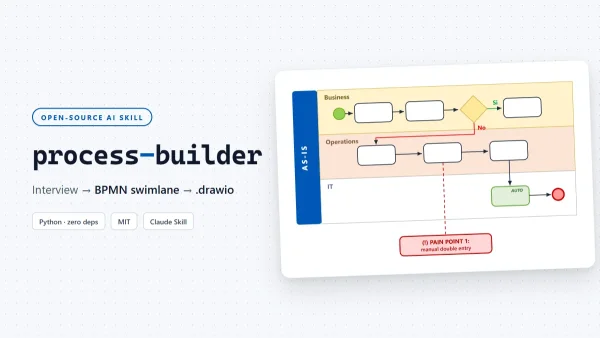
After that you add one fact at a time, when it comes up, and not before. The same discipline behind mapping your processes before automating them applies here: business memory is built on the work you do, not in a separate room.
The full path, with the commands and the decisions to make, is in the practical guide to building a company brain.
If you would rather not start from a blank page, start from the open source skeleton: press Use this template and you get a repository of your own, structure already in place and validators included. From there your only job is filling it with what you know. Make it private: it will hold pricing and clients.
If you want to see how this applies to your company, it is exactly what we do within our AI and automation services for small and mid sized businesses.
Frequently Asked Questions About Company Brains
How long does it take to build? The first twenty useful lines take half a day, starting from the three artefacts above. The work is not writing new documents, it is extracting facts from the ones that already exist. After that you add one fact at a time, as it comes up.
Do you need in-house developers? No. A company brain is text files organised by a criterion, not software to install. Technical skill helps to connect it to agents and automation flows, but the part that really matters, deciding what is true and who confirms it, is the job of whoever runs the company.
How is it different from a single project's instruction file? A project file holds the stack, critical files and conventions of that codebase. The brain holds the knowledge of the company, which every project needs. The sorting rule is the one in the table above.
Is there an open source template to start from? Yes, it is public on GitHub under the MIT license: company-brain-template. Folder structure, always-in-context file, routing contract, separation of the three genres and validators, with no confidential data at all.
Is pricing and client data safe in there? Only if you decide it explicitly. Confidential files are marked as such and never end up in public content or in documents that leave the company. And the brain never holds credentials: it describes where the secrets are kept, not what they are.
How do I know it is working? Ask an AI assistant to write something that requires knowing your company, giving it no extra instructions. If the output is usable on the first attempt, it works. If you have to correct it, that correction is the next fact to record.
Is your company using AI and getting generic results? Does everyone still come to you for the same answers, year after year?
In a free pre-assessment we look together at where your company knowledge lives today, which artefacts you already have that count as raw material, and we build the first ring of your business memory. Without stopping the work to document it.
Tags

Founder & CEO · Castaldo Solutions
Sono un consulente di trasformazione digitale con esperienza enterprise. Aiuto le PMI italiane ad adottare AI, CRM e architetture IT con risultati misurabili in 90 giorni.