Mandatory AI Training for SMEs: The Checklist (and the Funds That Pay for It)
No one chose AI: the market imposed it, through customers and competitors. But an employee using it without knowing what they are doing is a risk to themselves and the company. AI training is still an AI Act obligation, although since July 27, 2026 it asks you to support people's skills rather than guarantee a level, and in most cases it can be funded. Here is the checklist to get compliant and the funding channels.


In short
No SME chose artificial intelligence: the market imposed it, through the customers who use it and the competitors who adopt it. And today employees use it anyway, often quietly and without knowing what they are risking. AI training is still a legal obligation (Article 4 of the AI Act, applicable since February 2, 2025), although since July 27, 2026 it is an obligation of effort: it asks you to support people's skills, no longer to guarantee a level. The real reason to do it, though, was never the fine: it is protecting people and the company by putting knowledge where today there is improvisation. The good news is that in most cases you do not pay for it: between Interprofessional Funds, the New Skills Fund and regional calls, it is often covered by public funding. Here is the 6-point checklist and the funding channels.
You did not choose AI: the market imposed it
Let's make a distinction that changes everything. When a company adopted its ERP, or its CRM, or certified email, it decided to: it evaluated, bought, trained people. With artificial intelligence the opposite happened. It did not enter through a board resolution: it walked in on its own, because employees started using ChatGPT to write emails, because a customer wants faster answers, because a competitor already automated what you still do by hand.
It is a technology imposed by the market, not chosen by the entrepreneur. And this creates an anomaly: people use a powerful tool without anyone having explained how it works, where it fails, what should never be uploaded. According to the ISTAT "Enterprises and ICT" report of December 2025, 16.4% of Italian companies with at least 10 employees already use AI (double the 2024 figure), but in nearly 60% of the companies that evaluated AI without adopting it, the declared blocker is the lack of skills. The problem, in other words, is not the technology: it is people left alone in front of a technology no one explained to them.
Why training matters even before the law
An employee using AI without training is an exposed employee. Not out of bad faith, but because they lack the tools to recognize the three most common mistakes:
- Trusting a hallucination. AI produces plausible answers even when they are false. Those who do not know this take an invented number, rule or clause at face value.
- Uploading data they should not. A contract, a customer list, a payslip pasted into a public service is a confidentiality and GDPR problem. These are exactly the 7 things an SME must never upload to ChatGPT, and without training no one knows them.
- Not disclosing AI when required. From August 2, 2026 the AI Act transparency obligations apply: anyone generating content or running a chatbot needs to know.
Training people means protecting them: giving them the knowledge to use the tool without getting hurt and without putting the company at risk. It is the same principle as workplace safety applied to a new technology. And it has a positive side effect, the one we describe in how to overcome the fear of AI in the company: a team that understands AI uses it better and fears it less.
Is AI training really mandatory?
Yes, but since July 27, 2026 the obligation is lighter than before, and many pages online have not caught up. Article 4 of the AI Act (Regulation EU 2024/1689) has applied since February 2, 2025 to anyone developing or using artificial intelligence systems, and its original wording required them to ensure, to their best extent, a sufficient level of AI literacy among their staff. Regulation (EU) 2026/1744, the Digital Omnibus on AI in force since July 27, 2026, rewrote it: it now requires taking measures to support the development of AI literacy, and clarifies that no specific level has to be guaranteed for any individual. It went from an obligation of result to an obligation of effort, and the regulation sets no fine for Article 4, which is not among the infringements listed in Article 99.
AI literacy means the set of skills and awareness that let those who use AI do so in an informed way: understanding how it works, recognizing its limits and risks, and grasping its effects on their own work. The obligation also applies to the SME that uses AI only for marketing or customer service. We wrote the reference guide in AI literacy and the training obligation for SMEs.
Two things to know about the "how much":
- There is no legally fixed hour count. The AI Act asks for measures proportionate to role, experience and context of use: relevance matters, not the number of hours.
- It pays to document it. With an obligation of effort, what you can prove is precisely the effort: a plan, the content, the participants, the certificates. Training done but not tracked is, the day someone asks for it, as if it never happened.
How much does it cost? Often zero: the funding channels
Here comes the part that convinces entrepreneurs: AI training, in most cases, is not paid by you. In our experience with SMEs, almost every company has access to at least one of these channels, and they are often combinable:
| Channel | Who can access | How it works |
|---|---|---|
| Interprofessional Funds (Fondimpresa, Fon.Coop, Fondir and others) | Companies paying the 0.30% INPS contribution (almost all) | You recover contributions you already pay as funded training. The most continuous channel: it does not depend on a single call |
| New Skills Fund (Fondo Nuove Competenze) | Companies with employees, via the Ministry of Labour | Reimburses the labor cost of hours spent in training. Works in editions with application windows |
| Regional calls | Vary by region (Lombardy, Veneto, Emilia-Romagna and others) | Vouchers and grants for digital and AI training, managed by the Regions with their own windows |
| Chamber of Commerce vouchers | Local SMEs | The Dual Transition Voucher and the PIDs fund AI and 4.0-5.0 training and consulting |
An honest and important caveat: these channels open and close in windows, and at any given time a good share of the calls is closed. The New Skills Fund and regional calls work in editions with precise deadlines, while the Interprofessional Funds are the most continuous channel, because they depend not on a single notice but on the contributions the company already pays. This is why the right question is not "which fund is best", but "which one is open and accessible to me, right now", based on where the company is located, the sector and the fund it belongs to. This is exactly the mapping work we do with our clients before starting. The takeaway: before giving up on training because it "costs", check which channels are open in your case. There is almost always at least one.
The checklist: how to get your SME's AI training compliant
Six concrete steps, in the order to tackle them.
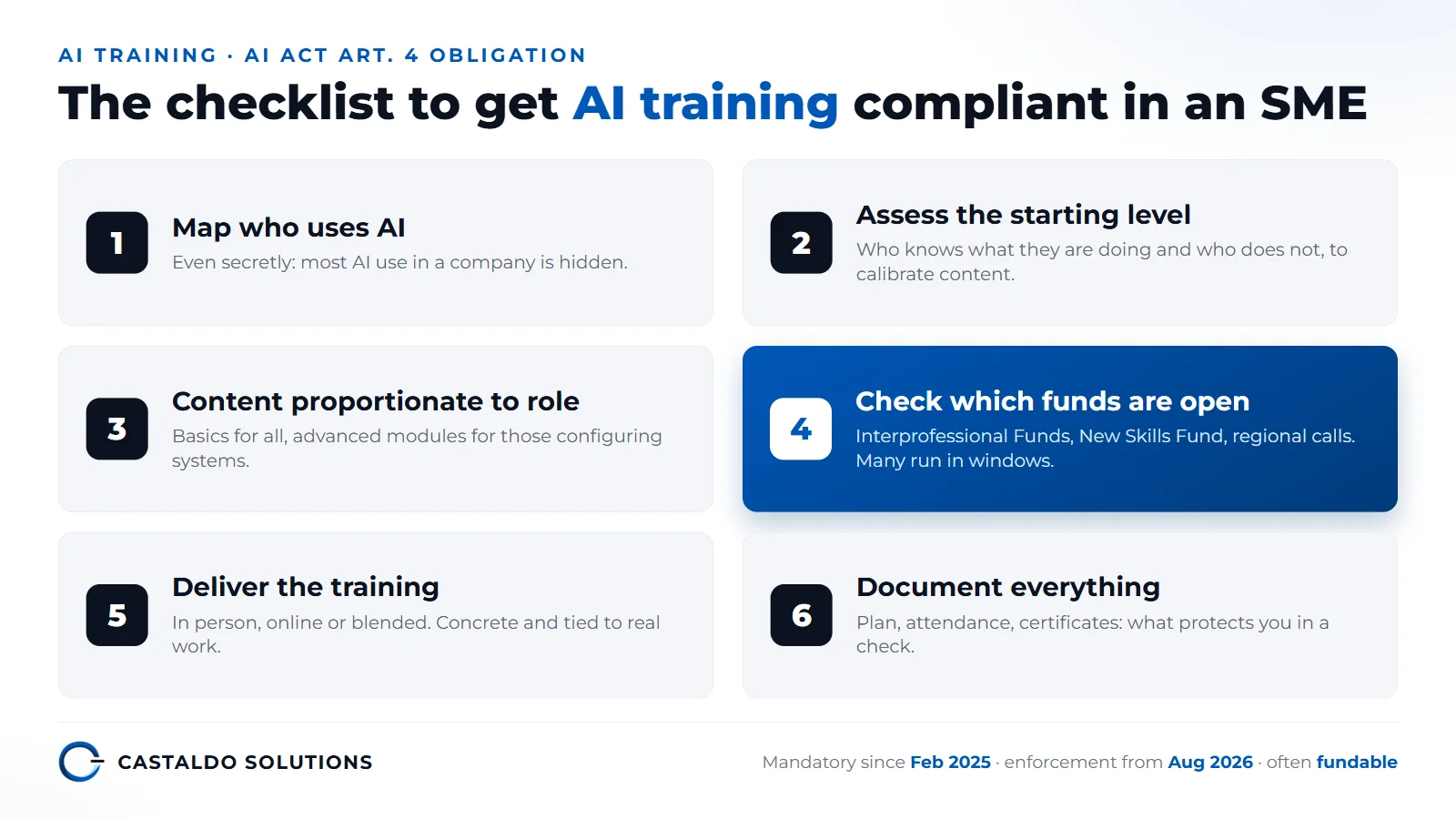
- Map who uses AI (even secretly). Not just the official users: most AI use in a company is hidden. Whoever writes texts, analyzes data or answers customers is almost certainly already using it.
- Assess the starting level. Who knows what they are doing and who does not. This calibrates the training: no point starting everyone from zero if half the team is already ahead.
- Choose content proportionate to the role. Basics for everyone (how it works, limits, risks, what not to upload, internal rules); advanced modules for those who configure the systems. Calibrated on the tools you actually use, not a generic course.
- Check which funds are open in your case. Start from the interprofessional fund you belong to (the most continuous channel) and check whether regional calls or New Skills Fund editions have active windows. Many are closed at any given time: what matters is finding the one open for you, not the "best" in absolute terms.
- Deliver the training. In person, online or blended. What matters is that it is concrete and tied to people's real work, not abstract theory.
- Document everything. Training plan, content, attendance record, certificates. It proves the measures you took and turns training into an asset, not a sunk cost.
Want to get AI training compliant (and funded)? Start here
AI training is the compliance task with the best effort-to-value ratio an SME can tackle today: it makes you AI Act compliant, protects people and the company, and in most cases a fund pays for it. The only real mistake is postponing until an incident arrives.
In our free Pre-Assessment we start from two concrete questions: who in the company already uses AI, and which funds you can activate to train them. And if you would rather compare notes with other SMEs facing the same transition first, the Solutions Hub community discusses it every week.