Is Your Company Afraid of AI? A Framework to Read Your Teams
Same AI, same role, opposite outcomes: enthusiasm on one side, anxiety on the other. The difference isn't in the technology, it's in the teams that meet it. Isabella Flecchia's two-matrix diagnostic framework (ImpulsoFuturo) to actually read how teams experience AI adoption in the workplace.
In short
To handle resistance to AI in workplace teams, don't treat it as a technical problem: resistance always has a shape, an origin and an internal logic. Use Isabella Flecchia's two-matrix diagnostic framework to understand where each team comes from (its baggage) and how it reads the present, then calibrate training and support to the specific profile. One size does not fit all.
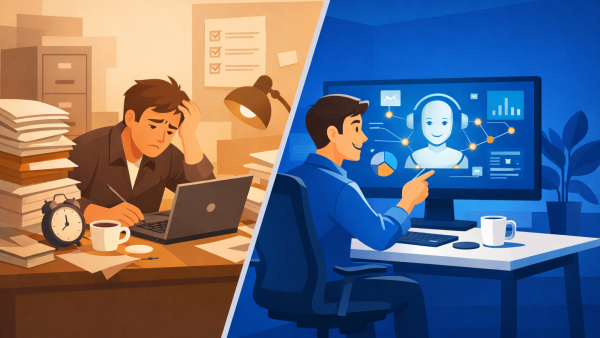
Same role, same technology, opposite psychological outcomes. In a manufacturing SME, the admin team automates payroll with AI, and the person who used to handle it tells me: "I can finally do the job I was hired for". In a professional firm, the same role adopts ChatGPT spontaneously, and the admin person has stopped studying in their free time because they think a bot will replace them in six months.
Same AI. Opposite outcomes. What makes the difference?
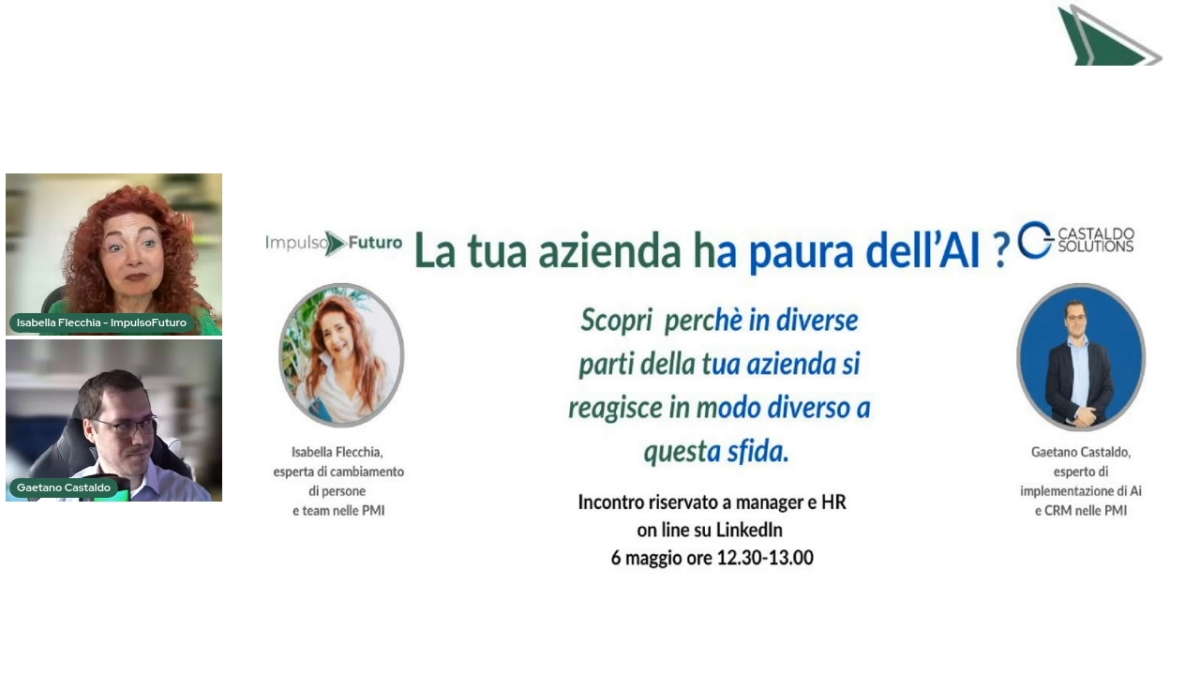
On May 6, 2026, I delivered this webinar together with Isabella Flecchia from ImpulsoFuturo, the first of a six-part series on AI integration in teams. Isabella has worked with organizations on change for over forty years, knows hundreds of teams, and is the author of the AI Mirror Method. I bring the technical reading and the data. What follows is the synthesis of the first session.
Why Does the Same AI Tool Generate Opposite Reactions?
The short answer: the technology is the same, the teams meeting it are not.
Resistance to AI is never generic. It has a shape, an origin, an internal logic. Edmondson and Seth, in a recent Harvard Business Review article, show that leaders who fail at AI adoption tend to treat it as a technical problem rather than a team effectiveness challenge. That is exactly the opposite of what is needed.
To read that challenge, Isabella has developed a diagnostic framework based on two matrices. They are not categories to label people: they are lenses to ask better questions. One looks back (the team's baggage), the other looks forward (how the team reads the present).
Matrix 1: The Baggage the Team Carries
The first matrix maps the team's history along two axes:
- Exposure to organizational change in recent years (reference: post-Covid, about six years)
- Past automation of the role, and how the team experienced it (loss of meaning, loss of responsibility, exclusion)
The intersection produces four profiles.
The invisible team (low change, low automation). Watched others change while staying out of it. Hasn't built change muscles or resistance antibodies. Initial relief ("at least they didn't drag us in") becomes a trap over time. With AI comes social shame: the gap is not just technical, it's visible to everyone. Example: purchasing office in a mid-large retail group, same procedures for years while the company invested in production and sales.
The tired team (high change, low automation). Always responded, always started over. But the load never dropped: every change was absorbed with the team's mental and physical resources, with no structural relief. It's not disappointment, it's exhaustion from continuous adaptation. Example: customer service of a retail chain that changed CRM three times and absorbed Covid peaks with the same headcount.
The disoriented team (low change, high automation). Suffered automation without being guided through the evolution. Knows how to do, but no longer knows why. The risk with AI is a professional identity crisis: if I don't know what I'm for, I don't know why to use AI either. Example: bank back-office, with reconciliations and controls progressively automated without redesigning the role.
The hollowed-out team (high change, high automation). Saw everything, responded to everything. Few people left, holding up complex systems. They are not afraid of AI: they have lost direction and motivation to keep supporting it. The risk is not blockage, it's silent disengagement. Example: internal IT of a pharmaceutical group, five people doing the work of fifteen.
Matrix 2: How the Team Reads the Present
The second matrix looks forward. Two axes:
- Automation demanded of the team today: how much the team perceives AI is actually arriving in their work
- Perceived agency: how much the team feels like an active subject of change, not just the recipient of someone else's decisions
Four profiles here too (five really, since one has two variants).
The team behind the door (low perception, low agency). Not refusal, unconscious filter. "In our sector it won't change that much. Not yet." That "not yet" is the diagnostic signal: not ignorance, existential procrastination.
The breathless team, variant 1: muscle never developed (high perception, low agency). Knows it has to change and knows it can't. Has never been through significant digital transformations: AI is the first real challenge and arrives unprepared.
The breathless team, variant 2: muscle in pieces (high perception, low agency). Has responded to everything until now, but has no reserves left. Same pressure as variant 1, opposite origin. Confusing the two variants is one of the most expensive mistakes a manager can make: the first needs structured training, the second needs relief before training.
The knocking team (low perception, high agency). Has the rarest resource: genuine motivation. Has already experimented, has results to show. But decisions are made elsewhere and they wait. Without psychological safety, the knocking team stops knocking: it's the digital version of quiet quitting.
The frontline team (high perception, high agency). Looks like the most ready. Underneath is a precise cognitive trap: if I prove AI works too well, what's left of me? They may unconsciously slow down, complicate, add conditions. It is the hardest resistance to spot, because it hides inside apparent success.
The Two Matrices Talk to Each Other: Why One Lens Isn't Enough
The baggage a team carries influences how it reads the present. The invisible team tends to become the team behind the door. The tired team and the hollowed-out team feed the breathless team variant 2. The hollowed-out team often ends up on the frontline: the most competent, under the spotlight, with existential fatigue already inside.
This means the intervention cannot be the same for everyone. Technical training is not enough. Communication is not enough. You need to understand where that team comes from, before deciding how to help it move forward.
What Anthropic Data Says About Real AI Adoption
Isabella's framework explains the human dynamics. Anthropic Economic Index 2026 data confirms that the issue today isn't massive substitution: it's the gap between potential and real use.
In Computer & Math, where everyone assumes AI has already revolutionized everything, the theoretical potential is 94%, but real use is stuck at 33%. In Office and Admin the potential is 90%, but real use is marginal. The public narrative of AI already replacing everyone is false. What is true is that the gap between theoretical potential and real use is enormous, and it's the space inside which companies can still decide how to get there.
Another key data point: at a macro level, 55% of AI use today is augmentation (working with us). Only 41% is pure automation (working in place of us). The absolute majority of real cases is collaborative, not substitutive.
The Digital Native Paradox: Why the Fastest Are Most at Risk
The public narrative says: young people are ready, less digitized people are not. What we see in the field flips the bias.
Digital natives learn prompts, tools, flows faster. Steep learning curve in the first months. But after a few months sentences come up like: "if AI does the first draft, what do I learn about my craft?". It's skill atrophy: the professional muscle doesn't train if the machine works in your place. And right now there is no real solution, it's an open phenomenon.
Less digitized people climb more slowly, but their professional identity stays stable. They know what they can do, what they can't, AI is a clear help not an existential threat.
Anthropic data confirms this reading: there is empirical evidence of a slowdown in junior hiring in occupations exposed to AI. Young people are no longer protected by their speed, they are the first to feel redundant. Operational consequence: one size does not fit all. Different generations need different training paths, even within the same department.
What Makes the Difference Between a Successful and a Failed AI Adoption
Back to the two cases from the opening.
Case A, positive outcome:
- Shared adoption decision, not top-down nor bottom-up
- Right people involved from day zero, co-designed the flow
- Structured training before the tool, not after
Case B, anxiety outcome:
- Spontaneous, bottom-up adoption with no support
- No training
- No organizational conversation about the future of the role
The communication void left by the company gets filled by the people, and they fill it with anxiety.
The operational message is clear: before asking which AI to use, the company needs to ask if it's ready. And ready doesn't only mean IT ready. It means people ready, processes ready, and above all leadership ready to hold the difficult conversation about "what changes for me".
FAQ on AI Resistance in Workplace Teams
How do you handle resistance to AI in workplace teams? Don't treat it as a technical problem, but as a team effectiveness challenge. Resistance always has a shape, an origin and an internal logic. Before training or communicating, understand where that team comes from using the two-matrix framework: the baggage it carries and how it reads the present. Then calibrate the intervention to the specific profile.
Why does the same AI tool generate enthusiasm in one team and anxiety in another? Because the technology is the same, but the teams meeting it are not. How adoption is introduced makes the difference: a shared decision, with people involved from day zero and training before the tool, brings enthusiasm. A spontaneous, bottom-up adoption with no training or conversation about the future of the role leaves a communication void that people fill with anxiety.
What are the two types of "breathless" team and why shouldn't they be confused? Variant 1 has the muscle never developed: it has never been through digital transformations and needs structured training. Variant 2 has the muscle in pieces: it has responded to everything but has no reserves left, and needs relief before training. Confusing them is one of the most expensive mistakes a manager can make.
Are digital natives really more ready for AI? No, and they often risk more. They learn prompts and tools faster, but after a few months skill atrophy emerges: the professional muscle doesn't train if the machine works in their place. Less digitized people climb more slowly but keep a stable professional identity, experiencing AI as help rather than threat. Different generations need different paths.
Is AI already replacing people in teams? Not massively today. Anthropic Economic Index 2026 data shows a huge gap between theoretical potential and real use (in Computer & Math potential is 94%, real use just 33%). At a macro level 55% of AI use is augmentation, only 41% pure automation: the majority of real cases is collaborative, not substitutive.
Want to Know If Your Company Is Ready for AI?
We are launching two complementary tools, one for each dimension of the problem:
- AI Team Emomap by Isabella Flecchia: the team's emotional map, the dimension no technical assessment measures
- AI Readiness Assessment by Castaldo Solutions: the technical and organizational reading of processes, data, governance and infrastructure
The two dimensions must be read together. A company with ready processes but a breathless team variant 2 fails AI adoption just as much as a company with a motivated team but fragmented data.
If you want to understand where your company stands on the AI adoption journey, our AI consulting for SMEs is the place to start: get in touch for a first conversation.
Tags

Founder & CEO · Castaldo Solutions
Sono un consulente di trasformazione digitale con esperienza enterprise. Aiuto le PMI italiane ad adottare AI, CRM e architetture IT con risultati misurabili in 90 giorni.