AI Agents: What They Are, How They Work and What They Are Really For in an SME
An AI agent is not a smarter chatbot: it reads context, decides and acts inside a process. What AI agents are, explained for SME leaders, with a real case and the rule that saves your budget: the process comes before the agent.
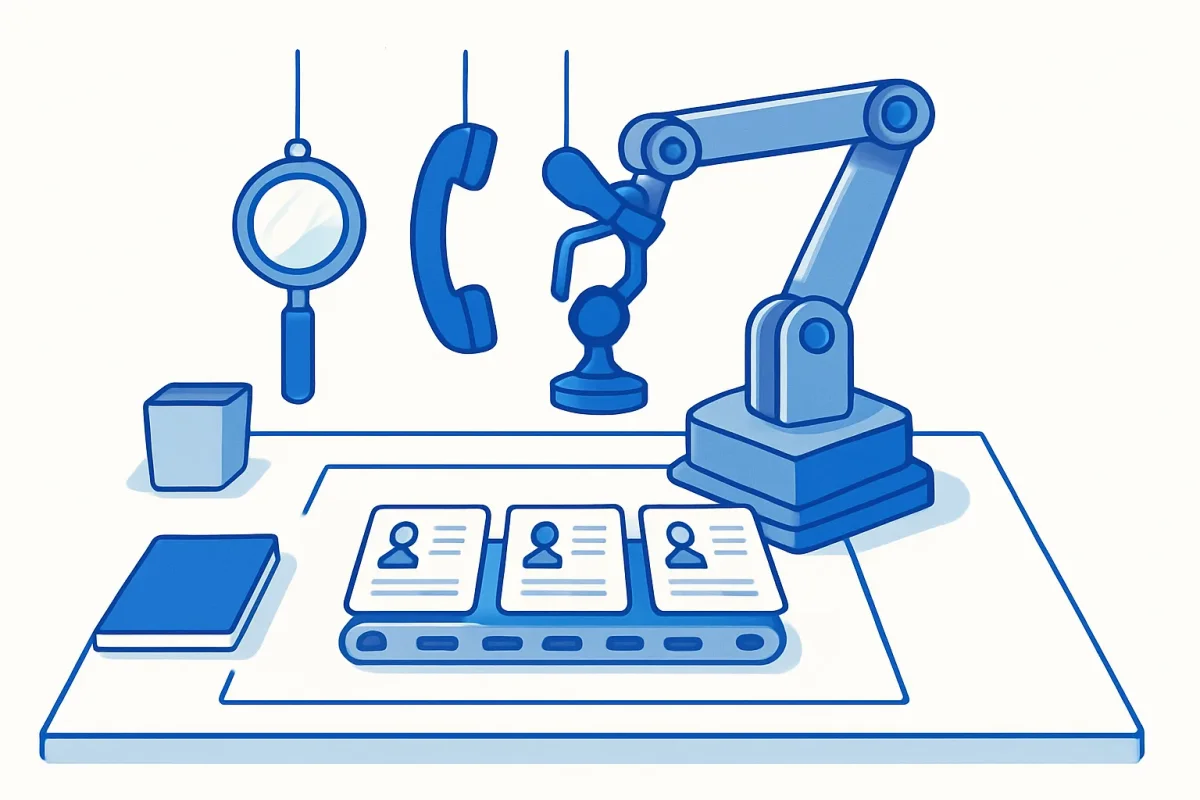
An AI agent is software that uses an artificial intelligence model to complete a task you define, deciding the steps on its own: it reads the context, chooses which tool to use, executes and checks the result. The difference from a chatbot is that it does not just answer: it acts on your systems, from the CRM to email. The difference from classic automation is that it does not follow a fixed sequence: it evaluates the situation and decides.
"What are AI agents" is currently the fastest-growing agent-related search in Italy (source: Google Trends, Italy, 90 days ending mid-August 2026). That is good news: it means business leaders have stopped asking whether AI concerns them and started asking how it works. This is the answer, without jargon and with a real case.
What Distinguishes an AI Agent from a Chatbot or an Automation?
The simplest way to understand it is to line up the three levels.
A chatbot answers. You ask a question, it produces text. Even the best chatbot, at the end of the conversation, has moved nothing in your systems: carrying the answer into the ERP, the CRM or the email is still your job.
An automation executes. A script or workflow connects two systems with a fixed sequence: when a form arrives, write a row in the CRM. It works as long as the world behaves as expected. When the odd case arrives, it stops or, worse, executes anyway.
An agent decides. It receives a goal ("qualify this lead"), has tools available (web search, the CRM, email) and chooses the path on its own: which tool to use, in what order, what to do if a step fails. It is the difference between a script and a colleague you explained the job to well, once.
The distinction is not academic: it changes what you can delegate. To an automation you delegate a step. To an agent you delegate a piece of process, exceptions included.
How Does an AI Agent Work in Practice? A Real Case
An example from our experience, in production at a B2B client. The process is lead qualification: before, every contact arriving from the website required manual research (who is this, what company, is it worth a call?) that the salesperson did when there was time. Which means late, or never.
The agent we built does this: it receives the new lead from the website form, looks up the person's LinkedIn profile, enriches the data with company information, assigns a priority score by reasoning on the collected data, and updates Salesforce. All inside a single workflow, with an operating cost close to zero: how we built it, step by step, is in how to build an AI Agent with n8n.
The point to notice is not the technology: it is that the agent makes sense because the process was clear. We knew what "qualified lead" means for that company, who uses it and what happens next. The agent automated a judgment that already existed in the salesperson's head.
What Are AI Agents For in an SME?
The concrete use cases we see working in Italian SMEs fall almost entirely into four families:
- Lead qualification and enrichment, as in the case above: the agent does in seconds the research a salesperson does in minutes, and does it on every lead, not just the promising ones.
- Email and request triage: reading, classifying, routing and drafting the reply, leaving the sending to a person.
- Checks and reconciliation: comparing documents, orders and invoices and flagging anomalies, instead of hunting for them by eye.
- Preparing repetitive documents: offers, reports, minutes, starting from data already in your systems.
Notice what is not on this list: "replacing the department". A well-built agent removes the mechanical part of a role, not the role.
Where Do You Start? The Process Comes Before the Agent
Here is the thesis of this article, and the point where I see most companies get it wrong: no SME needs "an AI agent". It needs a mapped process with an agent inside.
Buying the agent without the process is the same mistake as CRMs bought and never used: the technology arrives, the way of working does not receive it, and six months later it is a digital shelf nobody opens. 76% of Italian SMEs have not invested and do not plan to invest in AI (Osservatorio Innovazione Digitale nelle PMI, Politecnico di Milano, May 2026): the worst advertising for those still to start are the projects that started from the tool and died there.
Before the agent you need three answers, and none of them concerns technology:
- What the process is, in writing. Who does what, with which tool, where it jams. If it has never been mapped, that is where you start: mapping business processes is the work that makes everything else possible.
- Where it really costs. Hours, errors, missed opportunities. That is the number that later tells you whether the agent paid off.
- Who stays accountable. An agent decides within the boundaries you give it: which data it sees, what it can touch, when it must stop and ask. That is governance, and it is decided before, not after the first incident.
With these three answers, choosing the tool becomes almost trivial. Without them, any tool is the wrong one.
How Much Does an AI Agent Cost?
Less than you think, if the process is ready; more than you think, if it is not, because you also pay for the mapping that was missing.
The infrastructure itself is cheap: an agent built on a self-hosted open-source platform like n8n runs on the order of 20-40 euros per month of server costs, plus pay-per-use AI model costs. The full platform comparison, with numbers, is in n8n vs Zapier vs Make. The real cost of the project is the analysis and construction work, and it depends on how clear the starting process is: that is why mapping is not an extra cost, it is the part of the investment that protects the rest.
Frequently Asked Questions about AI Agents
What is the difference between an AI agent and ChatGPT? ChatGPT is a conversational assistant: it acts only inside the chat. An AI agent uses the same kind of model but is connected to your systems (CRM, email, ERP) and has a goal to complete: it decides the steps, executes the actions and stops when the task is done or a person is needed. The model is the engine, the agent is the vehicle.
Can an AI agent work without human supervision? Technically yes, and that is exactly why the boundaries must be decided first: which data it sees, which actions it can take on its own and when it must stop and ask. The practice that works in SMEs is supervision on irreversible actions: the agent prepares, classifies and proposes autonomously, but sending to the client or changing accounting records goes through a person until trust is built on numbers.
How long does it take to put a first agent in production? If the process is already mapped, a first agent on a well-scoped case (lead qualification, email triage) is built and tested in a few weeks. If the process has never been written down, the time shifts almost entirely there, and it is time well spent: automating a process with holes means automating the holes too.
Want to Know If Your Company Is Ready for an Agent?
The first step is not choosing the platform: it is understanding which of your processes are ready to receive an agent and which need to be put in order first. The AI Readiness Assessment is free and gives you that picture in minutes. If you prefer to talk directly, write to us: we start from the process, not the tool.
Tags

Founder & CEO · Castaldo Solutions
Sono un consulente di trasformazione digitale con esperienza enterprise. Aiuto le PMI italiane ad adottare AI, CRM e architetture IT con risultati misurabili in 90 giorni.