n8n vs Zapier vs Make: Which Automation Tool for SMEs in 2026
n8n, Zapier or Make for your SME? Honest comparison on AI, costs, GDPR and scalability from someone who uses them in production. Practical guide with clear verdicts on which to choose in 2026 based on your specific situation.

TL;DR
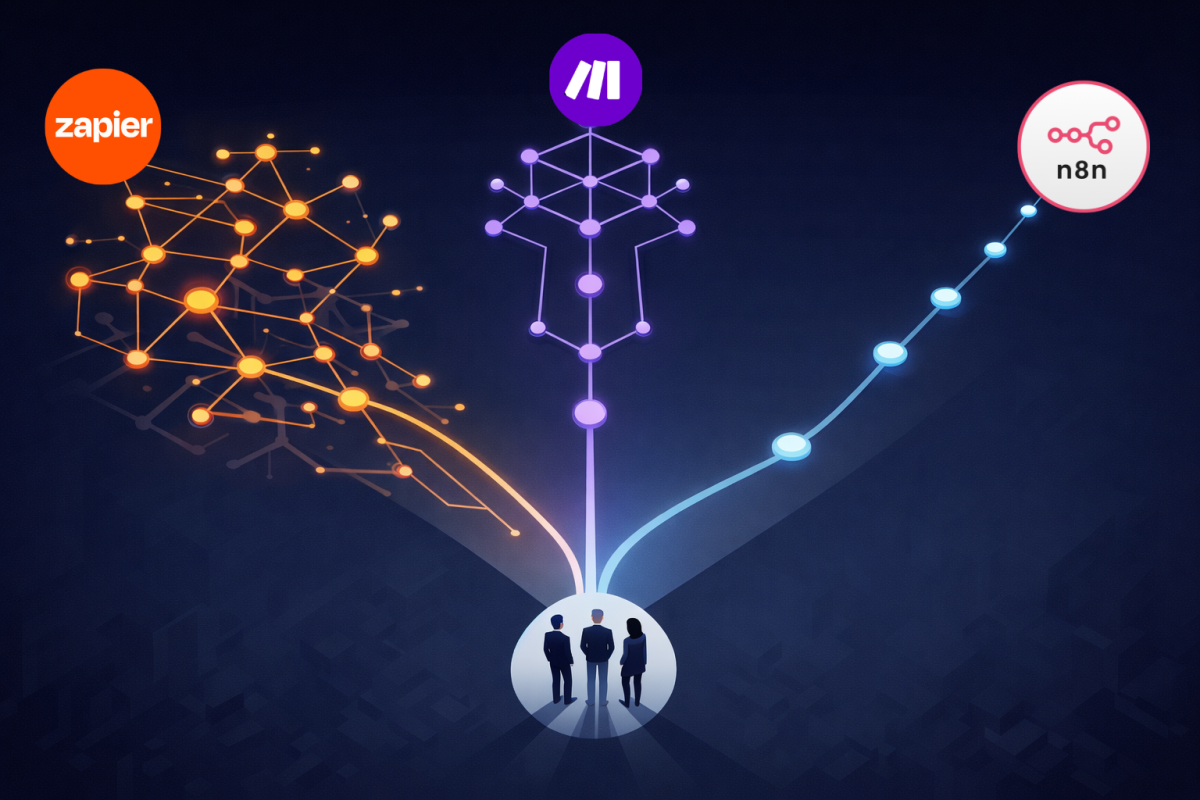
In 2026 three platforms dominate automation for SMEs: n8n (open-source, self-hostable, native AI), Make (visual, competitive credits, no self-hosting) and Zapier (simplest, 8,000 integrations, most expensive). The choice depends on three variables: do you have internal technical resources? Do you have strict GDPR requirements on data? How much will volumes grow? This guide answers with real numbers, clear verdicts and an operational decision matrix.
Why This Guide
Your company has 10, 20, maybe 50 manual processes that consume hours every week. A salesperson copying data from contact form to CRM. An assistant forwarding emails to different departments based on content. A marketing manager updating three Excel sheets after each campaign. Every Italian SME has them. The question is no longer whether to automate, but with which tool.
In 2026, three platforms dominate the market: Zapier, the veteran with 8,000 integrations and the simplest interface around; Make (formerly Integromat), the visual compromise with a competitive credit system; and n8n, the open-source platform that lets you self-host and customize completely.
Transparency: at Castaldo Solutions we use n8n as the primary tool for our clients' automation projects. We chose it after testing all three on dozens of real implementations. In this article we explain why, but also when we recommend one of the alternatives. Our goal is to help you make the right choice for your specific situation, not sell a platform.
The Comparison at a Glance
Before diving into details, here's a quick overview to orient yourself.
| Dimension | n8n | Make | Zapier |
|---|---|---|---|
| AI/LLM Integration | Native and deep. Dedicated nodes for OpenAI, Anthropic, local models. Tool calling and AI Agent support. | Good. Modules for OpenAI and custom AI. Less flexibility on local models. | Basic. AI Copilot to create Zaps, but AI integration in workflows is limited. |
| Self-hosting and GDPR | Yes. Free Community Edition on own VPS. 100% data in Europe. Zero foreign cloud dependency. | No self-hosting. Servers in EU and USA. SOC 2 Type II. | No self-hosting. USA-based servers. SOC 2 Type II. Privacy Shield. |
| Annual Cost (10k exec/month) | Self-hosted: 240–480€/year (VPS only). Cloud Pro: 720€/year. | Core: approximately 127€/year for 10k credits/month. | Professional: approximately 3,600€/year for 10k tasks (but 1 task = 1 step). |
| Learning Curve | Medium-high. Requires comfort with JSON, APIs, Docker for self-hosting. | Medium. Intuitive visual editor, but credits and router require practice. | Low. Anyone can create a Zap in 5 minutes. |
| N. Integrations | 400+ native + any API via HTTP | 3,000+ native | 8,000+ native |
1. AI and LLM Integration: The True 2026 Differentiator
This is where the distance between the three platforms is most evident, and the main reason we chose n8n for our projects.
n8n: AI as a First-Class Citizen
n8n built the entire 2025–2026 experience around AI. Dedicated nodes for OpenAI, Anthropic Claude, Google Gemini and local models via Ollama aren't superficial wrappers: they support tool calling, function calling, conversational memory and agent chains. This means you can build a complete AI Agent, a system that reasons, decides which tool to use, queries the CRM, responds to the customer and updates the database, all inside a single n8n workflow.
In a recent project for a B2B client, we built a lead enrichment agent that receives a new lead from the website form, searches the LinkedIn profile via Apify, enriches data with company information, assigns a lead score via a Claude prompt, and updates Salesforce automatically. All in a single n8n workflow, with operational cost near zero.
Make: Good Integration, Less Depth
Make offers modules for OpenAI and allows connections with custom AI providers on all paid plans since November 2025. The system works well for standard use cases like text generation, email classification or data extraction from documents. Where it loses ground versus n8n is building autonomous agents and integrating with local models: if you want to run an LLM on your infrastructure for privacy reasons, Make isn't the right platform.
Zapier: AI as Feature, Not Architecture
Zapier invested heavily in AI Copilot, which helps create Zaps with natural language, and Zapier MCP to connect AI tools. But AI integration in workflows remains shallow versus n8n. You can't build an AI Agent that autonomously decides which step to execute. For SMEs that want to simply add a text generation or classification step to a linear workflow, Zapier works. For those wanting to build intelligent, adaptive automations, no.
AI Verdict: n8n wins decisively. If AI is central to your automation strategy, it's the only choice.
2. Self-hosting and GDPR: Where Your Data Lives
For an Italian SME, the GDPR question isn't academic. Since 2024, European regulatory authorities intensified checks on data transfers outside the EU. If your automation workflows process customer personal data (and in most cases they do) knowing where that data resides is fundamental.
n8n is the only one of the three offering a completely self-hostable Community Edition. You can install it on a European VPS (Hetzner, OVH, Aruba) and be certain no data transits outside the EU. Source code is inspectable. Workflows stay on your infrastructure. For SMEs processing sensitive data (professional practices, healthcare companies, those working with public administration) this isn't nice-to-have: it's a requirement.
Make has servers in EU and USA with SOC 2 Type II certification, a good security posture for a cloud service. Zapier has similar posture, but with more server presence weighted toward the USA. Both require trusting the provider for GDPR compliance: your customer data passes through their infrastructure, with relative legal implications.
GDPR Verdict: n8n self-hosted is the only option guaranteeing full control. For those without internal DevOps skills, n8n Cloud or Make offer good compromises.
3. Real Cost Over 12 Months: The Numbers That Matter
This is where the difference becomes tangible. Let's use 10,000 monthly executions as a reference: a realistic scenario for an SME automating CRM, email marketing, lead management and some internal processes.
The critical calculation: Zapier counts every single step as a task. A workflow with 5 steps (trigger, filter, search, CRM update, Slack notification) that runs once consumes 5 tasks. So 10,000 workflow executions at 5 steps each means 50,000 Zapier tasks. Make counts each module as a credit, similar logic but much lower base prices. n8n counts the entire workflow execution as a single unit, regardless of step count. This radically changes the economics.
| Scenario | n8n (self-hosted) | Make (Core) | Zapier (Pro) |
|---|---|---|---|
| 10k workflows/month (5 steps each) | 20–40€/month (VPS cost) | ~50–100€/month (50k credits) | 300+€/month (50k tasks) |
| Annual Cost | 240–480€ | 600–1,200€ | 3,600+€ |
| Hidden Cost | DevOps time for setup and maintenance (~2–4h/month) | Extra credits at 25% markup. Polling triggers consume credits even with no data. | Overage at 0.01–0.03€/task. Busy months can double the cost. |
Cost Verdict: n8n self-hosted is the most economical, but requires technical skills. Make offers the best quality-to-price ratio for those wanting a managed service. Zapier is the most expensive and becomes exponentially more costly with volume growth.
4. Learning Curve: Who Really Uses It
Here we need to be honest. If you're looking for a tool that an administrative employee can start using tomorrow without training, the answer is Zapier. Its editor is so intuitive that someone with zero technical skills can create a working automation in 5 minutes. For SMEs where automation is managed directly by operational departments without IT support, this matters.
Make requires more practice. The visual editor is powerful but concepts like router, iterator and aggregator aren't immediate. A few hours of training are needed to become productive. In exchange, you get much more flexibility for managing complex flows.
n8n requires the highest technical competency level. Self-hosting requires familiarity with Docker, VPS management and backups. For workflow building, comfort with JSON, API REST and basic programming concepts. You don't need to know how to program, but it helps. n8n Cloud hosting reduces the infrastructure technical barrier, but the editor remains more technical than Zapier.
In our experience, n8n's learning curve amortizes quickly: after 2 or 3 days of training, an internal technical team becomes autonomous. And the power you get in exchange for that initial investment repays many times over.
Learning Curve Verdict: Zapier for those without time or technical skills. Make for those wanting a good compromise. n8n for those with at least one technical resource on the team and focused on the long term.
5. Emerging Alternatives Worth Watching
The automation market is moving rapidly. Beyond the three protagonists, some emerging platforms deserve mention.
Activepieces is an open-source platform with an approach very similar to n8n, but with an interface closer to Make. It offers a free cloud plan with unlimited tasks (on limited workflows) and complete self-hosting. Still young as an ecosystem, but growth is rapid and community is active. For SMEs finding n8n too technical but wanting to stay open-source, it's an interesting alternative to explore.
Automatisch is another open-source project, more minimal, designed for simple automations with a clean interface. Good for those needing just a few linear automations and unwilling to pay Zapier, but limited for complex workflows.
Windmill is an open-source platform oriented to developers, with native support for Python, TypeScript, Go and SQL scripts. More suited to development teams than generalist SMEs, but extremely powerful for those with the skills to leverage it. It is no longer a niche bet: in the 90 days ending mid-August 2026, automation-related searches for "windmill" grew 1,800% in Italy (source: Google Trends, related queries for "n8n", Italy).
Our advice: if you're evaluating n8n, look at Activepieces and Windmill too. If evaluating Zapier, look at Make too. The market is mature enough to offer valid alternatives at every complexity level.
August 2026 update: the picture in this comparison still holds. n8n remains one of the most searched automation terms in Italy, and interest keeps shifting from linear automations to AI agents inside workflows: the fastest-growing query in the cluster is "make ai" (source: Google Trends, Italy, 90 days to mid-August 2026). The direction is the same this article pointed to in February: AI inside the workflow is no longer an extra, it is the selection criterion.
Which to Choose? The Decision Matrix
After seeing each dimension in detail, here's the operational summary.
| Your Situation | The Right Tool |
|---|---|
| You have at least one technical person on the team, want to integrate AI Agents in processes, care about data control and want to scale without costs exploding. | n8n (self-hosted or cloud) |
| You need complex workflows with conditional logic, want a good quality-to-price ratio on a managed service, and don't need self-hosting. | Make |
| You have zero technical skills on the team, need simple automations between standard SaaS apps, and budget isn't a constraint. | Zapier |
| You're evaluating a strategic automation project touching CRM, AI, internal processes and want a partner managing the entire implementation. | Talk to us: we start from assessment, not the tool. |
The Point Isn't the Tool, It's the Strategy
The choice between n8n, Make and Zapier matters, but it's the second step. The first is understanding which processes to automate, in what order, and with what expected business impact. We've seen SMEs spend months configuring automations nobody uses, exactly like with CRMs.
The most common mistake is starting with the tool. The correct approach is starting with the process, measuring its current cost (in hours, errors, missed opportunities), and only then choosing the technology that optimizes it best. If you want to see where to start, AI Automation for Italian SMEs covers the first processes to automate, and the automation hub collects every article in the cluster.
If you want to calculate how much automation AI is actually worth for your company before choosing a platform, our AI ROI Calculator gives you an estimate in minutes.
How much is automation worth for your SME? Calculate in 3 minutes the potential ROI of AI automation for your business processes. Free and personalized analysis. Calculate AI ROI →
Frequently Asked Questions
Is n8n really free? n8n Community Edition is free and open-source, with unlimited executions and workflows. The real cost is the infrastructure you host it on: an adequate VPS costs 5-40 euros per month on European providers like Hetzner or OVH. You also need technical expertise for installation and maintenance. If you prefer avoiding infrastructure management, cloud plans start around 20 euros per month for 2,500 executions.
What's the most economical automation tool for an SME? For low volume (under 1,000 executions/month), Make is most convenient with the Core plan at about 10 euros per month. For medium and high volumes, n8n self-hosted becomes rapidly the most economical because cost doesn't grow with executions but stays anchored to infrastructure. Zapier is the most expensive at any volume level due to the task-counting system.
Do you need a programmer to use n8n? Not necessary to know how to code, but you need a technical mindset: comfort with JSON, basic understanding of REST APIs, and for self-hosting familiarity with Docker and server management. A power-user IT profile or junior developer is more than sufficient. n8n Cloud hosting reduces the infrastructure barrier by eliminating server management.
Can I migrate from Zapier to n8n without losing my workflows? There's no automatic one-to-one migration, but workflow logic transfers easily. Most of our clients rebuild workflows in n8n in 1 or 2 days, gaining more powerful workflows and drastically lower operational costs in return. Migration is also an opportunity to rethink and optimize existing automations.
n8n, Make or Zapier for AI Act compliance? If your workflows process personal data, n8n self-hosting offers maximum control over data residency and GDPR and AI Act compliance. Data never leaves your infrastructure. Make and Zapier are cloud services with good security certifications, but data transits on their servers, requiring data transfer impact assessment based on the type of information processed.