You Gave Your Team AI? Productivity Will Not Double, Because the Brain Does Not Scale Like a Server
With AI, building a website went from 20 days of work to 2, and yet the project did not take two days. At DevFest Modena 2026, with Isabella Flecchia, we talked about where the saved time goes: into verification, into people's professional identity and into the relationships inside the team.

No. AI cuts the production work a great deal, but not the cognitive and decision load of the person doing it: the saved time moves to verification, and the person who produces is also the person who reviews. In two projects we have followed, in departments such as administration, we have seen productivity gains of up to 40%. Double, never.
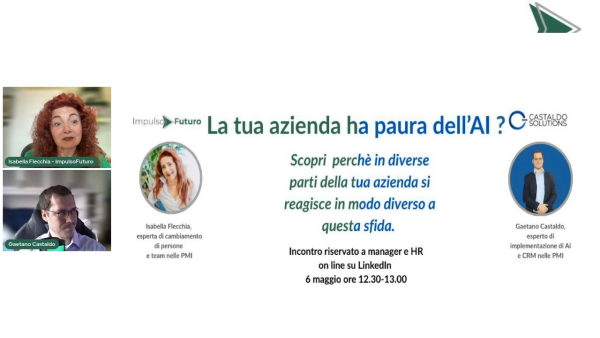
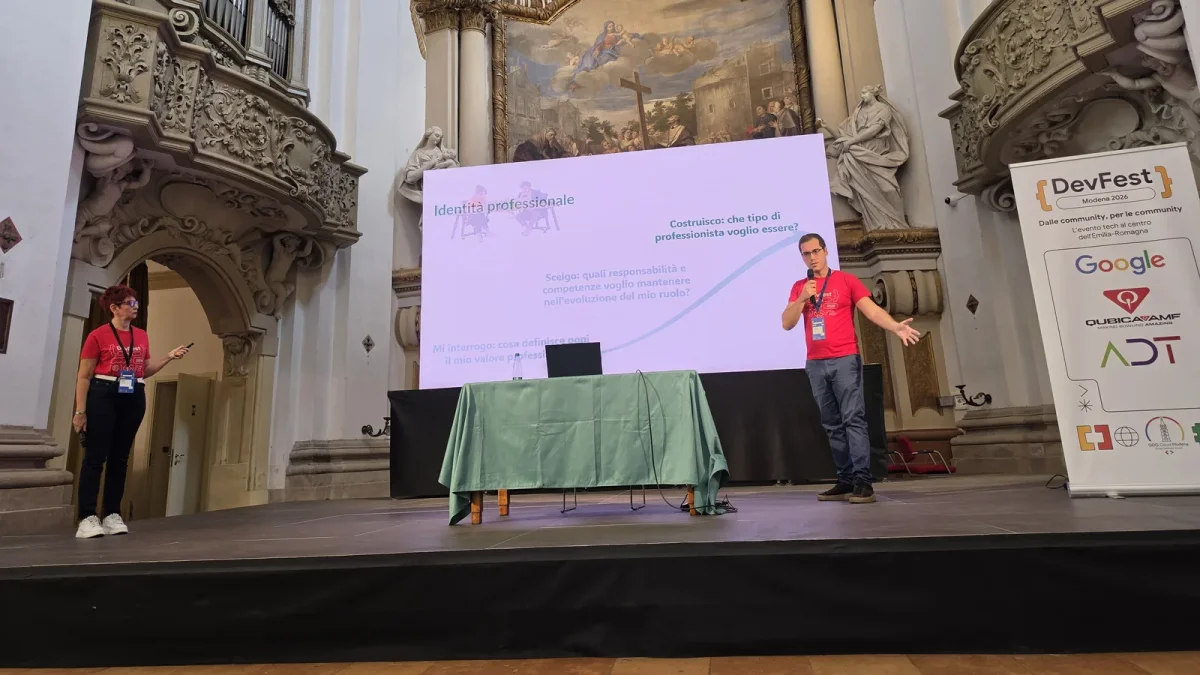
This article covers the talk "Il codice che ti cambia" (The code that changes you) that I gave on 4 October 2026 at DevFest Modena with Isabella Flecchia, CEO of ImpulsoFuturo, who works on how change affects people. The audience was developers, but what we said applies to any team you have just given AI to. Isabella and I had already talked about how teams experience the arrival of AI: this time we looked at it from the side of the people who build it. The talk is in Italian.
Why doesn't AI double a team's productivity?
Because people do not scale like machines. I will explain it with Isabella's website, which I built. Until recently, a site like that cost me 20 days of work. With AI, adding up the hours, the actual development took two days, with the same content and maybe a little more.
That does not mean I now build ten sites a month. The whole project did not go from 20 days to 2: at best, from 20 to 10. Two things do not compress.
- Cognitive load. The information I used to process over weeks now has to be digested in two days. It cannot be done.
- Decision load. A button can be light blue, dark blue or green, and that decision matures over days. The number of important decisions you can make in a day is limited, with or without AI.
The brain does not scale like a server, and we cannot go as fast as an API. So when a business owner has just bought the licences and expects double the output, I tell them double is not coming. The field data is clear: in the two projects where we introduced it, in departments such as administration, we reached up to +40%, which is already a huge result. But that is the best case, not the starting point. Whoever plans for double ends up thinking AI does not work, and that is how licences end up bought and never used.
Where does the time saved by AI actually go?
Into verification. The reliability paradox, as we called it at DevFest, is this: the more work AI produces, the more work it takes to check that it holds up, and the person checking is the same one who used to produce it. The bottleneck used to be whoever produced, everyone waited for the developer. Today it is whoever reviews.
A study by Microsoft Research and Carnegie Mellon presented at CHI 2025, based on 319 knowledge workers, describes it too: among the 936 use cases they reported, those that required understanding were described as less effortful in 79% of cases, synthesis in 76%, but the effort shifts to verifying information, integrating responses and steering the AI. These are participants' perceptions, not measurements, and the authors say so.
This is where Isabella brought the reading on people. When we feel we have the resources to face a challenge, we are in what she calls a state of safety: clear-headed, able to learn while we work. Under pressure that state thins out, and two opposite reactions take over. Some people floor the accelerator: they use AI everywhere, open three fronts at once, feel they are racing whoever says on a call "we use it from morning to night". Others pull the handbrake and switch off.
"When the accelerator is stuck to the floor, your vision narrows. You only see that goal, you only see that deadline." Isabella Flecchia, CEO of ImpulsoFuturo, at DevFest Modena on 4 October 2026
The point for anyone leading a team is that neither reaction is a choice. People go through it, and from the outside the first one looks like productivity.
Why do some employees refuse AI even when it works?
Because for people whose work rests on a technical skill, that skill is identity. I have led teams made up mostly of developers, and one of the best used to tell me: "I don't know PHP, I am PHP." If you hand the thing you are over to a machine, the question becomes: so who am I?
The gap shows up in the numbers. In March 2026 Anthropic published research on AI's impact on the labour market: in computer and mathematical occupations AI could in theory cover 94% of tasks (the estimate is by Eloundou and colleagues, 2023), while real Claude usage data shows it covering 33%. My reading is that the space in between is not just waiting time: it is made of the decisions people take every day about what to delegate, and of the fear that AI will do damage.
A collaborator of mine, a very good developer I respect, had to build a RAG agent: a new technology, poorly documented, to be tried again and again. In 20 days he produced 250 lines of useful code. He was working incredibly hard, I could see it: deleting and redoing. I asked him why he did not let AI run those attempts, and then rework the pieces himself. His answer was: "No. This is my job."
It was not about tools or knowledge. It was identity. Isabella read it this way: faced with the same stimulus you can withdraw, as he did, or accelerate and let AI do everything without understanding, or redefine yourself, which means deciding with a clear head what to delegate and what to keep. On the board where she collects answers to the question "what has AI changed in you?", someone wrote: "I have become an amoeba that can only press a button with one finger." That is a form of withdrawal too.
Does AI make your team lose skills?
Yes, if they use it to delegate rather than to understand. And the most serious damage does not show right away, because it travels through relationships.
Anthropic interviewed its own engineers (December 2025, survey of 132 people and 53 interviews): Claude has become the first stop for questions that used to go to colleagues, and some report fewer mentorship and collaboration opportunities.
I saw it with a team of AI trainers I work with. We had prepared 160 slides for a course to be adapted to different classes, and I had asked for one thing only: let's review them together. More than one answered: "Don't worry, I'll have AI review them and we'll meet at the end." It does not work that way. AI is powerful, but it does not beat the power of a real discussion: it is people who pass on the experience and context that nobody gave the machine.
The problem for a company is the ladder from junior to senior. You climbed it by asking a colleague, getting your code reviewed, taking corrections from the senior, making mistakes and understanding why. If those steps disappear, where will your seniors come from five years from now?
The data on skill atrophy is already measurable:
- Developers. In a randomised experiment by Anthropic (January 2026), 52 developers, mostly junior, learned a new library: on the comprehension test, those who had worked by hand scored 67%, those who had used AI 50%. The widest gap was on debugging, which is exactly the ability to verify.
- How you use it matters more than how much. In the same study, those who used AI to get explanations scored between 65% and 86%, those who handed it the work or the fixes between 24% and 39%. These are groups of a few people: a signal, not a law.
- Doctors. In an observational study published in The Lancet Gastroenterology & Hepatology (August 2025), endoscopists used to AI, once back to working without it, detected adenomas in 22.4% of colonoscopies against 28.4% before.
And that closes the circle with the paradox from before. Anthropic writes it in the study of its own engineers: supervising Claude requires the very coding skills that AI overuse may atrophy.
What can you do if you lead a team that uses AI?
Isabella closed each part of the talk with three questions instead of answers, and explained why: answers are individual and keep changing, what lasts is the ability to ask yourself the right questions. As a business owner, though, there are concrete things you can do.
- Budget for much less than double. +40% is our best case: start from what you can measure in your own department, and state where the rest of the time goes, which is verification. If it is not in the plan, people do the verification in the evening.
- Keep review between people. "Let's review them together" is where juniors learn, and review done only by AI takes it away.
- Ask people to use AI to understand, not only to produce. In the skills study, that is what separated the high scores from the low ones.
- Leave room for work without AI. I set myself some rules: I do not use it all the time, at some point I stop and try to do something on my own to stay in shape, I delegate some modules and not others, and every now and then I do the debugging myself. They are rules I impose on myself first, so I do not forget how the work is done.
- Bring the nine questions to a team meeting. They are the ones we left with the DevFest audience.
The questions on pressure
- Can I explain why what I just produced with AI works, beyond saying that it works?
- Am I judging from a state of safety, or is mine a reaction to pressure?
- How do I keep control over what I am dealing with?
The questions on professional identity
- What defines my professional value today?
- Which responsibilities and skills do I want to keep while my role changes?
- What kind of professional do I want to be?
The questions on relationships
- Which questions do I ask AI that I would once have taken to other people?
- Which difficult conversations am I avoiding by choosing AI?
- Which relationships, human and artificial, help me build the future?
On stage I answered the questions on professional identity like this: today my value lies in understanding processes, not just the class or the library. And the professional I want to be is more tied to relationships: a developer used to be able to sit in a company's basement writing their class in peace. Not anymore. The full account of the talk, from my side as a developer, is on the talk page on my site.
Frequently asked questions
How much does AI increase a team's productivity?
Less than individual tasks shrink. Developing a website that took 20 days of work can drop to two days of actual hours, but the whole project goes from 20 days to 10, not to 2, because cognitive and decision load do not compress and the saved time moves to verification. In two projects followed by Castaldo Solutions, in departments such as administration, the productivity gain observed reached up to 40%, not double.
What is skill atrophy?
It is the loss of skills that people stop practising because AI does the work. A randomised experiment by Anthropic in January 2026 with 52 developers measured 67% on a comprehension test for those who learned a library by hand and 50% for those who used AI, with the widest gap on debugging. A similar effect has been observed in doctors in an observational study: endoscopists used to AI, working without it, detected adenomas in 22.4% of colonoscopies against 28.4% before (The Lancet Gastroenterology & Hepatology, 2025).
How do you stop juniors from no longer learning when they use AI?
By keeping the moments where people learn from people: reviewing code or material together, asking the more experienced colleague, having someone explain a mistake. Then by asking people to use AI to get explanations and not only to delegate: in Anthropic's study on coding skills, the small groups that used it to understand scored between 65% and 86% on the test, those that handed it the work between 24% and 39%. Finally, by leaving part of the work, debugging for example, to be done without AI.
Who gave the talk "Il codice che ti cambia" at DevFest Modena 2026?
Isabella Flecchia, CEO of ImpulsoFuturo, and Gaetano Castaldo, founder of Castaldo Solutions, on 4 October 2026 at Fondazione San Carlo in Modena, Italy. Castaldo Solutions is a technology consulting firm with its registered office in Milan and its operating office in Pavia, bringing AI to Italian SMEs with up to 50 employees through the CompanyTech BattlePlan method, in 4 phases over 4-8 weeks. The first step for a company is a free Pre-Assessment.