Does AI Replace Jobs? The Real Data Nobody Tells You (and What to Do Now)

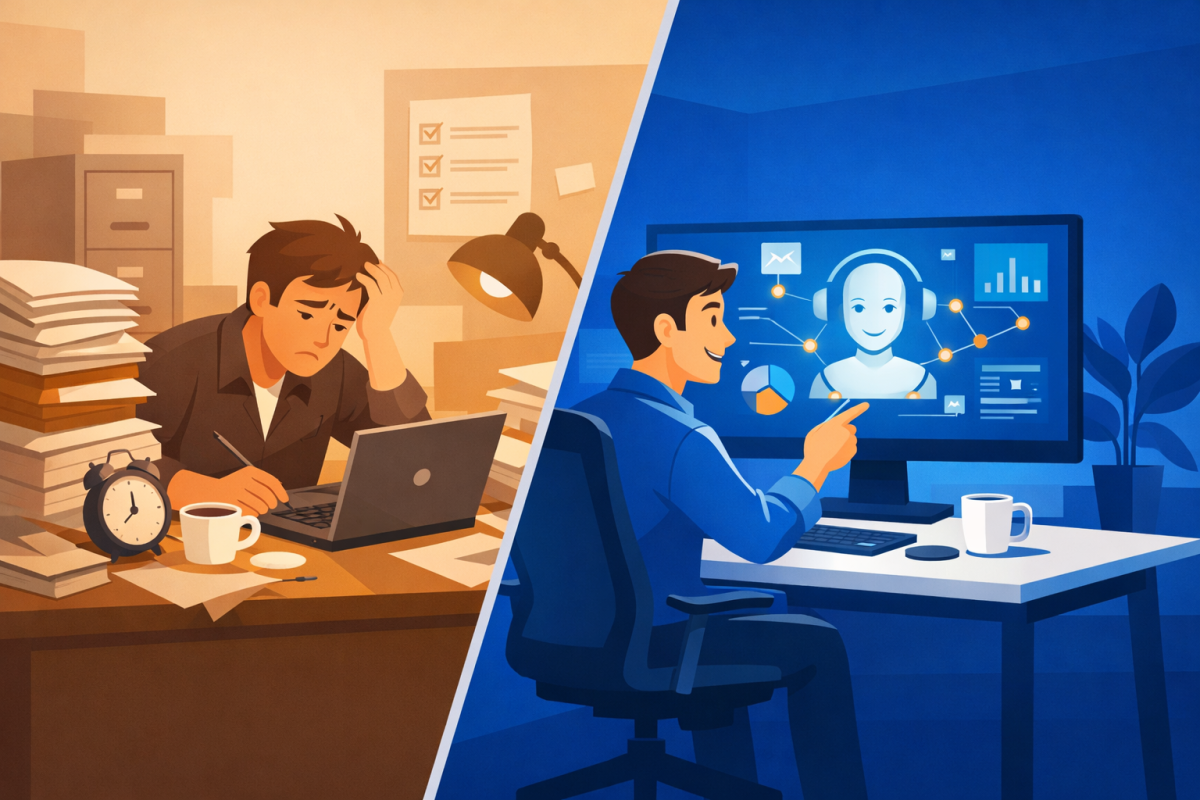
Every week you read a different headline. "AI will erase 300 million jobs." Or "AI creates more jobs than it destroys." In the middle, you have to make concrete decisions for your company.
Anthropic (the company behind Claude, one of the most advanced AI models in the world) has published research on the real impact of AI on the labor market. The results debunk almost all common assumptions. And for Italian SMEs, there is a window of opportunity that is closing.
In short
The impact of AI on work in Italian SMEs is not the mass replacement you fear: since 2022 there is no systematic increase in unemployment among the most exposed occupations. AI is shifting competitive advantage toward those who truly integrate it, especially in the backoffice (customer service, reporting, lead qualification). The gap between potential and actual adoption is still huge: that is your window of opportunity.
A Necessary Caveat: US Data, Universal Lesson
The data from Anthropic research refers to the United States labor market. Occupations, salaries and projections are based on American sources (O*NET, Bureau of Labor Statistics). The Italian context is different in industrial structure, collective bargaining and SME composition.
That said, the technological dynamics that emerge from the report are universal: how AI actually spreads in work flows, which professional categories are most exposed, and why the gap between theoretical capability and actual adoption is so wide. These are the insights that matter for anyone deciding how to move today.
What Anthropic Research Actually Says (and How to Read It)
The methodological problem with most previous studies was simple: they measured how much AI could do in theory, without looking at what users actually do in daily practice. The result was an inflated estimate of risk, fueling alarming headlines without offering useful data to decision-makers.
Anthropic built a different indicator, called "observed exposure". Instead of starting from academic assessments of what an LLM is capable of, it cross-referenced three concrete sources: 800 occupations from the O*NET database (the American professional reference), actual usage data from Claude users and companies, and BLS 2024-2034 occupational projections. The measure weights automated and work-related uses more heavily than simple personal conversations, because that is where AI produces real economic impact.
The following chart shows the difference between theoretical coverage (blue) and observed usage (red) by occupational category:
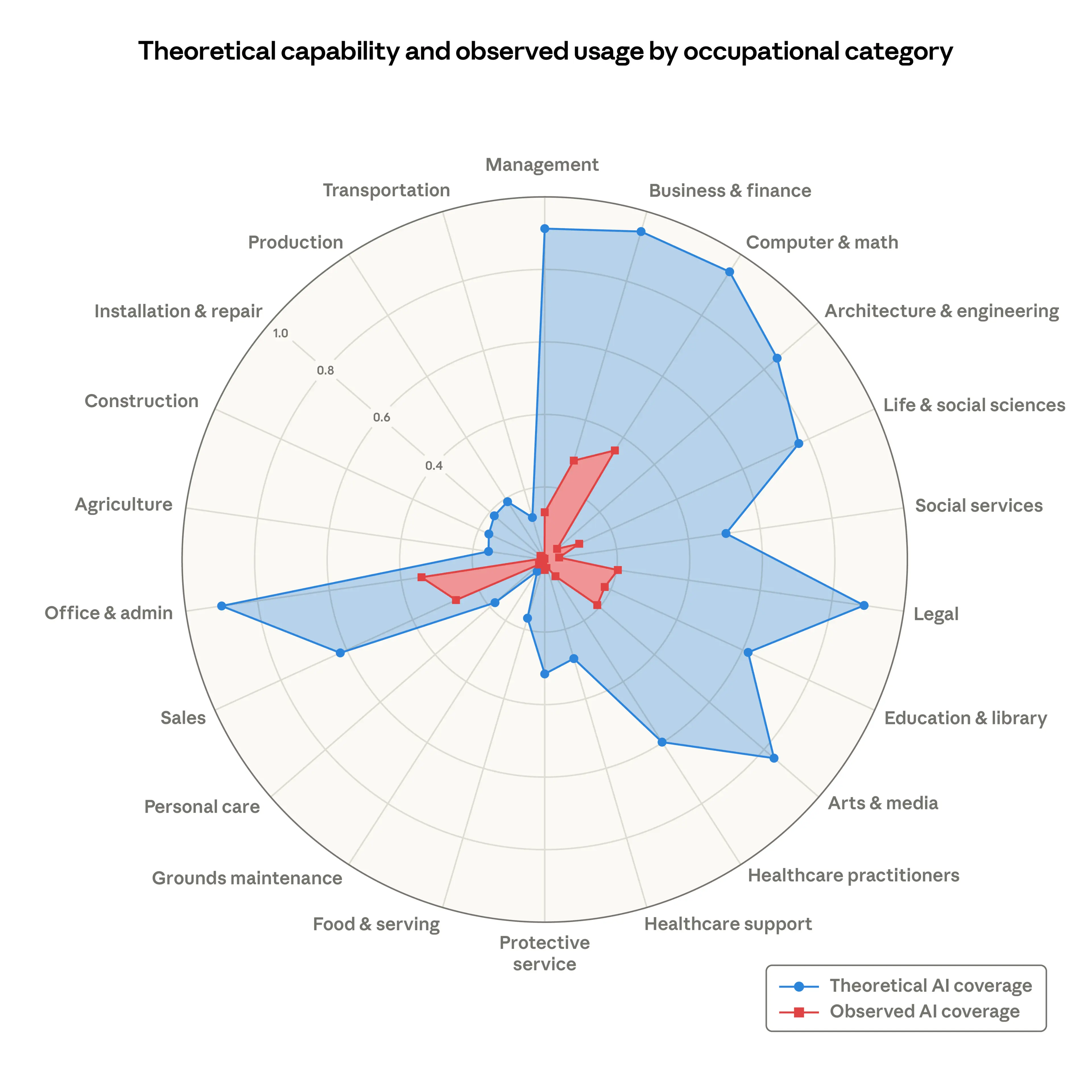
The blue polygon represents what AI could cover. The red polygon what is actually being used today. What strikes you is not just the distance between the two, it is the shape that distance takes in different sectors. Each category tells a different story.
Computer & Math: the Most Mature Sector, But Not By Much
This is the sector with the highest theoretical coverage and where adoption is most advanced. Programmers reach 75% theoretical coverage. Yet here too, observed usage stops at 33%. This means that even among technical professionals (those most predisposed to AI adoption) two out of three tasks have not yet been touched by AI in daily practice. Anyone who thinks the tech industry has already "solved" the AI integration issue is mistaken: we are just getting started.
Management: the Paradox of Maximum Potential, Minimum Use
Looking at the chart, the Management sector shows one of the largest gaps between theoretical and observed curves. From a technical standpoint, AI could cover a significant portion of managerial work, document synthesis, reporting, decision support, scenario analysis, internal communications. Yet observed adoption is nearly zero.
Why? Not because of model limitations. Managerial work is perceived as too "strategic" and "relational" to be delegated to an AI tool, even partially. There is strong cultural resistance, compounded by the fact that managers themselves are often the decision-makers for adoption, and tend to protect their own perimeter. The result is a massive untapped opportunity: companies that manage to bring AI to operational support for management (not to replace it, but to lighten it from low-value activities) have a significant advantage over those waiting for culture to change on its own.
Social Services: Low Potential, Adoption Practically Zero
Here the story is different. The theoretical coverage for Social Services is already low on the chart, AI struggles structurally with social support work, which requires contextual empathy, physical presence, trust relationships built over time. And consistently, observed usage is practically zero.
This is not a gap to close: it is a structural limitation. AI is not the right tool for direct care work, and probably won't be anytime soon. This does not mean the sector is immune to AI impact (administrative functions, case management, reporting remain exposed) but the professional core is protected. This is another manifestation of the HALO effect, which we will discuss later.
Business & Finance, Legal, Architecture: High Potential, Timid Adoption
These three categories show high theoretical coverage (document analysis, text drafting, structured data processing are tasks in which AI excels) but still very limited observed usage. The data suggests that adoption in these sectors has started, but is concentrated among a limited number of early adopters. The diffusion curve is still in its early stages.
For Italian SMEs working with law firms, financial consultants, technical professionals: the time to adopt is not "when the market is more mature." It is now, while the advantage is still capturable.
The Analytical Conclusion of the Chart
From 2022 to today, no systematic increase in unemployment is registered among workers in the most exposed occupations. AI is not laying people off, it is shifting competitive advantage toward companies that truly integrate it into workflows. And this shift, silent and progressive, is already underway.
This does not mean AI is weak. It means the vast majority of organizations have not yet done the real integration work. The gap between blue and red polygon is a photograph of an opportunity still open, for those who decide to cross it.
One final note on the report: Anthropic analyzed 20 occupational categories. Among these, however, Marketing does not appear explicitly. An absence that is surprising, considering that content creation, audience analysis, copywriting, SEO and campaign management are among the tasks most affected by AI in daily practice. It is possible that some of these functions were distributed among "Arts & Media," "Business & Finance" or "Management", but the lack of a dedicated category leaves a gap in the analysis. We look forward with interest to future research with a larger sample and greater granularity by sector: this will be one of the most revealing measurements in the coming years.
The HALO Effect: Why Physical Sectors Are Most Protected
Looking at the chart, something important jumps out for the Italian economy: the categories with the least AI exposure are Food & Serving, Construction, Installation & Repair, Agriculture, Grounds Maintenance. All professions with high physical content, relational, or tied to tangible goods.
This phenomenon has a name: HALO Effect (Heavy Asset Low Obsolescence). Sectors where core work depends on physical assets (a construction site, a kitchen, a warehouse, a real estate property) are structurally less exposed to AI substitution in operational work. Not because AI is incapable, but because the physical, contextual and relational component of these jobs creates a natural barrier.
For Italy (where manufacturing, real estate, hospitality, construction and food are pillars of the economy) this is a positive signal. The core competencies of the Italian productive fabric remain difficult to replace by AI.
But there is a flip side, and that is where the real opportunity opens.
Who Is Really at Risk: Data on the Profile of Exposed Workers
Anthropic research draws a precise profile of workers in high-exposure AI occupations. The data is more surprising than expected:
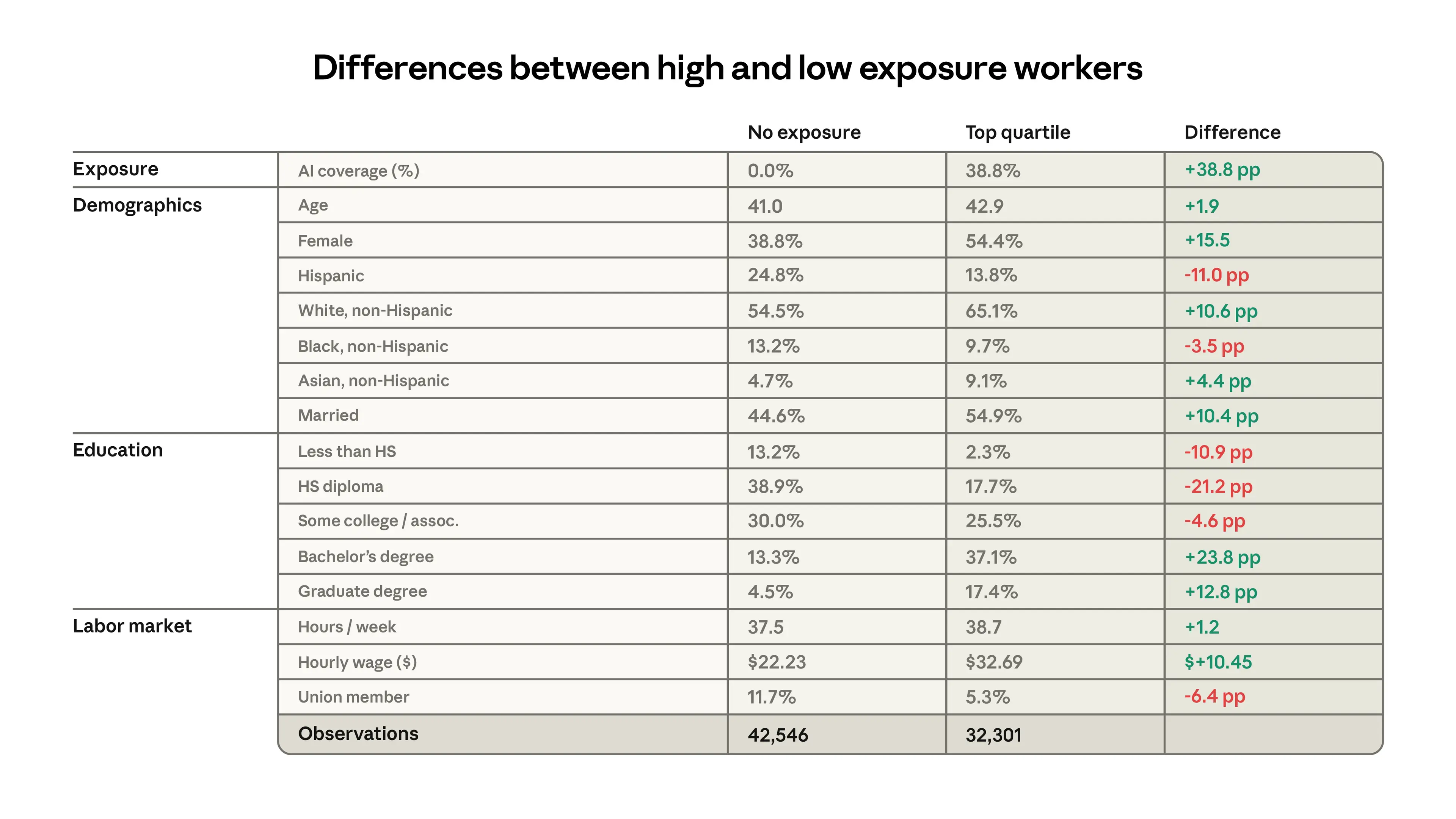
Workers in the highest AI exposure quartile earn an average $10.45/hour more than those with zero exposure, have a Bachelor's degree in 37% of cases (versus 13% of non-exposed), and work an average of more hours per week.
This completely reverses the dominant narrative. AI is not hitting the least qualified and worst-paid jobs, it is transforming mid-to-high-level cognitive professions: analysts, programmers, qualified customer service operators, legal and financial professionals.
The practical consequence for an Italian entrepreneur is twofold:
- The immediate risk is not losing employees, it is failing to attract young talent who will train on these tasks, because they will go where AI is already integrated and work is more interesting and productive.
- True competitive advantage is in the backoffice, not in core work: even in HALO companies, management, administration, customer service and marketing functions are fully exposed, and therefore fully optimizable.
The HALO Paradox: Protected in Core Work, Vulnerable in Efficiency
Here is the point worth understanding well, because it is counterintuitive.
A company in real estate, property management or distribution has core work (property inspections, negotiations, construction management, deliveries) that is highly protected by the HALO effect. AI will not replace the agent who inspects a property with a buyer, nor the technician who manages extraordinary maintenance.
But that same company has an office that is drowning in work: handling customer requests, reporting, lead qualification, internal coordination, CRM updates, online visibility management. These are all cognitive functions, highly repetitive, perfectly in the red area of the chart, the area where observed AI is already concretely usable today.
Companies working with us in sectors with strong physical component (real estate, property management, asset management) report departmental efficiency increases up to 40% after structured AI adoption in the backoffice. Not over years: within 60-90 days of project launch.
Competitors who do not adopt AI are continuing to do the same things with the same number of staff. The gap widens every month.
How to Address This Change Without Wasting Budget
The problem is not deciding if to adopt AI. It is understanding where it makes sense in your specific company, with your processes, your sector, and your resources.
The wrong answer is to buy an AI tool and hope it works on its own. The right answer is to start with a process analysis: which tasks take up the most time? Where are the most errors generated? Where does your team produce the least added value?
From there, build a structured journey, not an experiment, but a plan with clear KPIs and a measurable ROI horizon. We work on three levels: automation of repetitive processes, integration of AI into existing systems (CRM, ERP, management software), and team training to work with AI instead of suffering it as a threat.
Anthropic research shows that the gap between potential and actual adoption is still huge. Those who close it now build an advantage hard to recover.
FAQ on the Impact of AI on Work in Italian SMEs
Is AI really destroying jobs? The data says no. From 2022 to today there is no systematic increase in unemployment among workers in the occupations most exposed to AI. What is happening is different: AI shifts competitive advantage toward companies that truly integrate it into workflows, silently and progressively.
Which sectors are most protected from AI impact? Sectors with high physical, relational content or tied to tangible goods: food, construction, installation and repair, agriculture, maintenance. This is the HALO effect (Heavy Asset Low Obsolescence). For Italy it is a positive signal, because manufacturing, real estate, hospitality and construction are pillars of the economy and remain difficult to replace.
Who is most at risk from AI: the least qualified jobs? No, it is the opposite. Workers in the highest AI exposure quartile earn an average of $10.45/hour more and have a degree in 37% of cases (versus 13% of non-exposed). AI transforms mid-to-high-level cognitive professions: analysts, programmers, qualified customer service, legal and financial professionals.
My company is in a "physical" sector: does AI still concern me? Yes, in the backoffice. Even companies protected by the HALO effect have an office with cognitive and repetitive functions (handling customer requests, reporting, lead qualification, CRM updates) fully exposed and therefore optimizable. That is where the efficiency advantage is won, not in core work.
Where should I start to adopt AI without wasting budget? Not from a tool, but from a process analysis: which tasks take the most time, where the most errors are generated, where the team produces the least value. From there you build a structured journey with clear KPIs and measurable ROI, on three levels: automation of repetitive processes, integration into existing systems and team training.
Want to Know Where AI Really Makes Sense for You?
If you want to understand where AI makes sense in your company (without wasting budget on tools you won't use) let's talk directly. We always start from a concrete analysis of your processes, not a demo.
Source: Anthropic Economic Index, The Labor Market Impact of AI: Measuring Observed Exposure and Responses. The data refers to the United States labor market.