When AI Writes Code: How Consulting and Software Development Change
A complete prototype generated by AI in one hour: 12,000 lines of coherent code. If the analysis is clear, initial coding can be automated. Value shifts from writing code to the ability to design systems.


The other night I ran a very simple experiment: I took a functional specification document, prepared a structured prompt and fed it all into Claude Code, Anthropic's "developer" version. Empty repository, cloud environment, no human intervention after.
About an hour later, I had in front of me a complete prototype: Laravel stack, Tailwind CSS, Node.js, Postgres, all packaged in Docker. About 12,000 lines of coherent code, with logic, views and working APIs. What we would have considered, until yesterday, work for a development team over several days was generated autonomously by an AI model guided by good analysis.
This is neither an isolated case nor "black magic": it's the signal of a structural transformation. The barrier between idea and prototype is thinning dramatically. If the analysis is clear and the technical context is defined, the "initial coding" phase can be largely automated. Code doesn't disappear, but its value shifts: less in "hitting keys", more in the ability to design systems and correctly frame problems and requirements.
The shift in perspective for IT consulting
For the IT consulting world this perspective shift is enormous. Traditionally the business model rested on developer days: the consultant analyzes, the team develops, the client pays for the "construction".
If a working prototype can be generated by AI in a few hours, the relative weight of phases changes:
- Functional analysis, process modeling, definition of use cases and priorities becomes the real asset
- Base code writing becomes increasingly a commodity, accelerated or replaced by generative tools
- Quality plays out on architecture, integrations, security, data governance, and much less on "how many lines did I write"
In practice, the core competency is no longer "I can develop in X framework", but "I can design digital ecosystems that make business sense, that stand the test of time and that AI can help me realize faster".
The implications for companies
For companies, especially SMEs and mid-caps, the implications are significant. The distance between a good idea and a working app shrinks. Prototyping a new portal, dashboard or microservice becomes a much lighter cost item.
In my experience, this can mean reducing the cost (and time) of a first version by 70-90%: the client no longer pays for weeks of development to "see something running", but for consulting that rapidly produces a concrete object to test in the field.
The recurring, more complex and more valuable part becomes:
- Understanding if that prototype actually solves a business problem
- Integrating it with existing systems without creating new technical debt
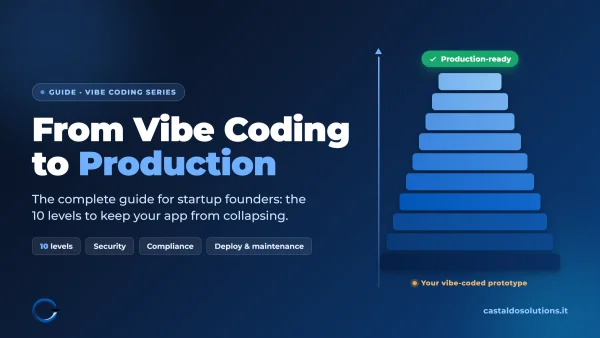
- Turning it, if it works, from prototype to robust and maintainable product
Such rapid prototyping also changes how ideas are validated: you can experiment more, quickly discard what doesn't work and focus investments only on initiatives that show real traction.
Risks to consider
Naturally, it's not all roses and sunshine. Code generated by AI still needs to be: verified, tested and put into a serious versioning and maintenance cycle. AI is very fast at building, but equally fast at "crystallizing" analysis errors or wrong architectural choices. If the input is confused, the output will be a confused application, just produced faster.
There's then a new risk: believing that "the prompt is enough". In reality the upstream work: analysis, process design, business domain definition: becomes even more critical. Without this part, companies risk filling up with ephemeral prototypes, hard to integrate and govern, the exact opposite of sustainable digital transformation.
The consultant's new role
For those in consulting, this transformation is a call to reposition. Value will no longer be "I bring you a development team for three months", but:
- I help you clarify what makes sense to build
- I get you a working prototype in rapid time
- I guide you in turning it into a solid digital asset, integrated, that generates return
In other words, less vendor of days, more system architects and strategic partners.
Conclusions
I personally find this phase exciting. Seeing an AI that, while you sleep, translates good analysis into a working app is impressive. But even more interesting is what it implies: if the machine can handle the mechanical part, we can: and must: move to where human thinking is needed most: in design, in choices, in the responsibility of technology decisions.
We're only at the beginning, and that's exactly the point: what amazes today as a "single experiment" will, in a few years, be the new operating standard. The real question, for consultants and companies, is whether we'll be ready to rethink our role before the market does it for us.
Gaetano Castaldo CEO & Founder, Castaldo Solutions