Compliance in Vibe Coding: AI Act, Law 132 and Who Owns Your Code
Compliance is not a sticker you slap on at the end. The AI Act, Italy's Law 132/2025 and fines up to 7% of revenue: here is why compliance is designed in from the start.

In short
Compliance by design under the AI Act for Italian SMEs means designing conformity from the very first line of code, not patching it before launch. Whoever builds the app must know which risk tier it falls into and guarantee transparency, human oversight and proper data handling. AI Act fines reach up to 7% of total worldwide annual turnover. In Italy, Law 132/2025 adds a further layer.
Compliance Is Not a Sticker You Slap On at the End
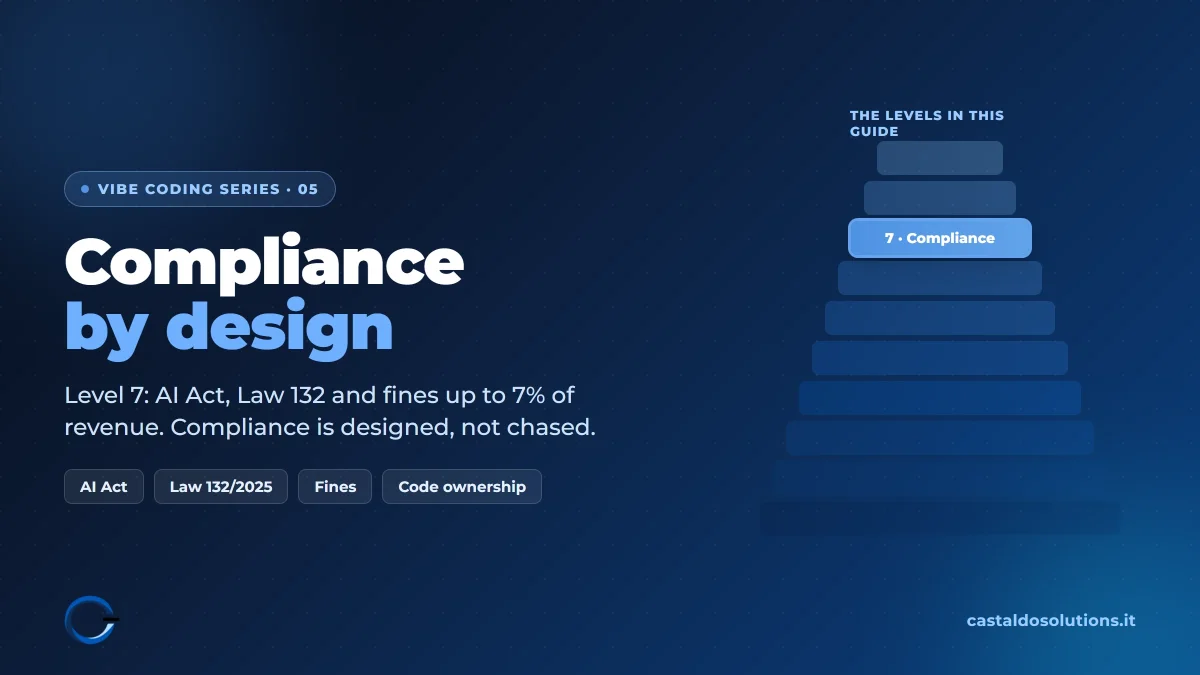
This is the fifth article in the From Vibe Coding to Production series. We are at Level 7 of the pyramid, and it is the one that differs most from the others: it is not a technical control, it is a process.
The typical vibe coding mistake is treating compliance as the last step, a checklist to tick before launch: cookies, privacy, terms and conditions, done. It does not work like that. Compliance is not something you add at the end: it is a choice you make, knowingly or not, from the very first line.
Architecture Is Already a Compliance Choice
Every technical decision made in the previous levels, where you keep data, how you handle PII, which external services you call, is also a compliance decision.
You cannot separate "how the app is built" from "whether it is compliant". If an external agent can forward personal data to a data center outside the European Union, that is not a technical detail: it is a regulatory problem born from an architecture choice. That is why compliance must be treated like security or scalability: a design constraint, not a final touch-up.
AI Act: What You Must Guarantee if You Build AI
The AI Act (Regulation EU 2024/1689) has a guiding principle: artificial intelligence must be trustworthy and human-centric. In practice that means protecting people's fundamental rights, with obligations that grow with the risk level of the system and that fall on whoever builds it.
Translated for a founder: before going to production you need to know which risk tier your application falls into and what you must guarantee, from transparency toward the user to human oversight, to proper data handling. The point is not to memorize a regulation: it is to know it exists and ask the right questions early, not late.
Compliance by Design or Late Compliance?
Sound familiar?
About to launch and only now wondering if you need a privacy policy? You are doing late compliance, the most expensive version there is.
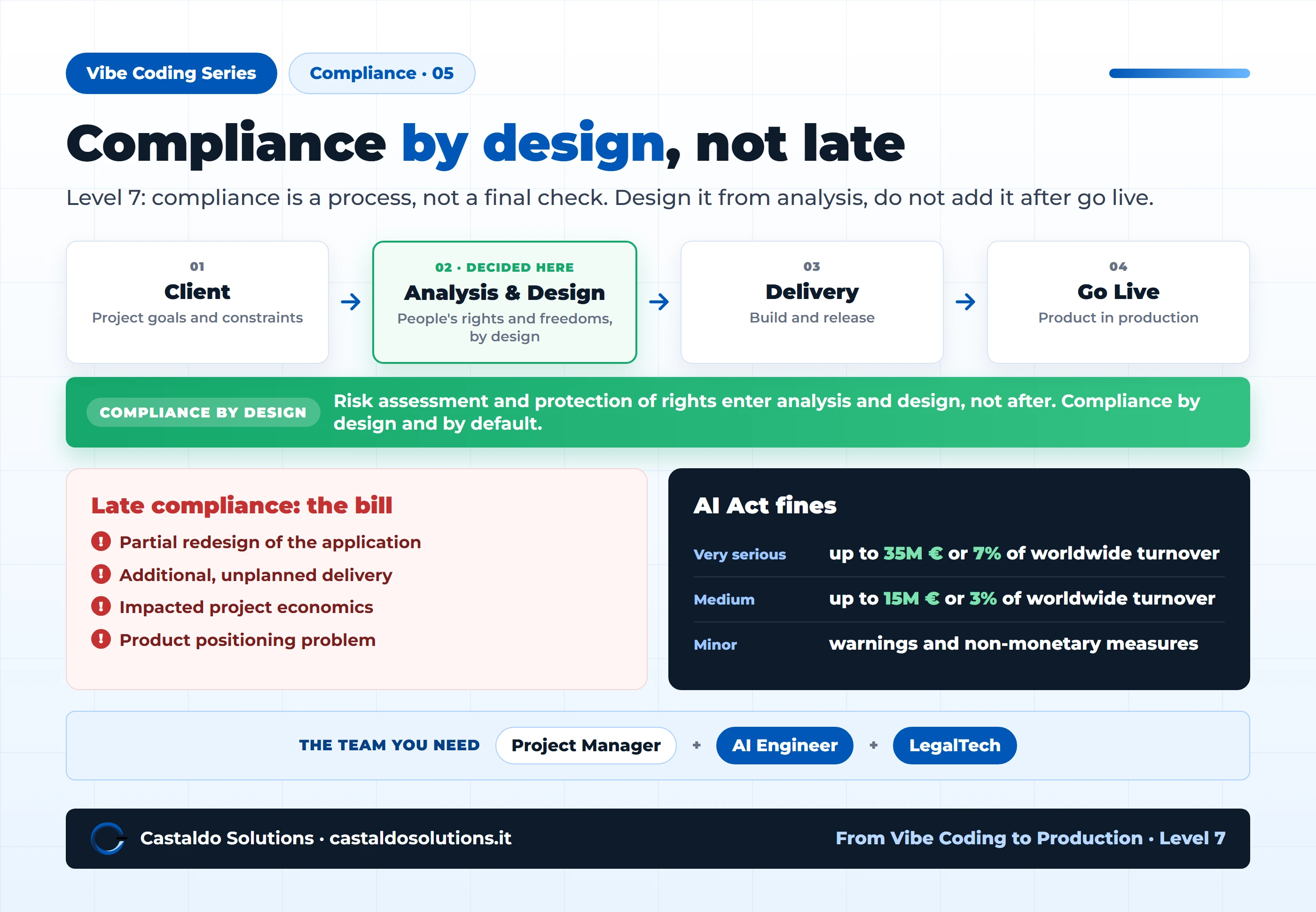
The best practice is simple to state and hard to apply: compliance by design and by default, with a risk assessment before delivery. It means bringing "people's rights and freedoms" into the analysis and design phase, not at go live.
The alternative is late compliance, fixing everything after the product is already online. And the bill is steep:
- partial redesign of the application;
- additional, unplanned delivery;
- impacted project economics;
- in the worst cases, a product positioning problem, because some features can no longer be offered.
It is the same message that runs through this whole series: discovering a constraint at the start costs a consultation, discovering it at the end costs a rewrite.
What You Really Risk: the AI Act Fines
This is not theory. The AI Act fines are heavy and scale with the severity of the violation:
- Very serious violations: up to 35 million euros or, for companies, up to 7% of total worldwide annual turnover of the previous year.
- Medium violations: up to 15 million euros or up to 3% of worldwide annual turnover.
- Minor violations: warnings and non-monetary measures.
For an SME or a startup, even the middle tier can be fatal. And it is exactly the kind of risk a non-technical founder does not see while building in vibe coding, focused on making the product work.
Law 132/2025: the Rules for Those Building for Italy
If you build for the Italian market, there is one more layer. Italy's Law 132/2025 states that the use of artificial intelligence systems must guarantee lawful, fair and transparent processing of personal data, compatible with the purposes for which it was collected and compliant with European Union law on data and privacy.
It then adds special principles for sensitive areas: healthcare, employment, intellectual professions, public administration, justice, copyright. If your application touches one of these sectors, the rules become stricter, and they must be known before you write the business logic. We covered the topic in the article on the AI Act for Italian companies.
The Team Changes: Enter LegalTech
Here is the real paradigm shift. To build a compliant AI app, the classic team is not enough, project manager, business analyst and developer. You need an AI Engineer and, above all, a LegalTech professional.
Bringing a LegalTech lawyer into the project is not a cost: it is what lets you make the right choices early, instead of chasing compliance later. There is also an intellectual property angle: without a well-structured license agreement from the start, a client can claim part of the code, especially on customizations. You defend the ownership of your product with paperwork, not just with code. We discussed this in the piece on the legal tech analyst.
Trust Is Designed and Verified
The point is one: trust in an AI system is designed at the architecture level and verified at the legal level. The two are not separate. An app can be technically perfect and legally unusable, or compliant on paper but fragile with data.
Taking a product from vibe coding to production means holding these two planes together from the start. It is the last control before the top of the pyramid: in the next article we reach infrastructure and maintenance.
FAQ on compliance by design under the AI Act for SMEs
What is compliance by design under the AI Act for Italian SMEs? It is the approach where conformity is designed from the very first line of code, not added at the end. It means bringing people's rights and freedoms into the analysis and design phase, with a risk assessment before delivery, instead of fixing everything after the product is already online.
What are the AI Act fines? They scale with the severity of the violation. Very serious violations reach up to 35 million euros or, for companies, up to 7% of total worldwide annual turnover of the previous year. Medium violations reach up to 15 million or 3% of turnover. Minor violations involve warnings and non-monetary measures.
What is the difference between compliance by design and late compliance? Compliance by design plans conformity from the start, as a design constraint on a par with security and scalability. Late compliance fixes everything after go live and is the most expensive version: it means partial redesign of the app, additional delivery, impacted economics and sometimes features that can no longer be offered.
What does Italy's Law 132/2025 add for those building in Italy? It states that the use of AI systems must guarantee lawful, fair and transparent processing of personal data, compatible with the purposes of collection and compliant with EU law. It adds stricter principles for sensitive areas: healthcare, employment, intellectual professions, public administration, justice and copyright.
Do you need a LegalTech lawyer in an AI development project? Yes. To build a compliant AI app the classic team (project manager, business analyst, developer) is not enough: you need an AI Engineer and a LegalTech professional. It is not a cost, it is what lets you make the right choices early and protect code ownership with a well-structured license agreement from the start.
Get a compliance check before going to production, not after.