Testing in Vibe Coding: Why the Happy Path Blows Up in Production
Your app works on your path, so it looks ready. But have you tested the other scenarios, the roles and the load? Here is Level 6: the testing that saves you in production.

The Happy Path Illusion
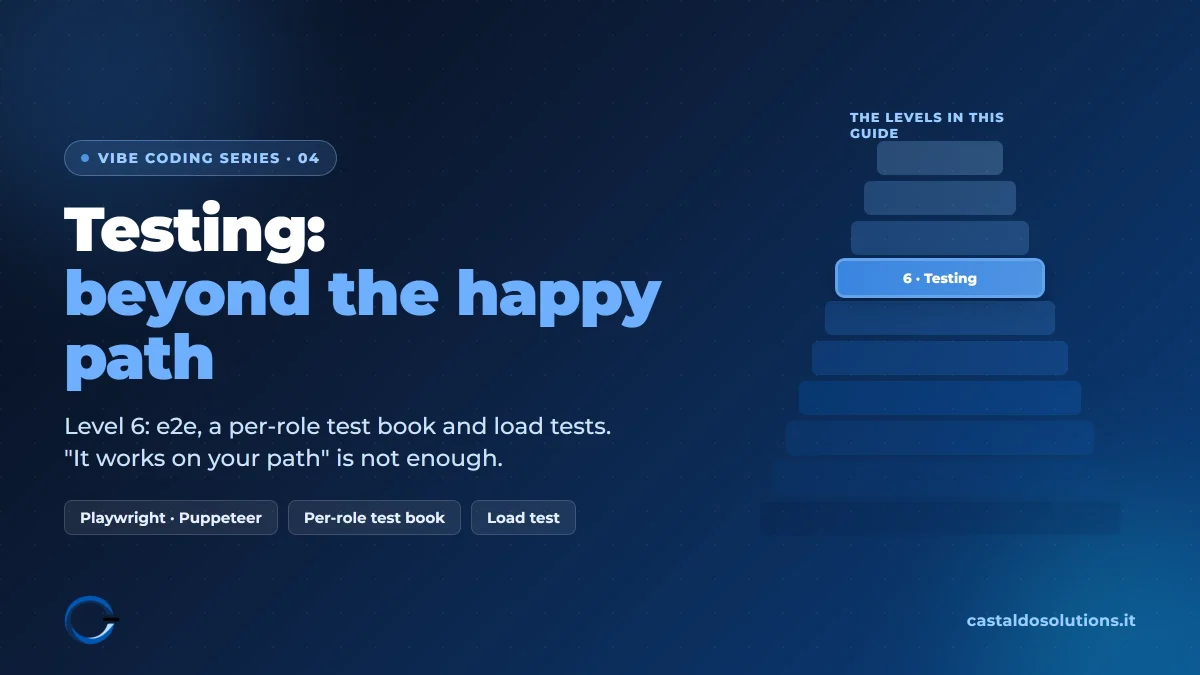
This is the fourth article in the From Vibe Coding to Production series. We are at Level 6, testing, the level that separates "it seems to work" from "it actually works".
Sound familiar?
Your app works on your path, so you shipped it to production? You only tested the happy path: no alternative scenarios, no different roles, no real load. You have built yourself the path to make it explode.
Vibe coding has a subtle side effect: you always follow the same path, the happy path, the one in your head while you build. The app responds, the screens open, everything looks fine. So it goes to production. But "it works on my path" is not "it works": you have not tested the different scenarios, the real customer journeys, and above all you have not verified the robustness of the application across the various roles.
The first user who steps off the happy path, who has a different role than yours, or who arrives from a device you have never tried, finds the bug you never saw. And they find it in production, right in front of them.
Automating Tests with AI: Playwright, Puppeteer and the Device Matrix
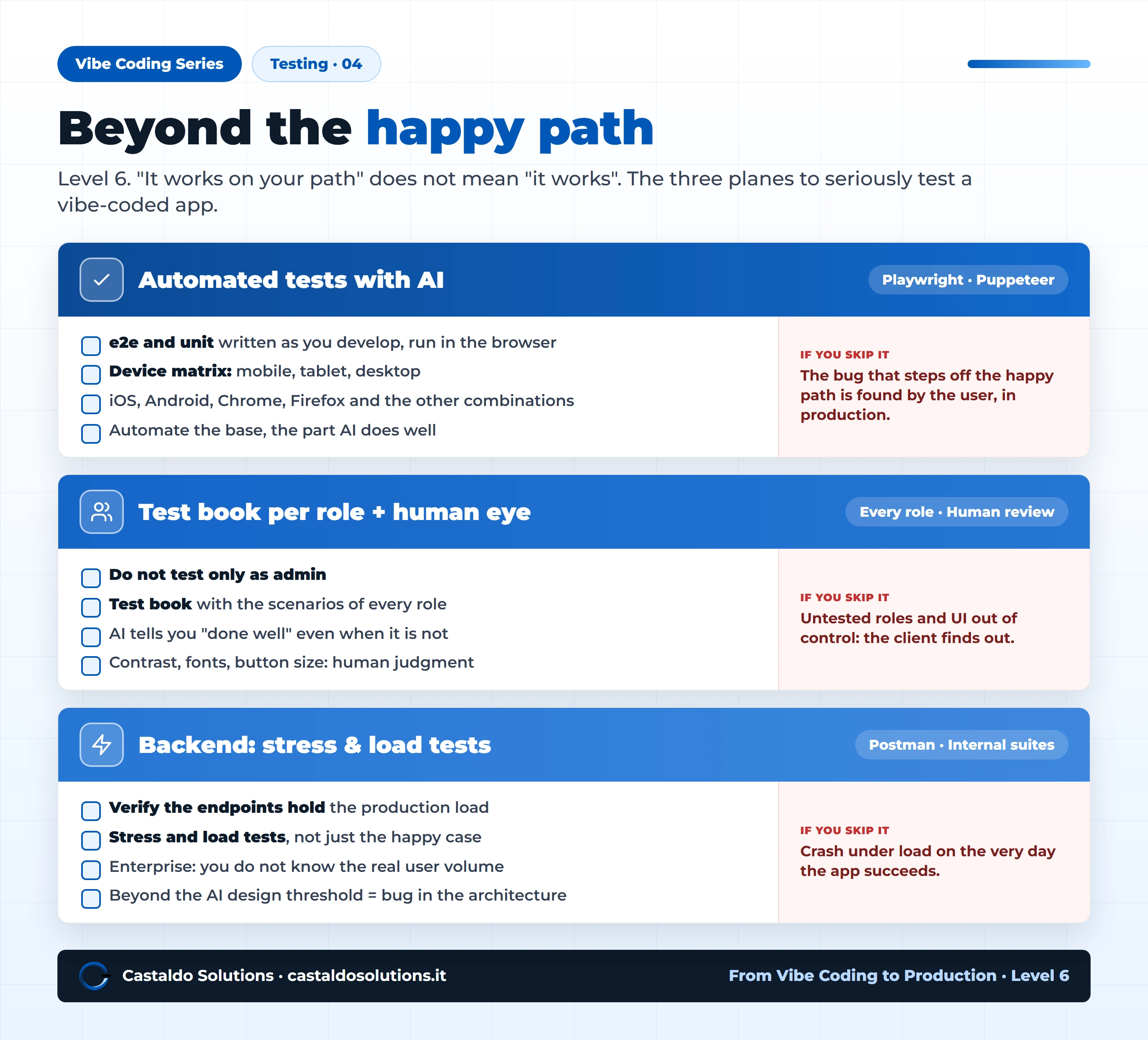
The good news is that today most testing can be delegated to AI. While you develop, you can ask the assistant to also write the end-to-end tests and the unit tests, and to run them directly in the browser.
Tools like Playwright (also via Playwright MCP) and Puppeteer automate most tests and let you cover the combination of scenarios that makes a web app fragile: mobile, tablet and desktop, iOS and Android, Chrome, Firefox and the other browsers. Testing your app across all these combinations by hand is unthinkable; automating them makes the base much more solid from the start.
This is the part AI does well, and it should be used to the fullest. But it is only half the job.
The Test Book: Testing Every Role, Not Just Admin
Here is the most frequent mistake: testing everything as an administrator. But an application lives on roles, and each role sees and can do different things. Robustness is not verified only on the admin: it is verified on every single role, by building a test book with all the scenarios, role by role.
AI can help you build the test book, and it is right to use it. But then you need the human eye, and this is where everything is decided. Even with Playwright MCP, AI sometimes tells you something is done well when it actually is not. Human judgment matters more than anything.
AI today is still not good at evaluating color contrast, the size of a button, the stylistic tone. Those differences, the tone between colors, the font type, the character size, the color pairing, we still have to judge ourselves. An automated test tells you the button exists and the click works; it does not tell you that button is unreadable or off-brand.
Backend: the Stress and Load Tests Nobody Does
Testing is not just frontend. The backend needs intensive tests too: stress tests and load tests, meaning verifying that your endpoints really hold up under production load.
You can do this with tools like Postman, with dedicated automations or by building internal suites, to put the endpoints under pressure and find out how far they hold. It becomes mandatory in enterprise contexts, because you do not know in advance the volume of users you will have to handle.
And here is vibe coding's most insidious trap: if that volume exceeds the base design threshold the AI used to think the application, you have just created the next bug, and it is not just any bug, it is a bug directly in the architecture. Without load tests, you discover it only the day the app finally succeeds, which is the worst possible moment.
Does It Work, or Does It Just Seem to Work?
Testing is the level that turns a prototype that "runs" into software you can trust. AI automation to cover scenarios and devices, a human test book on every role, stress and load tests on the backend: these are the three planes that hold up the difference between an app that works on your path and one that works for everyone, under load.
At Castaldo Solutions it is one of the first checks we run on founder-built MVPs, because it tells you whether you are really ready for production or just hoping you are.
In the next article we tackle Level 7, compliance as a process: the AI Act, Italy's Law 132/2025 and fines.
Have your app tested before you discover the bugs in production.