Which Stack to Choose for a Vibe-Coded App: TypeScript, PostgreSQL and Prisma
Foundations decide everything else. Here is why a vibe-coded app should start from TypeScript, PostgreSQL and Prisma, and how not to get the data model wrong.

Foundations Decide Everything Else
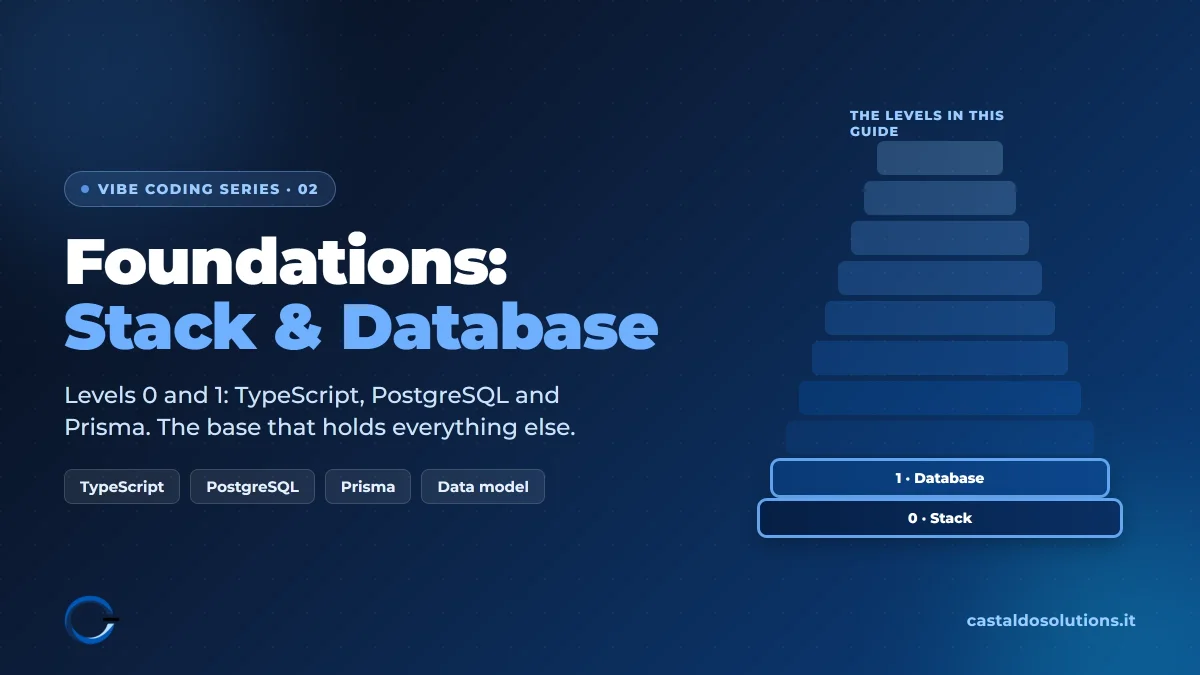
This is the second article in the From Vibe Coding to Production series. We start from the base of the pyramid, Levels 0 and 1, because if you get these wrong everything you build on top is fragile.
The beauty of vibe coding is that you can start writing code without deciding anything. The problem is that someone decides anyway, usually the AI, implicitly. And when those decisions concern the stack and the database, changing them later is very expensive.
Why TypeScript Is the Right Stack When You Start Solo
Sound familiar?
Change one thing in the frontend and three break in the backend (or vice versa)? You are paying the price of a non-unified stack.
If you start from scratch without a large team, my recommendation for the vast majority of cases is TypeScript.
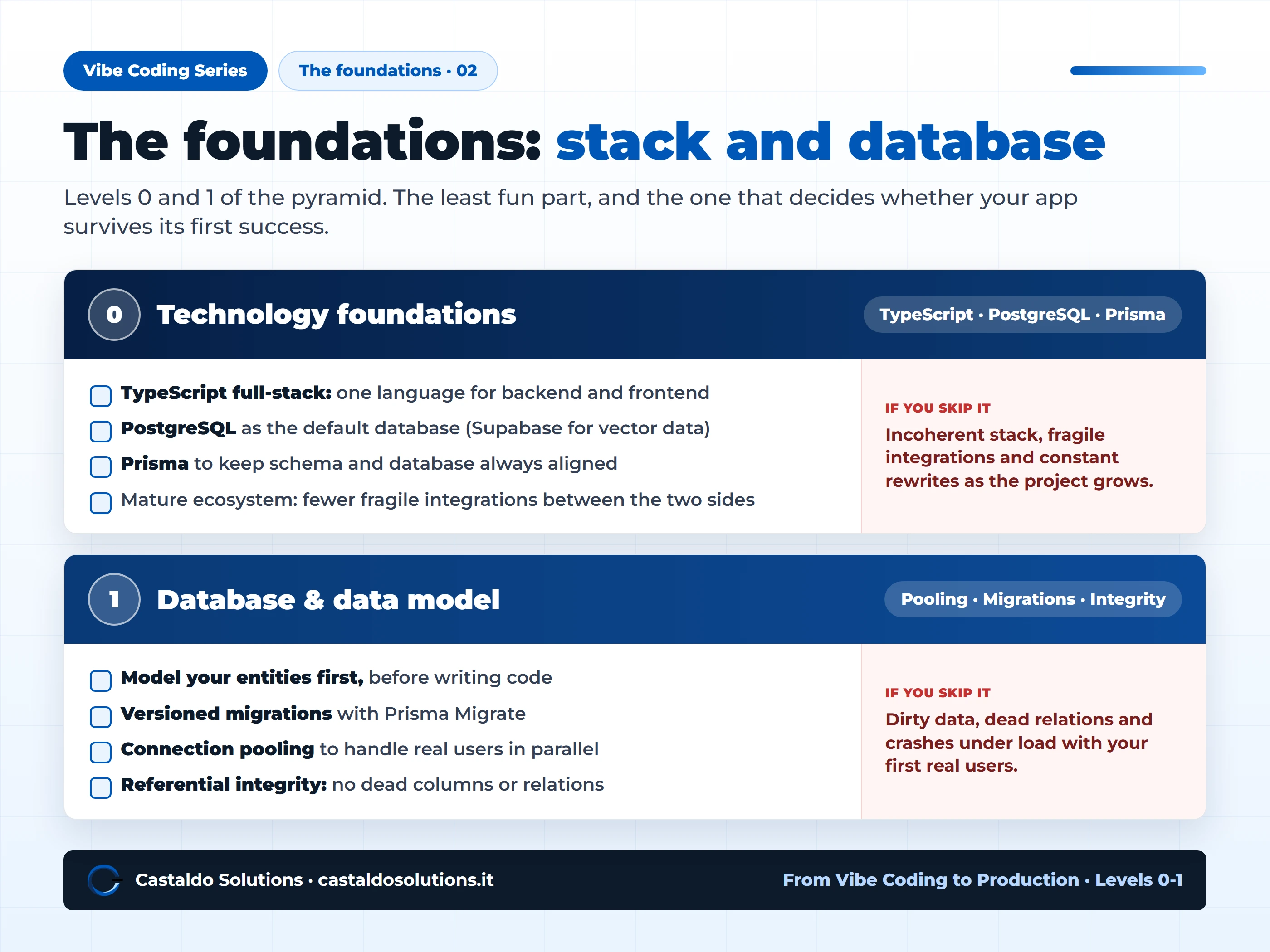
The reason is one: it unifies backend and frontend under a single language. One language means less context to manage, fewer errors when the two sides talk to each other, and a codebase an AI assistant can follow more easily. When back and front speak different languages, every integration is one more breaking point.
Add to that a huge ecosystem of mature frameworks and libraries, which make TypeScript complete enough to cover almost any business need. It does not apply to 100% of cases, but for the vast majority of projects it is the choice that lets you move faster without painting yourself into a corner.
PostgreSQL: the Default Database for (Almost) Everything
For the database, PostgreSQL is the sensible starting point for almost every application. It is mature, solid, documented everywhere and scales well.
The one exception worth considering is when you work intensively with vector data, typical of AI applications: there it can make sense to evaluate open source alternatives like Supabase, which integrates vector capabilities. But otherwise, Postgres is the choice you will not regret.
Prisma: Keeping Schema and Database Always Aligned
Having Postgres alone is not enough. What really speeds up development is a client like Prisma, which keeps the database schema aligned with your application entities.
With Prisma you define the model once, generate versioned migrations, and get typed data access consistent with TypeScript. That means fewer runtime errors and a single source of truth for your data structure. It is the setup I recommend right now to start well.
The Data Model: the Mistake You Pay for in Six Months
Here is the most expensive and most silent mistake. When the data model is left entirely to the AI or to an inexperienced founder, the same thing almost always happens: dead columns and relations, duplicated data, information scattered across multiple objects.
The result is data dirtiness that starts on day one. At first you do not see it, because there is little data. Then it grows, and the problem grows with it: reports that do not add up, data that is not connected the right way, features that become hard to build because the underlying structure never anticipated them.
The difference is made by an upfront analysis of the model: defining entities and relations before writing code, not while the app grows at random. It is an hour of thinking that saves you weeks of refactoring.
Connection Pooling: Why Your App Crashes With Its First Real Users
Sound familiar?
Does your app crash as soon as you pass 15 concurrent users? You have not implemented connection pooling.
There is a check almost no founder makes: connection pooling, the management of database connections.
Without pooling, your app behaves perfectly while only one person is testing it, you. Then real users arrive, in parallel, each opening connections to the database, and the application freezes at the worst possible moment: when someone is finally using it.
Starting from an architectural analysis of the database, pooling included, means having something that is already production ready. It is the difference between a prototype running on your laptop and software that withstands growth.
Where to Start
Foundations are not the fun part, but they are what decides whether your app survives its first success. If you have built an MVP in vibe coding and do not know whether the stack and the database will hold, now is the right time to have them checked.
In the next article in the series we go up one level and tackle security: authentication, secrets and vulnerabilities.
Talk to us about your app and find out whether your foundations are solid.