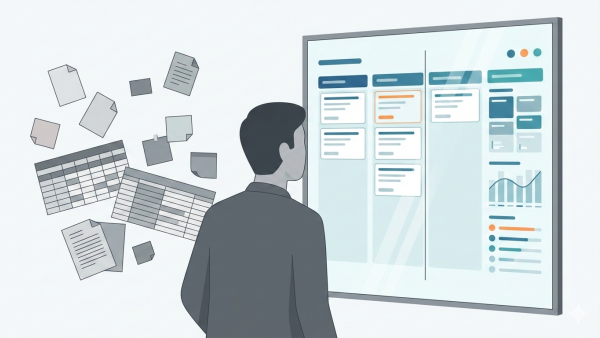
CRM Nobody Uses: 5 Mistakes That Cause 70% of Projects to Fail
You invested in a CRM but your team keeps using Excel? Discover the 5 mistakes that cause 70% of CRM projects to fail and how to avoid them with a concrete method.


TL;DR
70% of CRM projects fail to reach objectives, not because of the software, but because of five recurring mistakes: choosing the platform before mapping processes, underestimating data quality, skipping change management, customizing everything from day one, measuring nothing after go-live. The common thread is lack of method. In this article we analyze each one with concrete solutions.
The Problem That Doesn't Depend on the CRM
You spent 50,000, 100,000 or even 200,000 euros on a CRM. Salesforce, HubSpot, Dynamics: doesn't matter which. The salesperson had promised a revolution. Six months later, your sales team is still sending offers from a shared Excel file over WhatsApp.
If you recognize yourself in this situation, know that you're not an isolated case. Industry data indicates that approximately 70% of CRM projects fail to reach their stated objectives. It's almost never a technology problem. The software works. The problem is how it's chosen, configured and, most importantly, adopted.
In 15 years of CRM consulting, we've rescued dozens that were written off. In every case, failure traced back to one or more of these five mistakes.
Mistake 1: Choosing the CRM Before Mapping Processes
The scene repeats with striking regularity. The CEO comes back from an event, saw a spectacular demo, and Monday morning announces: "We're implementing Salesforce." Nobody has analyzed current workflows. Nobody has asked the sales team how they actually manage leads. Nobody has verified if customer service needs a ticketing system or just a shared sheet.
The result is a CRM configured to vendor specifications, not company specifications. Fields that nobody fills, automations that nobody understands, reports that nobody looks at.
The solution: before choosing any platform, you need a structured assessment of business processes. Who does what, when, with which tools and why. Only after understanding the human ecosystem can you design technology that amplifies it. This matters equally for a 20-person SME and a 500-person corporation.
Mistake 2: Underestimating Data Quality
A CRM is as powerful as the data it contains. Yet in most failed implementations we've seen, data migration is treated as a secondary activity: "We'll fix them later." That "later" never comes.
The team imports thousands of duplicate contacts, incomplete records, leads from three years ago. The salesperson opens the CRM, searches for a customer and finds four different versions of the same record. Closes the CRM. Reopens Excel. The project is dead, even though technically everything works.
The solution: dedicate at least 20% of the project budget and time to data cleanup, normalization and validation before migration. Define data quality rules that the CRM enforces automatically: mandatory fields, standardized formats, periodic deduplication. Dirty data isn't a technical detail, it's the main cause of abandonment.
Mistake 3: Zero Change Management
This is the most costly and least visible mistake. The company buys the CRM, configures it, runs one training day and then sends an email: "Starting Monday you use the new system." The team wasn't involved in the choice. Doesn't understand why they should change habits that work. Doesn't see the personal benefit.
The CRM is perceived as a control system, not a tool that simplifies work. Resistance is silent but deadly: salespeople fill minimum fields to avoid trouble, enter approximate data, and keep working as before.
The solution: involve key users from the design phase. Identify internal champions, people who see the value of change and can influence colleagues. Build the CRM around the real needs of the team, not features management likes. Train in phases, with practical sessions on daily workflows, not PowerPoint presentations about platform features.
Mistake 4: Customize Everything Right Away
Initial enthusiasm is dangerous. The project team wants to replicate in the CRM every single existing process, including exceptions, workarounds and procedures that exist only because "we've always done it this way." The result is an over-engineered system with dozens of custom fields, complex workflows and a learning curve that discourages everyone.
We've seen implementations with over 200 custom fields for a 15-person team. The CRM had become more complicated than the process it was supposed to simplify.
The solution: start with minimal configuration covering 80% of use cases. Use the CRM "out of the box" as much as possible for the first 90 days. Collect real feedback from users. Only after that, iterate with targeted customizations based on concrete usage data, not guesses or management wishes. Every field added must justify its existence with measurable benefit.
Mistake 5: No KPI, No Follow-up
The CRM goes live. The consultant celebrates. The project manager closes the project. And nobody asks: Is it working?
Without KPIs defined before launch, there's no way to know if the CRM is generating value or draining resources. How many leads are entered each week? What's the real adoption rate? Have response times to customers improved? Has the sales cycle shortened? If nobody measures, nobody improves.
The solution: define 3–5 clear KPIs before implementation. Not vanity metrics, but indicators tied to business results:
| KPI | What It Measures |
|---|---|
| Adoption rate | How many users use the CRM at least 3 times/week |
| Data completeness | % of records with all mandatory fields filled |
| Sales cycle | Variation in average days from lead to close |
| Conversion rate | % of leads that become opportunities or customers |
Review these numbers every 30 days for the first 90 days. If KPIs aren't improving, it's time to intervene, not wait.
The Common Denominator: Method is Missing
If you look closely, all five mistakes have a common root. It's not the wrong technology. It's the absence of a structured approach that puts people and processes before tools.
That's why at Castaldo Solutions we use TOGAF® certified frameworks and Agile Scrum for every CRM project. Not because we like acronyms, but because 50 projects taught us that method beats improvisation every time.
The CompanyTech BattlePlan is the first step: a strategic assessment that, in 2 or 4 weeks, maps the company's digital ecosystem and produces a roadmap with clear priorities, defined KPIs and a concrete action plan.
If your CRM has become the software everyone ignores, the problem isn't the CRM. It's the path that led to its implementation. And that path can be corrected.
Your CRM Isn't Working the Way It Should?
Book a free CompanyTech BattlePlan: we analyze processes together, identify bottlenecks and build the roadmap to transform your CRM from cost center to growth engine.
Request the BattlePlan Assessment →
Frequently Asked Questions
Why do CRM projects fail?
The main cause isn't technical but organizational. CRM projects fail when there's no assessment of business processes, migrated data is poor quality, the team isn't involved in choice and adoption, customization is excessive from day one, and no KPIs are defined to measure success. Addressing these aspects before implementation drastically reduces failure risk.
How much does it cost to rescue a failed CRM project?
Recovery cost depends on severity, but generally ranges from 30% to 60% of the initial investment. In our experience, a structured assessment like the CompanyTech BattlePlan lets you identify critical areas in 2 or 4 weeks and define a recovery plan with clear priorities and measurable ROI within 90 days.
How do I know if my CRM is working?
The three most reliable indicators are adoption rate (how many users actively use the system each week), data completeness (percentage of complete and updated records), and business impact (variations in sales cycle, conversion rate, customer response time). If you're not monitoring at least these three KPIs, your CRM probably isn't generating expected value.
Better Salesforce, HubSpot or Dynamics for an Italian SME?
There's no universal answer. The choice depends on the company's specific processes, available budget, internal skills and business goals. A common mistake is choosing the CRM based on the prettiest demo. Our approach is technology-independent: we first map needs, then identify the platform that best satisfies them.