AI and SMEs: Between Hype, Data and Reality - Podcast Nerd @ Work Lab
Italian SMEs want to 'do AI', but what does that actually mean? In the Nerd @ Work Lab podcast we discuss hype, avoidable failures, messy data and how to start with projects that actually work.


Italian SMEs want to "do AI": what does that really mean?
There's a phrase that comes up in almost every meeting with entrepreneurs: "We want to do something with AI."
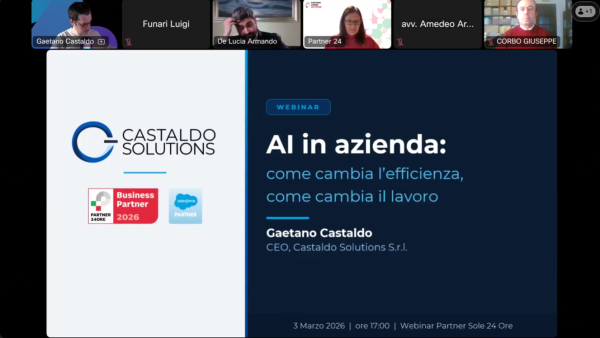
This is exactly where the Nerd @ Work Lab – S1E5 "AI and SMEs: Between Hype, Data and Reality" episode starts, where Enrico Murru talks with Gaetano Castaldo, strategic and technology consultant, former colleague and today a widely heard voice on AI adoption in businesses.
Behind that "do AI" there's everything: genuine curiosity, fear of falling behind, competitive pressure, conference FOMO. But what's really needed for artificial intelligence to transform a company, instead of becoming yet another dead project after a few months?
Listen to the podcast on Spotify
This article draws on the themes discussed in the podcast and organizes them into a practical guide for anyone in a company making real decisions.
1. The fashion effect: when "AI" is just another word in the slides
One of the central points of the conversation is the fashion effect: companies that want AI without really knowing why.
It often happens like this:
- management sees a spectacular demo at an event,
- reads a couple of articles on "how AI will revolutionize sector X",
- and decides "we need an AI project by year-end".
The problem? Starting from technology instead of from the problem.
Instead of asking themselves:
"What's the bottleneck in our sales, production or customer support process?"
they ask:
"Where do we put a chatbot?"
It's the digital equivalent of buying an incredibly expensive machine and then walking around the company asking: "Does anyone need this thing?".
2. Why so many AI projects fail in SMEs
The podcast speaks clearly about avoidable failures and projects that never really take off. Usually the reasons are always the same:
No business owner
- It's IT, or an external vendor, bringing AI "turnkey".
- The department that should use it hasn't been seriously involved.
- Result: solution poorly aligned with reality, extremely low adoption.
No measurable objective
- "Improve customer service" is not an objective.
- "Reduce response times by 20% within 6 months", yes.
- Without numbers, it's impossible to talk about ROI and the project becomes the first thing cut in the next budget.
Complexity was underestimated
- AI is talked about as magic: "give it the data and it understands everything".
- In reality, integrating a model into processes, existing systems and people's habits is the really hard part.
Stable processes are missing
- If the process today is confused, not documented, full of exceptions, AI amplifies it: it makes chaos faster.
A key phrase that emerged in the podcast is exactly this: AI amplifies processes, it doesn't fix them.
3. Data: lots, messy and often unusable
In the episode title two key words appear: hype and data. Not by chance.
All serious AI solutions: from predictive models to employee copilots: need clean, accessible data with at least some governance. In the real world of Italian SMEs, what happens instead is this:
- CRM used halfway, with fields filled in randomly.
- Parallel Excel spreadsheets, one for each department.
- Important documents in unreachable email attachments.
- Systems that don't talk to each other or talk poorly.
When you sit down at the table and say "let's make a model to estimate churn", the real question is: "Do we have reliable historical data on customers, renewals, support, tickets, invoicing?"
Often the answer is no. And the AI project becomes, in practice, an expensive data cleaning exercise in disguise.
Paradoxically, one of the healthiest outcomes of an AI project can be exactly this: Discovering that before building models you need to put your data in order.
4. The chatbot myth (that no one will use)
In the official podcast description it explicitly mentions "chatbots that no one will use".
It's one of the most widespread phenomena:
- You launch the chatbot on the website,
- You make a big LinkedIn post,
- You wait for a revolution in customer support.
After a few months:
- Very few users actually use it,
- Many quickly go back to traditional channels (phone/email),
- Internal customer care sees it as an "enemy" rather than an ally.
This almost always happens because:
- The chatbot isn't seriously integrated with internal systems (CRM, ticketing, orders).
- It responds too generically, like glorified FAQs.
- There's no clear leadership on when it should step in and for what.
An effective chatbot is not a marketing toy: it's an interface to business processes and data. If there's no substance behind it, the whole thing falls apart.
5. Missing skills and the role of "junior" staff
The podcast also touches on a delicate theme: AI's impact on more junior roles.
Here an interesting catch-22 comes into play:
- AI makes repetitive activities much faster;
- At the same time, companies struggle to find people with intermediate skills, capable of understanding processes, data and business impact.
In the middle stands a new hybrid figure:
- Not just developer,
- Not just process analyst,
- Not just data person,
- But someone capable of "talking to AI" and to internal departments, and of turning business needs into prompts, workflows, rapid prototypes.
For many SMEs this is the real mismatch: it's not so much a lack of technology, as a lack of people who can tie technology and operational reality together.
6. From "let's make a bot" to "let's rethink a process"
One of the underlying messages in the episode: and perhaps the most important: is that AI only makes sense if tied to a real process.
Some examples of "right" questions to ask yourself:
Sales
- Where do we waste time?
- Where do we lose leads?
- Which steps are repetitive and easily automatable (e.g. qualify leads, enrich data, prepare personalized emails)?
Customer service
- What are the 5 most frequent requests?
- What can we automate without hurting the customer experience?
- Can we use AI to suggest answers to human agents, instead of replacing them?
Operations / production
- Are we using production data for predictions, simulations or only for historical reporting?
- Are there bottlenecks that a predictive model could anticipate (failures, delays, material shortages)?
In all these cases, the question is not:
"Which AI model do we use?"
but:
"How do we redesign the process knowing we now have these new building blocks available (LLMs, automations, predictive analysis, etc.)?"
7. How to start healthy: a mini-framework for SMEs
Summarizing the points from the episode and translating them into a practical guide, a sensible path could be:
1. Map 2-3 key processes
- Not everything: choose where friction is highest (sales, support, logistics...).
- Sketch the "before" and "after" on paper, brutally and honestly.
2. Take inventory of data
- Where is it today?
- In what format?
- Who governs it?
- Is it historical, complete, reliable?
3. Define a measurable objective
- Reduce times, errors, costs, or increase sales, conversions, satisfaction.
- Turn "we want to do AI" into "we want to achieve this result".
4. Run a small controlled experiment
- A pilot of 4-8 weeks, on a subset of users or customers.
- With clear before/after metrics.
5. Decide based on data, not hype
- Did it work?
- Yes > scale gradually.
- No > figure out if the problem is technical, process or cultural, and adjust.
In practice, what emerges from the podcast is that AI is less "rocket science" and more "organizational craftsmanship": small steps, lots of cross-department conversation, continuous iteration.
8. The human side: between enthusiasm and responsibility
Another thing that comes through in the conversation is the tone: neither doomsday nor naively enthusiastic.
On one hand, AI is truly a huge lever for SMEs:
- It can offset the lack of people in certain roles,
- It can open new services previously unthinkable,
- It can improve work quality, removing tedious parts.
On the other hand, if used badly:
- It can create unrealistic expectations ("do more with half the people"),
- It can lead to cutting corners on compliance, security and data quality,
- It can create dangerous dependencies on a few vendors or unmanaged solutions.
This is where the responsibility comes in of whoever leads these projects: CTOs, CIOs, consultants, but also CEOs and entrepreneurs who decide where to invest time and budget.
9. Three takeaways for SME leaders
If we had to distill the episode into three key messages for an entrepreneur, they could be these:
1. Don't ask yourself "where do I put AI", ask yourself "what business problem do I want to solve"
Technology comes after, not before.
2. Data first, then models
If data is scattered, incomplete or ungoverned, AI will just be a magnifying glass on chaos.
3. Involve the right people from the start
Projects that work are not the most "spectacular", but those where business, IT and whoever works on processes every day sit at the same table.
Conclusion
This podcast is honest conversation, with no sales pitch, between people who've seen on the ground what works and what doesn't.
If you work in an SME and you're wondering "how do I get into this world without hurting myself", this episode is a great starting point.
And if you want to dive deeper into how to apply these principles in your company, let's talk.