The AI Pyramid Nobody Looks At: Energy and Chips Come First

TL;DR: AI is a five-layer pyramid. The debate focuses at the top (models and applications). The real constraint is at the base: energy and chips. On both, USA and China dominate. Europe depends on both and has no leverage over either.
Everyone talks about ChatGPT, Gemini, Claude. About how many parameters the new model has, about benchmarks, about who's winning the AI race. Meanwhile, Jensen Huang, NVIDIA's CEO, has been repeating the same thing for years, with more force each year: the problem isn't at the top of the pyramid. It's at the base.
Energy. Chips. Physical infrastructure. These are the foundations on which AI stands or falls. And on all three, Europe is a spectator.
The "AI-Cake": Five Layers We Only Discuss Two
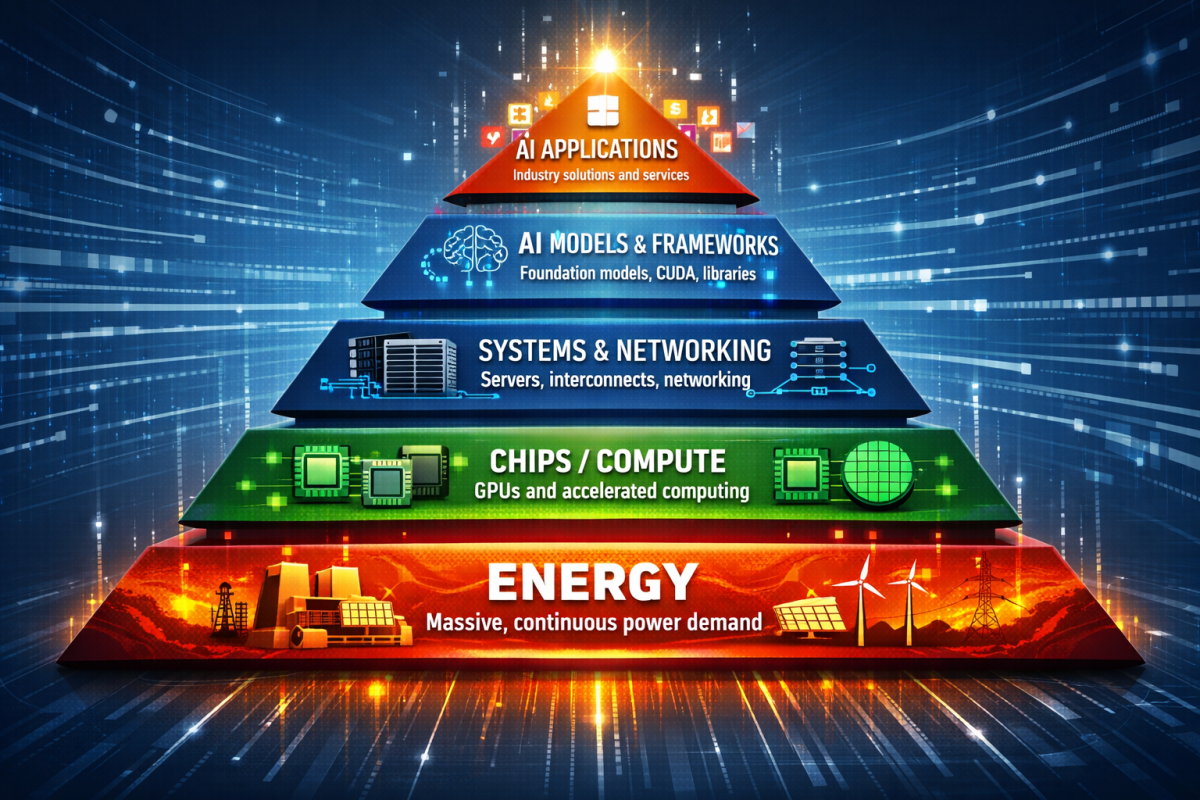
Huang made the five-layer AI cake image popular: five stacked layers, each dependent on the one below.
From bottom to top:
- Energy - massive and continuous electricity demand
- Chips and compute - GPUs, accelerators, advanced semiconductors
- Systems and networking - servers, interconnections, data centers
- Models and frameworks - Foundation Models, CUDA, libraries
- AI Applications - the products we use every day
Public debate, that of tech media and business decision-makers, concentrates almost exclusively on levels 4 and 5. The layers below don't exist in current conversation.
Yet, at GTC 2026 in March, Huang introduced a blunt formula:
"AI factory revenues are equal to tokens-per-watt. With power constraints, every unused watt is revenue lost."
Translated: AI revenue = tokens produced per watt available, multiplied by total gigawatts. If energy is missing, the world's most powerful model is worthless. Without electricity, no tokens.
Why AI's Future Depends on Energy
AI is hungry. A hunger that grows exponentially, not linearly.
According to the IEA (International Energy Agency), data centers will consume globally 945 TWh by 2030, nearly double the 415 TWh of 2024. Servers accelerated for AI are growing at +30% annually, four times faster than any other industrial sector. By 2035, AI data centers will consume as much electricity as all of Japan uses today.
At Davos 2026, Huang called AI "the largest infrastructure buildout in human history" and explicitly stated: "I think that it's fairly certain that you have to get serious about increasing your energy supply so that you could invest in the infrastructure layer."
This is not linear growth. It's systemic pressure on electrical grids designed for a pre-AI world. In many areas of the United States, grid operators are already rationing access to data centers. In Europe the situation is no better.
The complicating point: energy isn't a technical problem solvable with a software update. It depends on physical infrastructure, national policies, international treaties, and increasingly on geopolitical dynamics. Recent years of geopolitical tension have made clear that energy supply chains can be interrupted quickly and brutally.
An Europe dependent on outsiders for gas and electricity is an Europe that doesn't control its digital future. The structural answer isn't a green slogan: it's sovereign, renewable, distributed energy as a strategic requirement to compete in the AI economy.
Who Controls the Chips Controls AI: And We're Not in That Room
If energy is the problem few discuss, chips are what nobody discusses at all.
Every AI model, whether you use it to generate text, analyze data, or automate processes, runs on hardware. That hardware is produced almost entirely in Asia.
TSMC (Taiwan) controls 64% of the global foundry market and produces roughly 90% of the world's advanced chips (below 7nm). Samsung covers most of the rest. There is no European alternative for the processes AI requires.
China has invested over 150 billion dollars in semiconductor production in recent years, three times the entire American CHIPS Act. In the first quarter of 2024, SMIC surpassed GlobalFoundries to become the third foundry globally by revenue. China controls nearly 99% of global gallium production, a critical material for advanced chips.
Europe responds with the EU Chips Act: 43 billion euros to reach 20% of global production by 2030. Today we're under 10%, and the TSMC plant being built in Dresden will, when operational in 2027, use mature technologies, not the advanced nodes AI requires.
The result is that every GPU in an Italian company, every AI accelerator, every server in our data centers depends on a production supply chain we don't control. A supply chain exposed to trade tensions, embargoes, and in Taiwan's case, to a geopolitical risk that Bloomberg Economics estimates at 10 trillion dollars in global damages in the first year alone of conflict.
Where We Stand: Spectators on the Wrong Floor
Europe looks at the pyramid from the top. It adopts models, uses applications, discusses regulation with the AI Act. All legitimate and necessary.
But levels 1 and 2, energy and chips, are dominated by USA and China. We depend on both, often simultaneously, with no leverage over either.
This isn't a future problem. It's today's reality, and it worsens every year. Every Italian SMB that decides to "invest in AI" is building on foundations it doesn't control and that could become more expensive, less available, or interrupted for reasons beyond its control.
The concrete question isn't "which AI model do I choose?". It's: how much resilience does my digital infrastructure have if the global supply chain suffers a shock?
What to Do Concretely: Adopt AI with Structural Awareness
We're not saying you should wait for geopolitics to stabilize before using AI. That would be paralyzing.
But there's a substantial difference between adopting AI deliberately and doing it while only looking at the frosting.
Being aware means:
- Knowing that AI cloud service costs are directly tied to energy and chips, and can change rapidly
- Preferring architectures that don't create critical dependencies on a single provider or geographic region
- Evaluating the energy efficiency of adopted solutions: tokens per watt isn't just a hyperscaler metric
- Understanding that digital sovereignty starts with infrastructure, not applications
AI remains a concrete and real opportunity for Italian SMBs. But whoever understands the whole cake, not just the frosting, will make better decisions over the next five years. Because the constraint won't be the model: it will be the power and silicon it runs on.
For deeper dive into the relationship between energy, Jevons paradox, and AI, read also: Jevons Paradox, Nuclear Power, and AI: Energy as a Strategic Variable.