Who Manages AI in Your SMB? The AI Leader and the Roles You Actually Need
80% of Italian SMBs don't have a dedicated IT department. Who manages AI when it arrives? The AI Leader: an internal role you can train in 4 months with a structured framework. Here's how it works and what roles come next.


The AI Leader is the internal figure who manages AI adoption in an SMB, with a role similar to a PMO (Project Management Office) applied to AI: they define usage rules, coordinate projects, train the team, and measure results. No technical background needed: what's required is method, vision, and a structured operational framework.
80% of Italian SMBs don't have a dedicated IT department (source: Digital Innovation Observatory, Politecnico di Milano). When AI enters the company, who handles it? In practice, one of these things happens: nobody (and AI spreads chaotically, with employees using ChatGPT on personal accounts), or the owner personally (who already has 15 priorities and can't follow this one too), or it gets delegated to whoever "knows about computers" (who has neither the mandate nor the training to do it).
The result is always the same: tools used poorly, sensitive data shared without control, no measurement of results, and after 6 months the AI project gets filed under "didn't work."
There's a concrete alternative.
What Is an AI Leader and Why SMBs Need One
The AI Leader is not a technical role. They don't need to know how to code, don't need to understand how a transformer works, don't need to configure servers. It's an organizational figure with three responsibilities:
- Governance: defines the company AI Usage Policy (which tools can be used, which can't, with which data, with which licenses)
- Coordination: bridges management, the operational team, and the external consultant. Collects needs, prioritizes projects, monitors progress
- Continuous training: keeps the team updated on new tools, emerging risks (AI phishing, voice cloning, hallucinations), and best practices
In practice, it's the PMO of AI. Just as a PMO doesn't need to write code but needs to manage a project, the AI Leader doesn't need to train a model but needs to manage AI adoption in the company with method.
How to Train an AI Leader (the Process I Use with My Clients)
In the AI Adoption projects we run with Italian SMBs, AI Leader training is integrated into Phase 4 of the journey (Governance and Hypercare). It's not a theoretical course: it's practical coaching lasting approximately 4 months following a structured framework.
Month 1-2: Foundations
- Participation in kickoff and initial team training (AI history, risks, tools, security)
- Shadowing during the Discovery and Mapping phase
- Understanding real business processes (not the documented ones)
Month 3: Operations
- Participation in design workshops with management
- Co-creation of the impact/feasibility matrix
- First draft of the AI Usage Policy
- Vendor scouting management with consultant support
Month 4: Autonomy
- Finalization and communication of the AI Usage Policy to the entire team
- First independent procedure verification cycle
- Definition of the AI Literacy plan for subsequent quarters
- Results presentation to management
At the end of the journey, the AI Leader has an operational framework and practical experience to manage the next cycle without the consultant. The goal isn't to create dependency, but to transfer the method.
The Ideal Profile: Who to Choose in Your Company
No need to look outside. The best AI Leader is almost always already in the company. Here are the characteristics I look for when helping a client identify the right person:
- Cross-functionality: knows multiple departments, not just their own. Ideal: operations manager, office manager, controller, quality manager
- Technology curiosity: doesn't need to be a technician, but should be someone who tries tools, asks questions, isn't afraid to experiment
- Internal credibility: the team listens to them. If the person isn't respected by colleagues, the AI policy will remain dead letter
- Access to management: must be able to speak directly with the owner/CEO for strategic decisions
The worst person for this role? The one who "knows everything about computers." The AI Leader isn't the technician who installs software: they're the manager who decides how the company uses AI.
What AI Roles Does Your Company Need as It Grows
The AI Leader is the starting point. As the company's AI maturity grows, more specialized needs emerge. According to IBM, organizations with a dedicated Chief AI Officer see 10% higher ROI on AI projects. In my clients, I see a recurring pattern that develops across 3 time horizons.
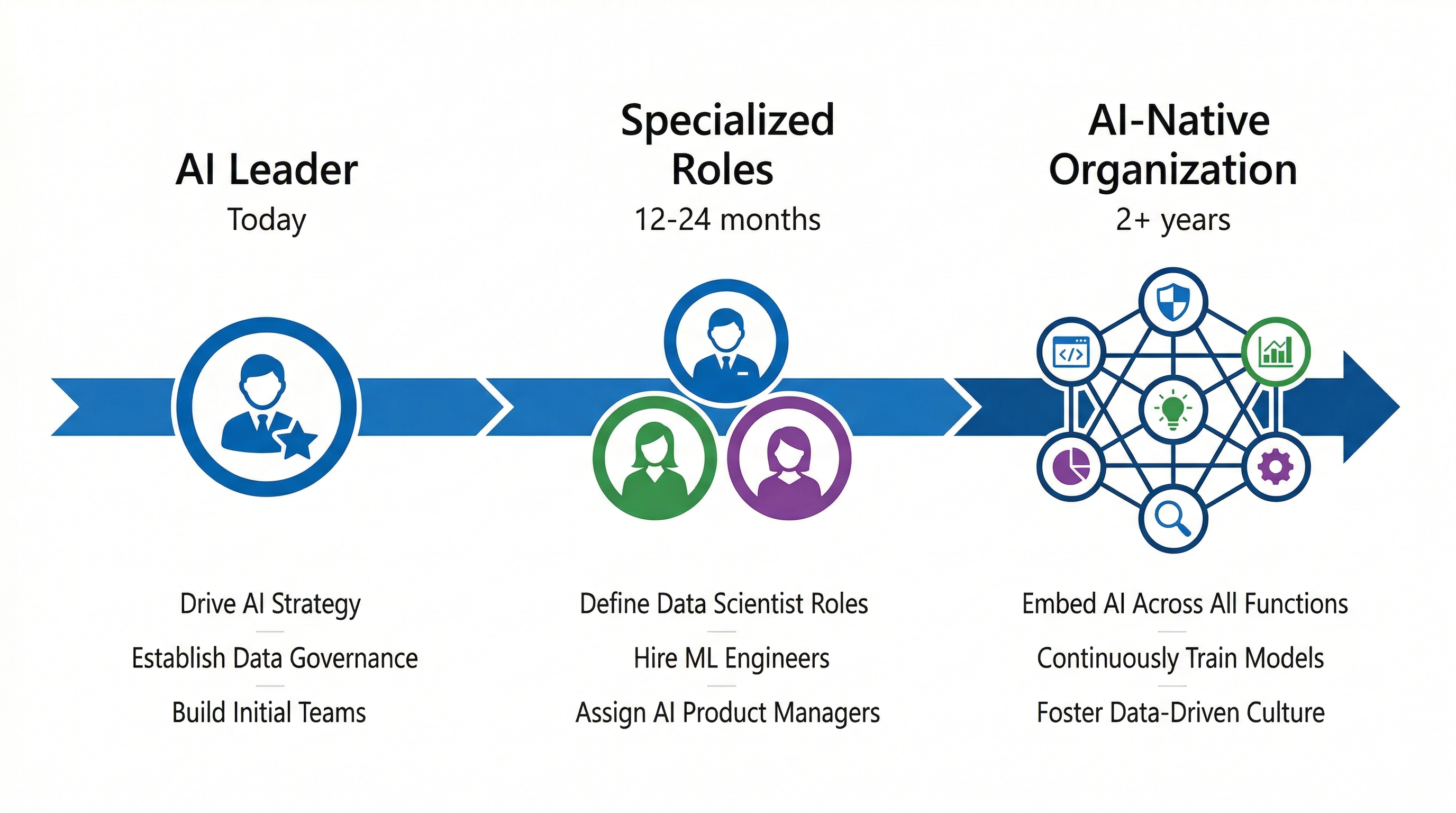
Today: the AI Leader (one person, many hats)
In an SMB with 20-50 employees, one person covers governance, coordination, and training. It's sustainable because AI projects are few and focused. The external consultant supports the technical and strategic side.
12-24 months: specialized roles emerge
When the company has 3-5 active AI projects, the AI Leader can no longer cover everything. Three clusters of needs emerge:
The Builders (who implements)
- Internal Prompt Engineer: the person who structures prompts for business processes, creates reusable templates, optimizes interaction with AI tools
- Automation Specialist: who builds and maintains automated workflows (n8n, Zapier, Make), integrates APIs, connects systems
The Strategists (who decides)
- AI Product Owner: defines what to automate and with what priority, based on the impact/feasibility matrix. In an SMB, this often coincides with the evolved AI Leader
- Data Steward: who handles the quality of data feeding AI. No data scientist needed: someone who ensures CRM data, ERP data, and shared folders are clean and structured
The Guardians (who controls)
- AI Risk Manager: monitors compliance (AI Act, GDPR), manages incidents, updates policy. In smaller SMBs it's an additional hat for the AI Leader; in larger ones it becomes a dedicated role
- AI Trainer/Coach: trains new hires, manages periodic team updates, handles AI onboarding
2+ years: the AI-native organization
SMBs that reach this level have AI integrated into all processes. It's no longer a "project": it's how the company works. At this point, AI figures aren't separate roles but distributed competencies. Each department has its own automations, prompts, and workflows. The AI Leader becomes a Chief AI Officer (in miniature) coordinating the overall strategy.
Not all SMBs reach this point, and not all need to. The point is that the journey is progressive: you don't need to hire 6 new figures tomorrow. You need to start with one trained person and a clear method.
Mistakes I See Repeating
"Let's hire a full-time external AI Expert" In a 30-person SMB, a full-time AI Expert doesn't have enough work to justify the cost. After 6 months of initial setup, they become underutilized. The formula that works: internal AI Leader + external consultant on-demand.
"The IT Manager is the right person" Not necessarily. The IT Manager handles infrastructure, network, security. The AI Leader manages processes, people, policy. Different competencies. Sometimes they overlap, often they don't.
"Let's buy the tools first, then think about who manages them" This is the fastest way to waste budget. 40% of data entered into AI tools contains sensitive information (source: Cyberhaven). Without a policy and someone to enforce it, the operational and legal risk is real.
"We don't need an AI Leader, we only use ChatGPT" If employees use ChatGPT (or Claude, or Gemini) on personal accounts, the company already has an AI governance problem. It just doesn't know it yet. The AI Leader exists precisely to transform wild usage into structured usage.
Frequently Asked Questions About AI Roles in Companies
How much time does an AI Leader spend on the role? In SMBs under 50 employees, the AI Leader dedicates about 20-30% of their time to this role, maintaining their original responsibilities. It's not a full-time role until the company exceeds 5 concurrent active AI projects.
Do you need a certification to become an AI Leader? No. There are no recognized certifications for this role (and be wary of anyone selling them). What's needed is a practical coaching path with an experienced consultant and a tested operational framework. Competence is built in the field, not in a classroom.
What's the difference between AI Leader and Chief AI Officer? The AI Leader is an operational internal role in an SMB, often part-time, focused on governance and coordination. The Chief AI Officer (CAIO) is a dedicated C-level role, typical of companies above 200-500 employees, with strategic responsibilities across the entire organization. Today's AI Leader can become tomorrow's CAIO as the company grows in AI maturity.
Where do I start to understand if my company needs an AI Leader? If at least 3 people in the company use AI tools (even just ChatGPT), you already need an AI Leader. The first step is measuring current AI maturity with a structured assessment.
Where to Start
| Your situation | First step |
|---|---|
| "I don't know how AI-mature we are" | Free AI Readiness Assessment to measure maturity across 5 areas |
| "I want to understand how to structure an AI journey" | Read how AI consulting for SMBs works |
| "I'm ready, I want to train my AI Leader" | Contact us for a free 30-minute call |
| "I want to see how the full journey is structured" | Explore AI consulting for SMEs |
The future of work with AI isn't replacing people. It's giving the right people the right role to manage the change. And that role, in your SMB, is called AI Leader.