AI Consulting for SMBs in Italy: How to Choose the Right Partner and Avoid Wasting Money
Most AI projects in SMBs fail for lack of method, not technology. Here's how to choose the right consultant, the 4 phases of a structured AI project (3 to 6 months), and mistakes to avoid.


AI consulting for SMBs is a structured journey, typically lasting 3-6 months, that guides small and medium businesses through AI adoption starting from team training, through process mapping, to defining internal AI governance. It's not selling a tool, it's building a method.
Most of the AI projects we see fail in SMBs do not fail because of the technology: they fail because there is no method. The problem isn't finding a tool: there are plenty, and many are free. The problem is knowing where to start, what to automate, and how to do it without disrupting operations.
If you're looking for an AI consultant for your business, you've probably already run into two extremes: big consulting firms proposing six-figure projects, and freelancers who configure ChatGPT and disappear. There's a gap in between.
This article explains what to expect from a serious AI consultancy, how to identify a reliable partner, and the concrete steps to bring AI into your company without wasting budget.
Whether you're based in Milan, Rome, or anywhere in Italy, the approach is the same: a serious AI consultant works both remotely and on-site across the country, and starts from your processes, not from a tool.
TL;DR
AI consulting for an SMB is a structured journey of 3 to 6 months in four phases: team training (weeks 1-3), process mapping (3-7), analysis and design (7-12), governance and hypercare (12-24). Projects that fail do not fail on the technology, they fail on the lack of method: the tools exist and many are free, what is missing is knowing where to start. SMBs that adopt AI through a structured path record up to 40% time savings on the processes they optimize, with measurable benefits landing between month three and month six and a return on the first processes usually within 90 days. The market splits into three tiers: freelancers charging a few hundred euros who configure a tool and disappear, big consulting firms charging tens or hundreds of thousands with timelines out of scale for an SMB, and partners built for SMBs in between. In this guide: how to recognize a reliable consultant, the four phases with real timelines, what it actually costs, and what the first step looks like.
Why Italian SMBs Can No Longer Postpone AI
2026 is the year AI stops being an experiment and becomes a measurable competitive advantage. SMBs that move now have a window: tool costs are accessible, direct competitors in most cases haven't started yet, and results come in weeks, not years.
But there's a critical point many ignore: if your processes aren't digitalized, you can't automate them with AI. You can't feed an AI agent a process that currently lives on sticky notes, emails, and phone calls. The good news is that AI itself can accelerate digitalization: mapping workflows, identifying bottlenecks, proposing digital structure. In practice, AI helps you build the foundation on which AI itself will operate.
The numbers are clear: SMBs that introduced AI with a structured approach report up to 40% time savings on optimized processes. Not on everything, not on anything, but on the right processes chosen with criteria.
What "AI Consulting" Actually Means for an SMB
When we talk about AI for businesses, we're not talking about ChatGPT. ChatGPT is a tool, like a drill. But a drill doesn't build your house.
Enterprise AI operates on three progressive levels:
-
Conversational AI (Prompt and Response): the user asks a question, AI responds. The classic ChatGPT model. Useful for copy, research, document drafts. But it always requires human input for every single action.
-
Workflow Agent: AI executes multi-step procedures autonomously on known steps, but requests human approval at critical points (Human-in-the-Loop). Example: an agent that receives a supplier email, extracts data, updates the ERP, and drafts the response. You approve, it executes.
-
Personal Assistant / Agentic AI: an assistant that detects missing information, proactively asks what it needs, and can execute actions directly on your systems. It's no longer automation, it's configurable autonomy.
A serious AI consultancy takes you through these levels progressively, starting from where you are today. It doesn't sell you level 3 when you're still at level 0.
If you want to see concrete use cases, we've collected the 7 processes to automate with AI in an SMB, with typical costs and ROI.
How to Choose the Right AI Consultant (and Spot the Wrong Ones)
Signs of a reliable consultant
- Starts with listening, not with a solution. Before proposing any tool, they come to your company, observe processes, talk to the people who execute them (not just those who designed them). On-site shadowing.
- Has a structured method with milestones. A serious AI project runs 3 to 6 months and has defined phases: initial training, process mapping, solution design, governance, and support.
- Includes training as the first step. You can't adopt AI if the team doesn't know what it is, what the risks are, and how to use it safely. Training isn't an add-on, it's the prerequisite.
- Talks about security and compliance. 40% of data entered into AI tools contains sensitive information (source: Cyberhaven). A serious consultant discusses AI Usage Policy, business/enterprise licenses, AI Act classification, and data protection before discussing automation.
- Shows measurable results. Not vague promises, but KPIs: hours saved, errors reduced, processes digitalized, ROI within 90 days.
Red flags
- Proposes a specific tool immediately without having seen your processes
- Doesn't mention team training
- Ignores security and data privacy topics
- Promises results without having done an assessment
- Has no plan for the "after": governance, policy, internal coaching
The 4 Steps of an AI Project for SMBs (3 to 6 Months)
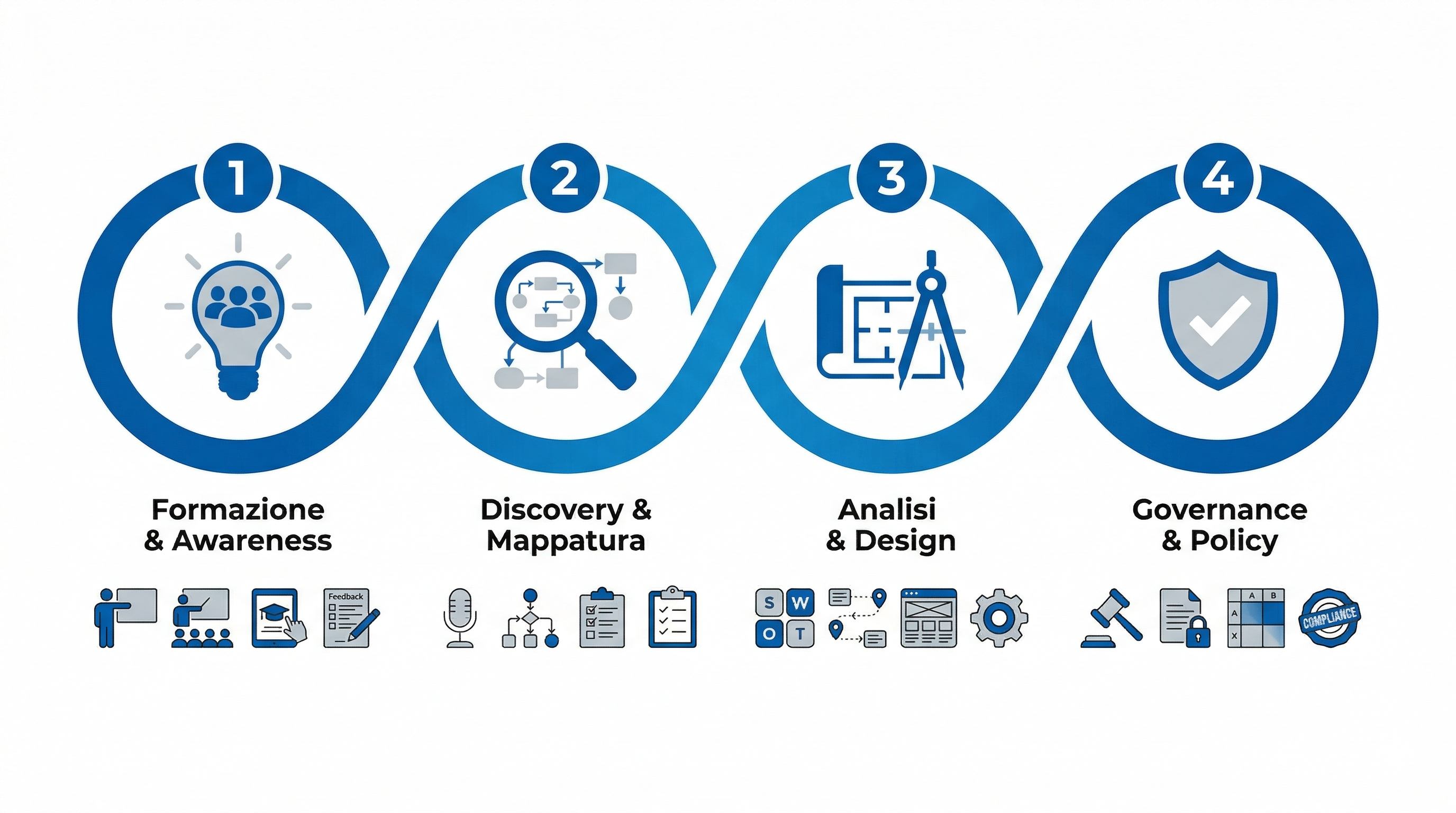
Phase 1: Training and Awareness (weeks 1-3)
Everything starts with training. The team needs to understand what AI is (and what it isn't), what the real risks are (hallucinations, data leaks, bias, skill atrophy), and how to use tools safely.
Includes:
- AI history and fundamental terminology
- Security: what should never be shared with an AI tool
- AI-powered social engineering (perfect phishing, voice cloning, deepfakes)
- Tool comparison (Gemini, ChatGPT, Claude, Perplexity): which one for what
- Prompt engineering framework for reliable results
- Practical exercise: each person maps what they do, what they'd like to stop doing, what they'd like to start doing, and where AI could help
This phase is critical: skip it and the project fails. Companies that adopt AI without training the team end up with expensive tools nobody uses. Training is now a legal obligation, too: here's the checklist for mandatory AI training and the funds that pay for it.
Phase 2: Discovery and Mapping (weeks 3-7)
The consultant enters the company and observes real processes (not documented ones, which are always different). On-site shadowing, interviews, census of AI tools already in use (often there are employees using ChatGPT secretly with personal accounts). The method for drawing the workflows is swimlanes built with AI.
Output:
- AS-IS swimlane diagrams of key processes
- Tools and risks inventory
- Gap map between documented process and actual process
Phase 3: Analysis and Design (weeks 7-12)
Workshop with management to define priorities. Not everything should be automated: an impact/feasibility matrix is used to select processes with the best benefit-to-effort ratio.
Output:
- TO-BE swimlane diagrams with redesigned processes
- AI Act classification (see what kicks in on 2 August 2026)
- Vendor scouting and pilot cards for selected solutions
- Implementation plan with milestones and KPIs
Phase 4: Governance and Hypercare (weeks 12-24)
The phase everyone forgets and that makes the difference between a project that works and one that dies after 3 months.
Includes:
- Company AI Usage Policy (what's allowed, what isn't, with which tools)
- Internal AI Leader coaching (the person who becomes the AI reference in the company)
- AI Literacy plan for the entire team
- Periodic procedure verification
- Final results presentation with measured ROI
How Long Before You See Concrete Results
With a structured method, the first tangible results arrive by Phase 2 (month 2): simply mapping real processes and auditing unauthorized AI usage reveals immediate risks and opportunities.
Measurable operational benefits (time savings, error reduction) materialize between month 3 and month 6, with average savings up to 40% on optimized processes.
The real long-term value is Phase 4: a company with an AI Usage Policy, an internal AI Leader, and a trained team no longer depends on the consultant to evolve. The goal isn't to create dependency, but autonomy.
A real case. Appkeep, an Italian SMB, took this path using AI as a second layer of control: it streamlined timelines and reduced non-conformities without disrupting operations. The CEO explains what changed in the full case study.
How Much Does AI Consulting Cost for an SMB
There's no single price: it depends on process complexity, how many people need training, and the level of autonomy you want to reach. But to orient yourself, the market splits into three tiers:
- Freelancers and micro-agencies (a few hundred euros): they set up a tool or a few prompts. Cheap, but they leave no method: when the freelancer disappears, so does the know-how.
- Big consulting (tens to hundreds of thousands of euros): solid method, but projects designed for large enterprises, with timelines and budgets out of scale for an SMB.
- Structured partners for SMBs (in between): they combine the method of big consultancies with sustainable costs, working in phases with measurable KPIs and ROI. This is where we position ourselves.
The right question isn't "how much does it cost", but "how much does it return". A well-run project pays for itself through hours saved and errors avoided, usually within 90 days on the first processes. And the cost can often be reduced with incentives for AI in SMBs, from tax credits to grants and funded training. Before committing budget, you can estimate the return with the free ROI calculator and validate feasibility with the AI consulting service, which starts with a no-commitment pre-assessment.
Where to Start: Your Concrete First Step
If you're reading this article, you're probably in one of these situations:
| Your situation | First step |
|---|---|
| "I don't know if my company is ready for AI" | Free AI Readiness Assessment - 5 minutes, PDF report with recommendations |
| "I have a project idea but don't know if it's worth it" | Free AI ROI Calculator - calculate costs, payback and 5-year projection |
| "I want to understand how a structured journey works" | Discover the CompanyTech BattlePlan - strategic assessment in 4-8 weeks |
| "I want to see your AI consulting service" | AI Consulting for SMBs - complete journey from training to governance |
| "I'm ready, I want to talk to someone" | Contact us - free 30-minute call |
Frequently Asked Questions About AI Consulting for SMBs
How long does an AI consulting project for an SMB take? A structured project takes 3 to 6 months, including process digitalization. The first concrete evidence (identified risks, mapped processes) emerges by the second month.
Do I need to train the team before introducing AI? Yes, it's the prerequisite. Without training on risks (hallucinations, data leaks, bias) and how to use tools safely, the project fails. Companies that skip training end up with expensive tools nobody uses, or worse, employees sharing sensitive data on personal accounts.
My company hasn't digitalized its processes yet. Can I still use AI? You can't automate a process that lives on sticky notes and emails with AI. But AI can accelerate digitalization itself: mapping workflows, identifying bottlenecks, proposing digital structure. In practice, AI helps you build the foundation on which it will then operate.
What's the difference between a Workflow Agent and a Personal AI Assistant? A Workflow Agent executes multi-step procedures with human approval at critical points (Human-in-the-Loop). A Personal Assistant has configurable autonomy: it detects missing information, proactively asks what it needs, and can execute actions directly on your systems without continuous intervention.
How do I know if my AI consultant is reliable? A reliable consultant starts with listening (on-site shadowing), includes training as the first step, discusses security and compliance before automation, and has a structured method with milestones and measurable KPIs. If they propose a tool immediately without seeing your processes, that's a red flag.
Who is Castaldo Solutions and how does it run an AI consulting project? Castaldo Solutions is a technology consulting firm registered in Milan with operations in Pavia, Italy. It works with Italian SMBs of up to 50 employees, where the decision maker is the owner or the CEO. Its method, the CompanyTech BattlePlan, is adapted from TOGAF ADM and runs in 4 phases over 4 to 8 weeks, with KPIs defined upfront and ROI measurable within 90 days. The first step is a free Pre-Assessment.
AI isn't a passing trend. It changes the way we work. But it only works if you start from the method, not the tool. And the method always starts with people.