AI in Business: How Efficiency and Work Are Changing in Italian SMEs

87% of AI projects never make it to production. Yet your employees are already using ChatGPT, Copilot or Gemini every day, with or without your approval. The problem is not the technology: it is the absence of strategy, governance and skills.
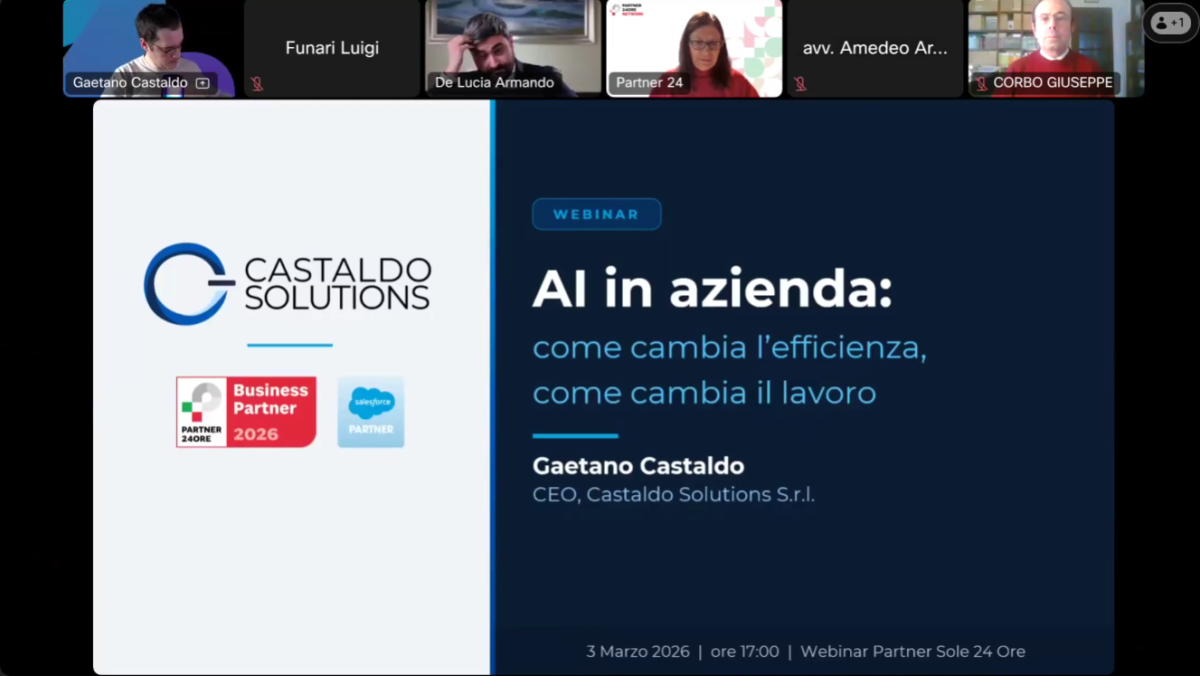
On March 3, 2026, I held this webinar as an official Business Partner of Sole 24 Ore: the network selected by Il Sole 24 Ore to provide educational and consulting content to Italian businesses. What follows is a structured summary of the content, designed for those who want to understand where to start and how to do it sustainably.
The Scenario: Italy Is Falling Behind, Very Behind
The numbers are clear. According to DESI 2024, only 45.8% of the Italian population aged 16 to 74 has at least basic digital skills. The EU average is 55.6%. The European target for 2030 is 80%.
We have not yet completed basic digitization, and we are already facing the AI revolution.
Three statistics that should concern every manager:
- 87% of AI projects never make it to production (Gartner)
- 60% of companies have never conducted an AI risk assessment (RiskConnect 2025)
- $67.4 billion in global losses in 2024 attributed to AI hallucinations (AllAboutAI)
The conclusion is simple: AI is already in your company as a "shadow" technology. Your employees use it on their own, without rules, without supervision, without training. This amplifies chaos instead of reducing it.
Where AI Creates Real Value, Department by Department
Based on the projects we follow, here are the changes observed across different departments:
HR & Recruiting: Automated resume screening, personalized onboarding, intelligent management of internal requests. Selection times are significantly reduced.
Finance & Admin: Automatic reconciliation, real-time reporting, predictive cash flow analysis. Manual errors decline and teams focus on strategic analysis instead of copy-pasting.
Marketing & Sales: AI-generated content, predictive lead scoring, at-scale outbound personalization. Content production speed increases and conversion rates improve.
Operations: Intelligent ticketing, workflow automation, predictive maintenance. Repetitive requests decrease and downtime is reduced.
Legal & Compliance: Automatic contract review, accelerated due diligence, continuous regulatory monitoring. Review times drop and compliance oversight becomes more thorough.
IT & Development: Assisted coding, auto-generated documentation, automated testing. Team productivity increases and production bugs decrease. Concrete example: +30% delivery in 3 months with agentic coding adoption.
The key point: AI doesn't work if the underlying process is broken. Without solid processes, AI amplifies chaos. You need a method, not just a tool.
Before/After: What Changes in Daily Activities
Here is the most immediate and visible transformation:
| Activity | Before | After |
|---|---|---|
| Create a document | Hours or days of work | 1/10 of the time |
| Data analysis | Manual processing | Real-time insights |
| Reports | Copy-paste from multiple sources | Auto-generated |
| Write from scratch each time | Intelligent drafts, human review |
Attention: you need skills to guide AI, not to replace people. The highest value today comes from team-level AI agents, which support each individual in their daily work, keeping the human at the center of the process, in line with AI Act requirements.
The HALO Effect: Why Those Who Don't Evolve Become Commodities
The AI Economy introduces a concept I call the HALO Effect (Heavy Asset Low Obsolescence): physical assets (real estate, machinery, infrastructure) have high durability of value and low obsolescence. Digital services, by contrast, are subject to accelerated cost inflation and rapid obsolescence.
This applies to services delivered by professionals as well. Those who don't integrate AI into their offerings risk becoming commodities: replaceable and interchangeable.
The answer is a two-phase journey:
- Change as professionals: update skills and mindset, learn to work with AI, become supervisors instead of executors.
- Evolve services: integrate AI into every process, reduce obsolescence of offerings, create hybrid human + AI services.
The 3 Competencies to Bring to Your Company Now
To launch an effective AI adoption path, you need three cross-functional competencies:
Data Awareness: Data is the foundation of every AI project. Before thinking about algorithms, you must ask yourself: are my data clean? Do I have an automated system to feed them? Without reliable data, any AI model produces unreliable results.
AI Thinking: Thinking in terms of automation means identifying repetitive activities and asking: is it automatable? Can I have an AI agent do it? This approach delivers immediate value with contained investments.
Digital Governance: Define rules, supervision processes and control metrics. If you don't have an AI Leader in your company, you need to create one. Compliance and accountability must be formalized, not left to chance.
AI Act: The Obligations Companies Ignore (and the Penalties)
The AI Act is not a future problem. Some provisions are already in effect as of February 2, 2025.
Article 4 That All Companies Overlook:
"Providers and deployers of AI systems shall adopt measures to ensure an adequate level of AI literacy of their personnel." (Art. 4, EU Regulation 2024/1689, original wording)
Since July 27, 2026, Regulation (EU) 2026/1744 has rewritten the article: it now requires taking measures to support the development of AI literacy, without guaranteeing a level. The obligation still applies to all companies using AI, even just ChatGPT. It is not limited to IT: training must involve all personnel, and it pays to document it. Failure to train is an aggravating factor in case of other violations.
Key Deadlines:
| Date | Status | What Takes Effect |
|---|---|---|
| Feb 2, 2025 | Already in effect | General provisions + prohibited practices |
| Aug 2, 2025 | Already in effect | Transparency, operational sanctions |
| Aug 2, 2026 | Imminent | Main body of Regulation |
| Aug 2, 2027 | Final deadline | High-risk systems (Art. 6) |
The Penalties:
- Up to 35 million euros or 7% of global revenue for prohibited practices
- Up to 15 million euros or 3% of revenue for operational obligations
- Up to 7.5 million euros or 1% of revenue for inaccurate information
For SMEs and startups, amounts are proportionate but still significant.
The Italian AI bill adds specific criminal penalties: imprisonment from 1 to 5 years for deepfake without consent, general aggravating circumstances for using AI in illegal activities, and up to 6 million euros for market manipulation via AI.
How to Get Started: 4 Phases for a Realistic Approach
You don't need to revolutionize everything. You need a method.
01. Start with the problem, not the technology. Identify the processes where you lose the most time and where errors cost the most. Don't buy technology and then search for a problem to solve.
02. Start small, measure, scale. A pilot project with clear KPIs. If it works, expand. If not, correct. The goal is measurable ROI within 90 days.
03. Train people, not just IT. AI works when people understand it and use it with confidence. Training is not a cost: it is a regulatory obligation and an investment with direct returns.
04. Govern first, automate later. Compliance, supervision, accountability. Define the rules of the game before you put players on the field. Then technology follows.
Available Funding: Cost Should Not Be an Obstacle
Regions are investing concrete funds to bring AI competencies to businesses:
- Lombardy: up to 10,500 euros in grants (100%) for AI training and digital skills; up to 50,000 euros at 90% for corporate continuous training
- Umbria: active, already operating on digitization and training projects
- Lazio: coming with regional voucher re-funding
We work with specialized partners to identify and access the regional grants best suited to each company.
Frequently Asked Questions About AI in Business
Does AI in business work for SMEs or only for large enterprises?
Yes, and SMEs often achieve proportionally superior results. Large companies have more processes to transform and more organizational resistance. An SME of 20-50 people can launch a pilot project, measure ROI in 90 days and scale quickly. The requirement is not size: it is data quality and clarity of objectives.
Where is it best to start adopting AI in business?
From the process that costs you the most in time and errors. Not from technology. Identify a repetitive activity (data reconciliation, email classification, document screening) with sufficient volume to make improvement measurable. Launch a pilot with defined KPIs, measure results within 60-90 days, then scale.
Does the AI Act also apply to SMEs using only ChatGPT or Copilot?
Yes. Article 4 of EU Regulation 2024/1689 (in effect as of February 2, 2025) requires all companies using AI systems to take measures to support their personnel's AI literacy: since July 27, 2026 it is an obligation of effort, no longer one to ensure an adequate level. This includes SMEs, even if they only use consumer tools like ChatGPT. Failure to document training is an aggravating factor in case of other wrongdoing.
How much does it cost to introduce AI in business?
It depends on the scope. A pilot project on a single process (email automation, internal support, data analysis) can start from a few thousand euros. Many Italian regions offer non-repayable funding specifically for AI training and digitization: in Lombardy up to 10,500 euros at 100% just for the training component. The real cost to calculate is the cost of doing nothing.
How is AI business ROI measured?
The most immediate KPIs are: hours saved per person per week, reduction in manual errors, reduction in time-to-decision. They convert to economic value by multiplying by cost/hour and by the number of people involved. Our AI ROI Calculator does it automatically: enter your data and get an estimate of expected returns.
Where to Start Right Now
If you've made it this far, you already have the answer: don't wait. Every week without an AI strategy is an advantage handed over to your competitors.
The first concrete step is to understand where you stand. You can do this with two free tools:
- AI Readiness Assessment: evaluates your company's readiness on data, skills, infrastructure and governance
- AI ROI Calculator: quantifies expected returns based on your processes and number of people involved
If you prefer a direct conversation, our AI consulting for SMEs starts with a free 30-minute session: we analyze your situation together and identify the 2-3 interventions with the highest ROI over the next 90 days.