MCP Servers: What They Are and Why They Change Everything for SMBs

In October 2024 Anthropic published the Model Context Protocol specifications. Within months, OpenAI, Google, and practically every relevant player in the sector had adopted it. This didn't happen out of mutual courtesy: it happened because the protocol solves a real problem that no one had addressed in a structured way before.
This article explains what MCP servers are, how they change the relationship between AI assistants and business tools, and why for Italian SMBs they represent probably the most accessible digital transformation of the last twenty years.
What Are MCP Servers (Model Context Protocol)
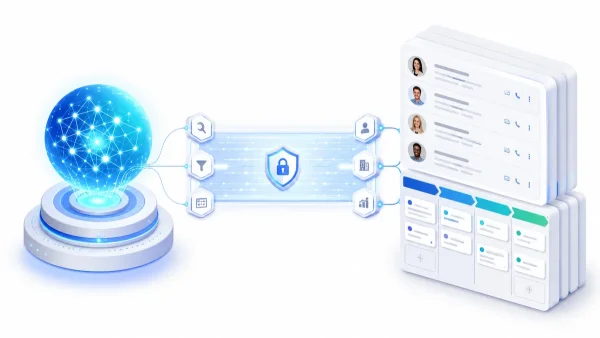
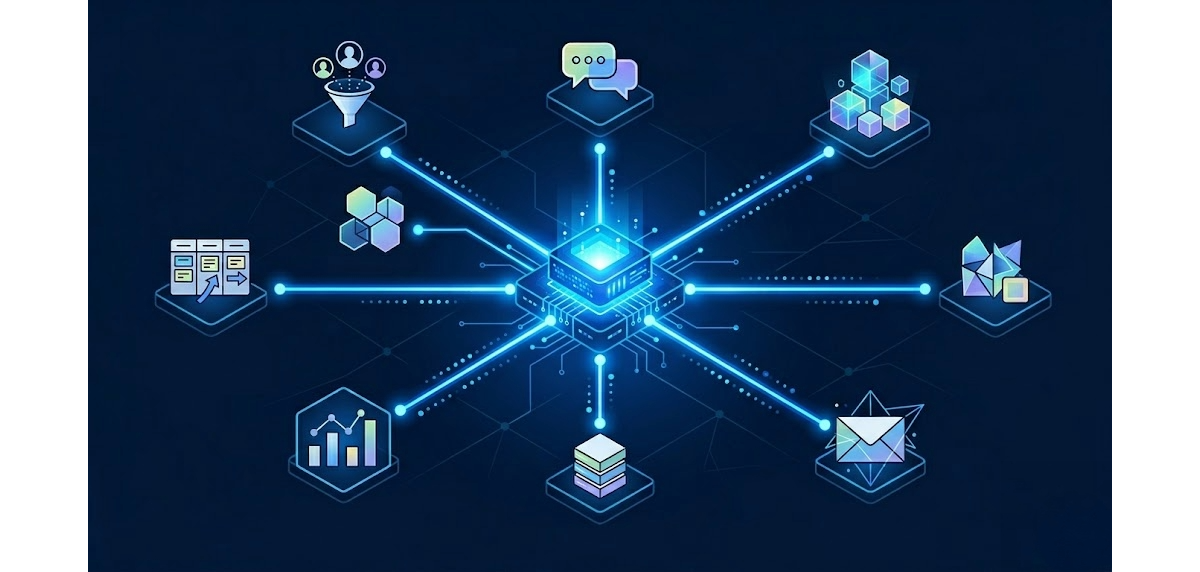
An MCP server is a standardized intermediary that allows an AI assistant like Claude to communicate directly with external tools: CRM, databases, calendars, management systems, business APIs. Instead of copying and pasting data from one system to another, the protocol defines a common language that any AI can use to access any tool in real time, during a natural language conversation.
In technical terms: the MCP exposes a system's functions as "tools" that the AI can invoke. Claude asks for data, the MCP server retrieves it, Claude processes it and responds. No export, no copy-paste, no dashboard to learn.
The protocol is open source, published by Anthropic in October 2024 and adopted within months by OpenAI, Google DeepMind, and Microsoft. It followed the same adoption path as MCP for Claude Code skills: created by Anthropic, became the industry de facto standard.
How an MCP Server Works: The Flow in 4 Steps
The flow is simpler than it sounds:
- You install or build an MCP server for your tool (CRM, management system, database)
- The server exposes functions as tools that Claude can use ("find customer", "create opportunity", "generate report")
- You talk to Claude in natural language: "give me the revenue of active customers this quarter"
- Claude queries the server, gets the data, and responds by processing it
The interface is no longer the dashboard: it's the conversation.
What an MCP Server Does in Your Company: Use Cases by Department
This is the most practical question. Here's how MCPs change work across typical SMB departments:
| Department | Typical Operation | With MCP |
|---|---|---|
| Sales | Search for opportunities in the CRM, filter by status | Ask in Italian, get the list with analysis |
| Administration | Export data for periodic reports | Report generated directly in conversation |
| Operations | Check order status or open tickets | Natural language query, instant response |
| Management | Aggregated dashboard from multiple systems | An assistant that aggregates and interprets in real time |
| IT | Test APIs, verify configurations | Direct interrogation through Claude without writing code |
The common denominator: operations that previously required technical skills or deep system knowledge become accessible to anyone who can ask a question.
My First MCP: How n8n Convinced Me
The first MCP server I used was n8n, the workflow automation platform. Through the MCP, I can create and test automations in natural language directly from Claude, without opening the GUI.
That was the moment I understood that something structurally different was emerging in the AI community. It wasn't just another integration: it was a different way of interacting with systems.
From there, the decision to build a custom MCP was just a small step away.
Why I Built an MCP for VTENext CRM (and How Long It Took)
The concrete case came with a client. There was a need to have administration and operational managers talk directly to their CRM (VTENext) through Claude as an assistant. Impossible without a server built from scratch.
The alternatives didn't exist: no public MCP for VTENext, complex but documented API, departments without technical skills. The only way was to build following a precise path: development, testing, system integration, production.
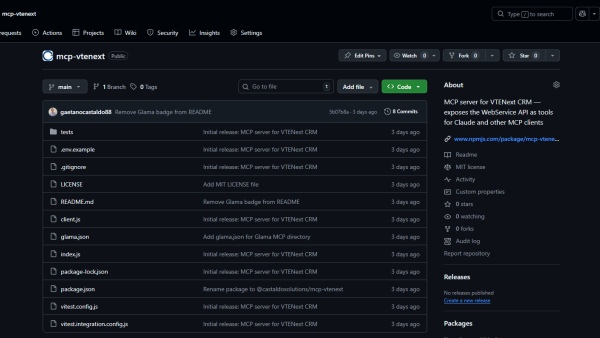
Development time: 2 days. The result is now available open source on npm and GitHub. If you want to do it on your own CRM, I collected the full process, with code and a directory of tested CRM MCP servers, in the practical guide to connecting Claude to your CRM.
The operational change was immediate: Claude analyzes the CRM metadata, verifies the meaning of tables through data analysis itself, creates if necessary a dedicated skill to memorize that knowledge, and then operates. The sales manager asks "who are active customers with more than three open opportunities in the last 90 days?" and gets the answer, without going through IT.
MCP Servers vs Traditional Integrations: What's the Difference
The question I get most often from people evaluating MCPs is: why not use native integrations or Zapier/Make connectors?
| Feature | Traditional Integration | MCP Server |
|---|---|---|
| Setup | Predefined flows, fixed logic | Natural language, adaptive |
| Skills Required | IT or no-code specialist | Anyone who can ask a question |
| Flexibility | Limited to anticipated cases | Unlimited (AI interprets the request) |
| Setup Cost | Monthly subscription per connector | Open source server, one-time cost |
| Maintenance | Updates with every API change | Stable as long as the system's API doesn't change |
| Output | Raw data or notifications | Analysis, synthesis, reports in natural language |
The difference isn't technical: it's conceptual. A traditional integration executes predefined actions. An MCP server lets the AI reason about data and answer questions you didn't anticipate.
What Is Context Rot and Why It's the Main Risk of MCPs
Context rot is the progressive degradation of AI response quality as the context window fills up over a session. As the context approaches the limit, older information loses influence: the AI "forgets" initial instructions and produces less accurate, less coherent, sometimes contradictory responses.
With MCPs the problem is amplified: each tool call adds context (the server response, metadata, logs). In intensive sessions with many queries, context fills up fast.
The most dangerous consequence concerns write operations: an AI in context rot that has access to modify or delete functions can perform operations it shouldn't have, because it's lost track of the original context of the request. It's not a theoretical case: it's a risk I actively manage with clients in production.
The rule we apply today: MCPs in production should be used predominantly for reading and analysis. Write operations require a human approval layer until context management becomes more mature in the ecosystem.
MCP as Industry Standard: Opportunities and Current Limitations
The Model Context Protocol is adopted by OpenAI, Google DeepMind, Microsoft, and practically every relevant player. It's the standard by which AI systems connect to external tools in 2025-2026.
Opportunity: MCP servers built today will remain compatible with future models, regardless of vendor. It's an investment in the ecosystem, not in a single product.
Current limitation: the protocol generates significant context at each interaction. This creates entropy in the work session and accelerates context rot. The community is working on solutions (context compression, stateful sessions), but today the issue requires attention in every MCP design.
The prediction is that those who adopt MCP in the next 12-18 months will have an assistant that cuts access times to their business tools in half. For Italian SMBs, it's the first truly accessible digital transformation: not six-figure budgets, not months of project. Days of development, open source tools, immediate impact.
What's About to Change: What's Coming for the MCP Protocol
The problem described above, context rot amplified by MCP calls, is right at the center of the protocol's next revisions. The most concrete change concerns the session token: today, every session between an MCP client and server requires state management that adds complexity and consumes context at every exchange. The protocol's next versions aim to eliminate this complexity, making stateless calls possible: the client no longer has to generate and maintain a session token, each call authenticates and completes on its own.
The direct consequence is less context used at each interaction. Less context means less ground for the context rot described above, and it also means faster responses: an MCP that doesn't have to carry the session state along with every call processes less unnecessary data and returns the useful data sooner. For anyone running MCPs in production, as I do, this is the right direction: performance improves exactly where the protocol loses the most ground today. If you want to see where MCP fits among the rest of the Claude Code toolset, the right place to start is Claude Code: the complete guide: skills, CLAUDE.md, and MCP explained in the right order to get started.
Frequently Asked Questions about MCP Servers
What is the Model Context Protocol (MCP)? The Model Context Protocol is an open source standard created by Anthropic in 2024 that defines how AI assistants communicate with external tools and systems. It allows Claude and other models to query databases, APIs, and business applications during a conversation, returning real-time data in response to natural language questions. It's adopted by OpenAI, Google, and Microsoft.
Do MCP servers work only with Claude? No. The protocol has been adopted as a standard by OpenAI, Google DeepMind, Microsoft, and other vendors. An MCP server built for Claude is compatible, in principle, with any AI system that implements the standard.
How much does it cost to build a custom MCP server? A basic server for a CRM with documented REST API takes 1-3 days of development. More complex servers with advanced authentication and error handling can take 1-2 weeks. The code is open source and reusable. The main cost is development time, not licenses.
What can you do with an MCP server in your company? Analysis and reports from CRM or management systems in natural language, searching internal databases, consulting calendars and activities, checking order or ticket status, integration between different systems without custom development. Write operations in production are currently inadvisable due to context rot risks.
Are MCP servers secure? Security depends on implementation. The server exposes only the functions you choose to expose, with the permissions you configure. The main risk isn't unauthorized access but AI behavior in sessions with saturated context: this is why critical operations should be kept in read mode with human approval.
MCP server or Claude skill: what to choose? They're complementary tools. The MCP is for accessing real-time data from external systems. The skill is for configuring reusable behaviors, formats, and operating instructions. In practice, you use both: the MCP brings the data, the skill tells Claude how to process it. For practical examples from real workflows, read the 8 skills that change my work. To build your own from scratch, read how to create a Claude Code skill.
Getting Started with MCP Servers
If you have a CRM, a management system, or any tool with an API, you can now build an MCP server that makes it accessible in natural language.
The path we follow with clients in our AI services for SMEs always starts with a mapping: which tools you use every day, which data you need most often, where you lose the most time searching for information. From there, you build the server on high-impact use cases and exclude high-risk operations.
If you want to understand if and how an MCP can integrate into your business workflow, start with a conversation with us.