AI Assistants for Marketing: What Already Exists, What to Build Custom, How to Start
Second article in the AI Assistants for SMEs series: the three paths applied to marketing. Ready-made skills for video, graphics and strategy (with GitHub repos), the brand skill that must be custom built, the closed analytics-SEO loop with the human at the center, and the open source tools that run locally for compliance.

In short
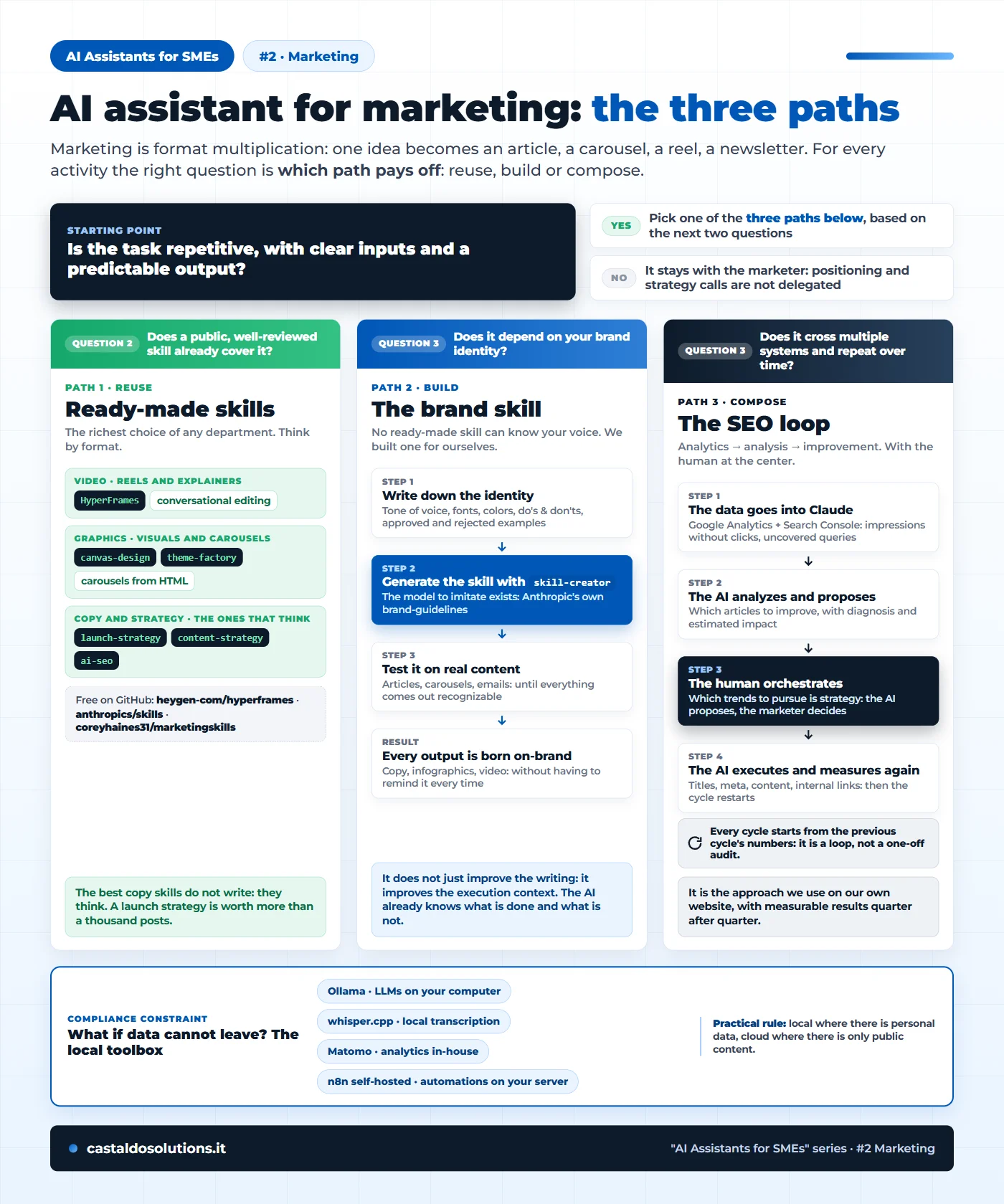
An AI assistant for marketing follows the same three paths we saw for the sales team: reuse the public ready-made skills (and marketing has more of them than any other department: video, graphics, launch strategy), build a custom one where no skill can know your company (your brand voice and identity), compose a pipeline where the activity crosses multiple systems (the analytics → SEO → improvement loop, with the human at the center). On top of that, marketing has a constraint other departments feel less: it handles customer and prospect data. So in this episode we add the open source toolbox that runs locally, for when data cannot leave the company.
Why marketing is the department where AI pays off the most
Modern marketing work is format multiplication: one idea becomes an article, the article becomes a LinkedIn post, a carousel, a newsletter, a reel, a slide for the sales team. Every step is rewriting, adapting, laying out. It is exactly the kind of repetitive, predictable-output work an AI assistant absorbs best, on one condition: it must know your brand (we get there in path 2).
If you have not read the sales episode, the core concept in one line: an AI assistant is an AI like Claude that has been given your company's context and your procedures, codified in skills (our guide on what Claude skills are covers the technical detail). And for every activity the right question is not "can AI do it?", but which path pays off: reuse, build or compose.
Path 1: ready-made skills for video, graphics and strategy
For marketing, the choice of public skills is the richest of all. Instead of a flat list, it pays to think by format.
Video (reels, explainers, social assets). This is where AI has made its most recent leap, and we say it from direct experience: this is how Castaldo Solutions videos are produced. There are two tools:
- HyperFrames: an open source framework (Apache 2.0, no per-render fees) where the AI writes a video the way it writes a web page: HTML in, MP4 out. Animations, subtitles, voiceover, music. It was built specifically for AI agents, and with the right skills Claude produces complete motion graphics and explainer videos.
- Conversational editing: the second skill we use lets you manipulate existing footage by talking to the AI: "cut the first 12 seconds", "add subtitles", "fix the colors". For a marketer who today pays an editor for every minor change, it is a category shift.
Graphics (visuals, carousels, themes). From Anthropic's official repository:
canvas-designcreates posters and static visuals with an actual design philosophy, not clip art.theme-factoryapplies consistent themes (colors, fonts) to slides, documents and landing pages.- We produce LinkedIn carousels with the same flow as the infographics you see in this series: the AI generates the graphic as HTML and exports it as an image, repeatable and always on-brand.
Copy and strategy (few skills, high value). From the marketingskills collection (~36,000 stars on GitHub) we already used for sales, the three most valuable for marketing are not the ones that write, but the ones that think:
launch-strategybuilds the complete launch strategy for a product or feature: channels, sequence, checklist. Far more value than a plain copywriter.content-strategydecides what to publish and why, before writing anything.ai-seooptimizes content to get cited by ChatGPT and Perplexity, the topic we covered in our guide on how to appear in ChatGPT answers.
Path 2: the brand skill. Why we built one for ourselves
In the sales episode, the "custom by necessity" case was the quote generator. In marketing it is your brand voice and identity, and here we tell our own story: the skill we internally call castaldo-branding.
Inside it there is everything that makes the brand recognizable: tone of voice (informal address, direct, never corporate), fonts and colors, graphic rules, the do's and don'ts, examples of approved and rejected copy. What surprises people who watch it work is that it does not just improve the writing: it improves the execution context. Whatever the assistant produces (an article, an infographic, a carousel, an email) is born already fitted to the brand, without anyone having to remind it every time. It already knows what is done and what is not done.
It is not just our idea: Anthropic itself maintains a brand-guidelines skill in its official repo that applies its own brand to any output. You cannot reuse that skill (it is Anthropic's brand, not yours), but it is the model to imitate: the process is the same four steps we saw for the quote generator, documented in our guide on how to create a skill. Write down the identity (if you already have a brand book you are halfway there), generate the skill, test it on real content, hand it to the team. The extreme result of this approach is the CL-AI-RA case, the system that writes content autonomously while staying on brand.
Path 3: the closed analytics → SEO → improvement loop
The pipeline that matters most for marketing is not linear like the salespeople's post-meeting: it is a cycle that repeats, and we describe it with confidence because it is how we work on our own website, with measurable results quarter after quarter.
- Start from the data: Google Analytics and Search Console go into Claude (via scripts or connectors). Which pages get impressions but no clicks? Which emerging queries are we not covering?
- The AI analyzes and proposes: a ranking of the articles to improve, with the diagnosis (weak title, outdated content, missing keyword) and the estimated impact.
- The human orchestrates: here is the point that enthusiastic AI stories always skip. Deciding which directions to pursue, which trends fit the company's positioning and which do not, remains a strategy call. The AI proposes, the marketer decides.
- The AI executes: rewrites titles and meta descriptions, updates approved content, consolidates internal links.
- Measure again on the next cycle, and the loop restarts.
The difference compared to "doing SEO once" is all in the word loop: every cycle starts from the numbers of the previous one. And the marginal cost of one cycle, with the assistant doing analysis and execution, is a fraction of a traditional audit.
What if data cannot leave? The local toolbox
Marketing handles email lists, browsing data, recordings of interviews and focus groups: personal data, often belonging to customers. This is where this episode differs from the usual AI tool lists: there is a generation of open source tools that run entirely on your computer or your server, where data never leaves the company perimeter.
- Ollama (~170,000 stars on GitHub): runs language models directly on the marketer's computer. Drafts, rewrites and analysis on customer data without anything going to an external cloud.
- whisper.cpp: local speech transcription. Customer interviews, focus groups, webinars: your customers' voices never get uploaded to any third-party service.
- Matomo: the open source alternative to Google Analytics, with data on your own server. It is among the few web analytics tools the French data protection authority (CNIL) has approved for use without a consent banner, in the correct configuration.
- n8n self-hosted: marketing automations run on your server, with credentials and data in-house. We run it this way on our own infrastructure, and our guide n8n vs Zapier vs Make explains when it makes sense.
The practical rule we give clients is simple: local where there is personal data, cloud where there is only public content. Local models are less capable than the best cloud models, so it makes no sense to use them to write a post: it makes sense to use them where the constraint is confidentiality, not prose quality. And in any case, the rules on what never to upload to an AI apply.
Where to start: three steps for your marketing
- Start with path 2, not path 1. For marketing the order flips compared to sales: without the brand skill, every output of the ready-made skills will be generic and need redoing. Identity first, production second.
- Pick one format and industrialize it. A single flow (for example: article → carousel → post) brought to full speed is worth more than ten experiments. The video and graphics skills of path 1 come in here.
- Turn on the analytics loop when you have volume. The path 3 cycle pays off when there is traffic to analyze: if the site is young, produce first with paths 1 and 2, then measure and improve.
The fastest way to understand which assistants your team needs is our free AI Team Builder: a few questions, and you get the recommended team of AI assistants for your company. On the tools front, our guide to AI tools for multilingual marketing completes the picture. If you would rather start with a direct conversation, our AI consulting for SMEs service helps you map the three paths onto your specific case.
This is the second article in the AI Assistants for SMEs series, after the one dedicated to salespeople: the next one will cover administration.