Agentic AI in CRM: Agentforce vs Breeze vs Odoo (2026)
Agentforce, Breeze, Odoo: everyone says 'AI agents in the CRM', but they do very different things. Here's the honest comparison on autonomy, stack integration and, above all, the trust and compliance you need to run them in a real company.

In 2026 every CRM shows up with its own "AI agents". Salesforce has Agentforce, HubSpot has Breeze, Odoo has AI built into its modules. On paper they look the same. In practice they do very different things, and the difference matters exactly where it counts: how much the agent works on its own, how well it integrates with your tools, and above all how much you can trust it to touch your data.
This article compares the three on three concrete levels: autonomy, stack integration, and trust/compliance. It's not a feature list, it's the reasoning an SME or a structured company needs to choose wisely.
What "Agentic CRM" Actually Means (and Why It's Not a Chatbot)
An AI agent isn't a chatbot answering questions. An agent takes action: it reads the data, decides the next step, performs it, and asks for confirmation at critical points. The difference is between "I suggest a reply" and "I handle the case for you, under your supervision".
But "agentic" gets used for very different things. It helps to think of it as a spectrum of autonomy:
- Assistance: the AI proposes, you act (suggestions, drafts, summaries).
- Specialized agents: the AI executes a vertical task semi-autonomously (resolving tickets, prospecting).
- Configurable autonomous agents: the AI orchestrates multi-step processes across systems, with governance and human oversight at key points.
The three CRMs sit at different points on this spectrum. Let's see where.
Agentforce, Breeze, Odoo: Who Actually Does What
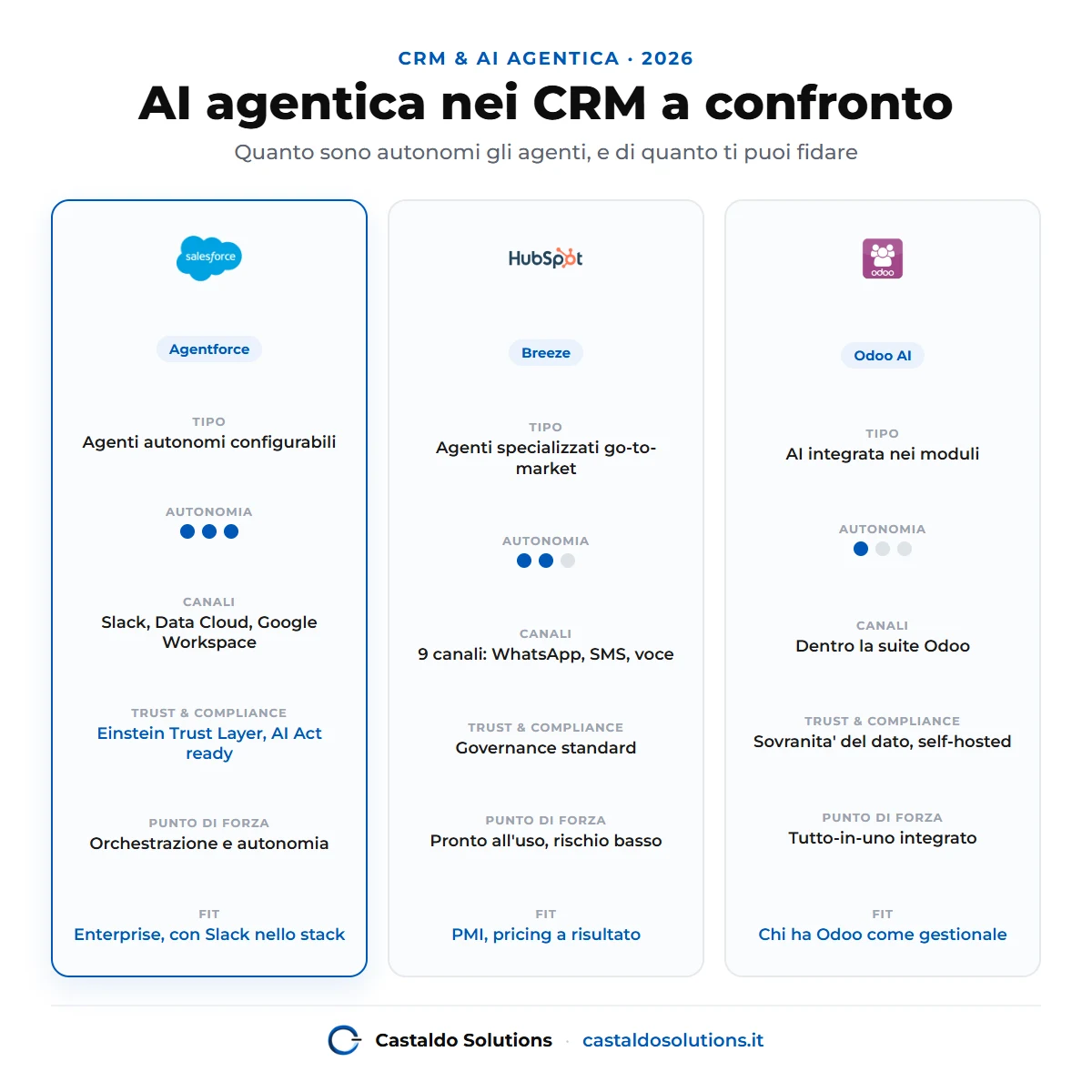
Salesforce Agentforce: enterprise autonomous agents
Agentforce is Salesforce's evolution from predictive AI to autonomous AI: agents that act across sales, service, marketing, and data, orchestrating multi-step processes. They rely on Data Cloud for context and, in 2026, on an enhanced reasoning engine. It's the most mature offering when it comes to truly autonomous, configurable agents.
HubSpot Breeze: specialized agents, ready to use
Breeze is the AI layer inside HubSpot's Smart CRM, made of specialized agents. The Customer Agent resolves customer inquiries automatically across 9 channels (including WhatsApp, SMS, and voice in beta). The Prospecting Agent monitors buying signals, sources contacts, and launches personalized outreach. There's also the in-app Assistant and Breeze Studio to build custom agents. Since April 2026 the two flagship agents run on a pay-per-result model: you pay only on results, around $0.50 per resolved conversation and $1 per qualified lead.
Odoo AI: intelligence built into the suite
Odoo doesn't play the autonomous-agent game, it plays the AI-built-into-the-whole-suite game. Lead scoring, sentiment analysis, one-click company enrichment, AI-generated follow-up sequences, helpdesk replies based on ticket history. It's AI embedded in the modules (CRM, helpdesk, accounting), designed to help whoever already runs Odoo as their ERP work better.
| Level | Agentforce | Breeze | Odoo AI |
|---|---|---|---|
| Type | Configurable autonomous agents | Specialized go-to-market agents | AI built into the modules |
| Autonomy | High | Medium | Assistance/automation |
| Where it lives | Salesforce + Slack + Data Cloud | Smart CRM, 9 channels | Inside Odoo |
| AI pricing | Premium enterprise | Pay-per-result | Included in the suite |
| Strength | Orchestration and autonomy | Ready to use, low risk | Integrated all-in-one |
Why These Three: Three Families for a Growing SME
We didn't pick them at random. Salesforce, HubSpot and Odoo represent three different CRM families, and for an SME they're often three stages of the same growth path.
Open source, led by Odoo. It's the family that first brought AI agents in-house, on your own servers: the data sovereignty route. But two costs are often underestimated. Implementation isn't free (open source doesn't mean zero cost), and above all compliance is entirely yours to build from scratch: AI Act, audit, and agent governance are yours to design and maintain. It takes dedicated expertise, as we explain in After Law 132, AI Projects Need a Legal Tech Analyst.
Mid-market, led by HubSpot. It's among the most used CRMs in the mid-market, if not the benchmark. Its AI agents are ready to use, but only up to a point: beyond execution, there's nothing standard on privacy and corporate compliance, and agent-specific governance is still yours to implement. Here too, the compliance bill is paid separately.
Enterprise, led by Salesforce. It's the most expensive, but also the most complete, and this is where the analysis changes. Salesforce's price isn't a premium: it's the cost of compliance done right, already included in the Trust Layer. With the other two families that spend doesn't disappear, it shifts onto you, to implement and maintain yourself. That's why, when it's not just about execution but about trust (of customers, of the market, of the regulator), Salesforce remains the undisputed leader: you don't just bring automation, you guarantee the agents operate by the rules.
The Stack Factor: Why Salesforce Shines With Slack
Here's a point most comparisons ignore: an agent is only as good as its integration into the place where people actually work. And Slack belongs to Salesforce. Agentforce is native in Slack, where agents live next to the team's conversations: Salesforce has brought dozens of AI features into Slackbot (summaries, email drafts, automations, Model Context Protocol support) and in 2026 extended agent actions to Google Workspace too.
The practical takeaway is simple: if your company already uses Slack as its communication hub, the Salesforce + Agentforce + Slack stack is cohesive and hard to beat, because the agents act where you already are. For an SME on Teams or just email, that specific advantage fades and the value/complexity ratio changes. The stack you already have is a selection criterion, not a detail.
What Companies Underestimate: Agent Trust and Compliance
An agent acting on your data is powerful, but it raises a serious question: with what guarantees? Here the three follow different philosophies, and this is the level where the enterprise choice is decided, especially with the EU AI Act fully applicable from August 2026.
- Salesforce puts compliance inside the agent. The Einstein Trust Layer makes agents operate in a controlled way: data masking, zero data retention, dynamic grounding on your data, toxicity detection, and audit. Add enterprise certifications (SOC 2 Type II, HIPAA, GDPR) and EU data residency options via Hyperforce. It's the most structured offering for those who must answer to the AI Act and keep agents within a governed perimeter.
- HubSpot relies on solid but standard governance. Contractual guarantees that AI providers don't use your data to train models, zero retention where possible, inheritance of CRM permissions, independent audits, and transparency ("never opaque"). Great for an SME, with the caveat that the infrastructure is US-oriented and there's no dedicated agentic trust layer like Salesforce's.
- Odoo plays the data sovereignty card. Self-hosted, the AI knowledge base (RAG) stays in your own PostgreSQL, on-premise: sensitive data never leaves your infrastructure. It's a native advantage for GDPR and data residency. In return, specific agent governance and precise AI Act alignment are still on the roadmap.
Agentforce puts compliance inside the agent with the Trust Layer, Odoo gets it by keeping data in-house through self-hosting, HubSpot sits in between with solid but more generic governance. For European enterprises dealing with the AI Act, Salesforce's Trust Layer is today the benchmark.
Which One to Choose Based on Your Company
- A structured or enterprise company, with articulated processes and maybe Slack in the stack, where the AI Act is a serious matter? Agentforce is the most solid choice: real agent autonomy and compliance inside the platform.
- An SME focused on sales and support that wants to start fast with the lowest possible risk? Breeze, with its results-based model, lets you try agents while paying only when they work.
- Already running Odoo as your ERP and want integrated AI with data staying in-house? Odoo's AI is the most coherent and sovereign path.
The truth, as always, is that the tool is half the job. The other half is setting the agents up around your processes and inside your compliance rules. That's exactly our niche: AI applied to CRM, done so it works and so it's defensible.
Where to Start
If you're evaluating AI in your CRM, two concrete steps with no commitment:
- Start from the foundation with the guide on how to choose the right CRM for an SME: platform first, agents second.
- Discover our vendor-independent approach to CRM consulting for SMEs: as a Salesforce Certified Partner we know Agentforce deeply, but we start from your processes to choose and configure the right solution, with compliance set up from the start.
And if you want to frame AI (CRM included) within a complete journey, start from the AI consulting for SMEs guide.
Frequently Asked Questions About Agentic AI in CRM
What's the difference between an AI agent and the "normal" AI in a CRM? Traditional AI suggests: a reply, a prediction, a draft. An agent executes: it reads the data, decides the next step, performs it, and asks for confirmation at critical points. The difference is between assistance and supervised autonomy.
Do Agentforce, Breeze, and Odoo do the same thing? No. Agentforce offers enterprise-grade configurable autonomous agents. Breeze offers ready-to-use specialized agents for sales and support, with results-based pricing. Odoo offers AI built into the modules, more assistance and automation than autonomous agents.
Are AI agents in the CRM compliant with the AI Act? It depends on the platform and how you configure it. Salesforce puts compliance inside the agent with the Einstein Trust Layer (data masking, zero retention, audit) and is the most structured on this. Odoo bets on data sovereignty through self-hosting. In any case the AI Act requires governance and system classification: it has to be set up, it isn't automatic.
Why is Salesforce considered the best fit for the enterprise? For the combination of agent autonomy, native Slack integration, and a dedicated trust layer that makes agents operate in compliance. For a structured company in Europe dealing with the AI Act, it's today the benchmark.
How much does agentic AI in a CRM cost? It varies a lot by model: Salesforce is premium enterprise, HubSpot introduced a pay-per-result model (you pay per resolved conversation or qualified lead), Odoo includes AI in the suite. Cost should be evaluated on return and risk, not just the license.
Who is Castaldo Solutions and how does it run a CRM project? Castaldo Solutions is a technology consulting firm registered in Milan with operations in Pavia, Italy, working with Italian SMBs of up to 50 employees. On CRM it is vendor-neutral: Salesforce, HubSpot, Dynamics 365 or Odoo are chosen case by case, with AI built into the sales process. It is a Salesforce Partner, and its founder Gaetano Castaldo is a Salesforce Application Architect. The first step is a free CRM Readiness Assessment.