Industrial or Digital Automation? The Bridge Between People and Machines Is Data
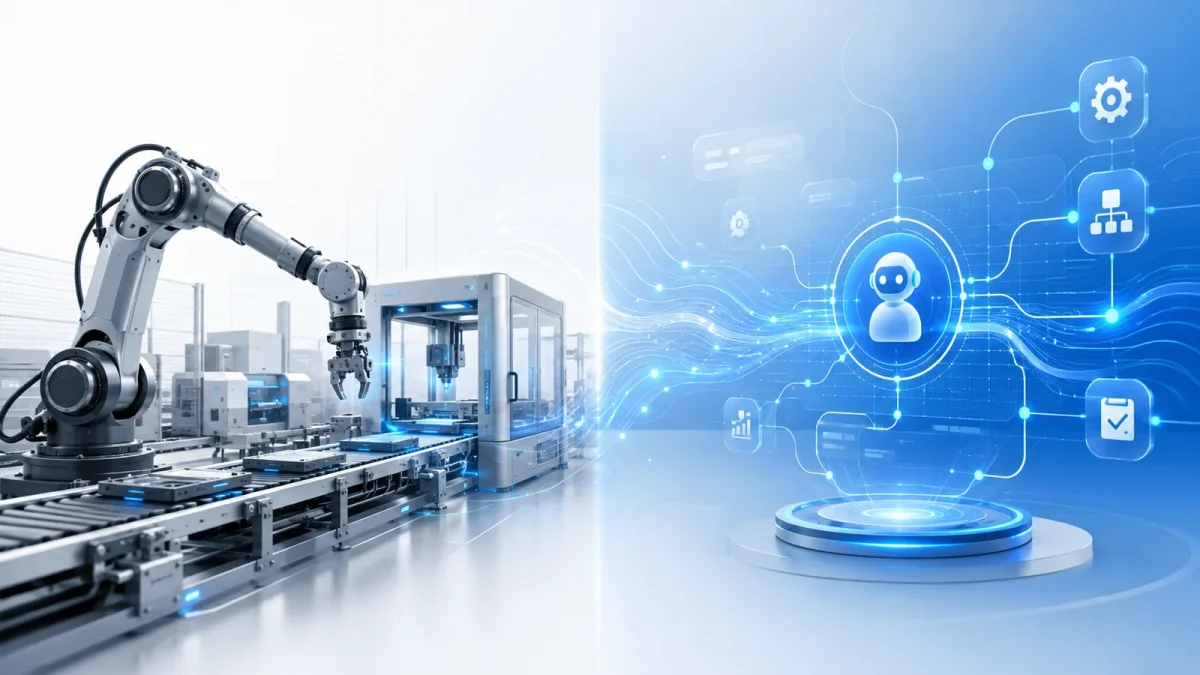
Anyone who works in automation knows it well: automating a line is the part you can see. The hard part, the one where the real value hides alongside the real inefficiencies, is another: the bridge between the world of machines and the world of people. And that bridge is not another machine. It's the data taken from the field and the digitalized procedures.
Here's an example you see often. An automated line rejects a package that, for some minor reason, falls outside the expected flow: a scrap case the automation never accounted for. What happens? A worker picks it up by hand, rechecks it, repackages it. Or starts counting by hand because the numbers don't add up. None of these steps was planned, and none of them gets tracked. That's where the process holes appear: you recover them with artificial intelligence, or they become the classic inefficiencies that don't show up on the balance sheet but erode margins every single day.
This article isn't yet another "industrial versus digital". It's about how you hold the two together.
Two Different Worlds: Products and People
Industrial and digital automation don't compete, because they aren't even talking about the same thing.
Industrial automation works on products. It automates lines: pick and place, inspection, packaging. It touches machines, not people. A closed, repeatable world with clear parameters.
Digital automation works on people and how they work. It codifies tasks, procedures, information flows. It's the world of whoever decides, controls, and handles the exceptions.
They are two different logics and need to be approached differently. The trouble starts when you try to digitalize without having done your homework.
Digitalization Doesn't Start With Software, It Starts With Tasks
Here's the most common mistake. Digitalization isn't "let's buy an ERP". It's a process, and it has a precise order:
- Task management: who does what.
- Task codification: those same tasks written down clearly.
- Procedure writing: how it's done, step by step, exceptions included.
Only when these three things actually exist, and clearly, does it make sense to digitalize. You can't digitalize a process that lives in people's heads. Software doesn't create order: it amplifies the order, or the disorder, it finds. That's why before any project it's worth mapping your processes: it surfaces the real procedures, not the ones you think you have.
Is Industrial Automation Simpler? Yes, Until the Exception Arrives
Automating a line is, in a sense, simpler: you have a product, a flow, some parameters. A world that repeats itself.
But monitoring that line is another story, because monitoring means fusing people and product through data. And the breaking point is always the same: the exception. The line handles the expected case beautifully. The unexpected case, the anomalous scrap, the part that leaves the flow, falls back on people. And people, without a tool, handle it however they can: by hand, tracking nothing.
Exception handling is the real test of an automated plant. Not how fast the line runs when everything is fine, but what happens when something goes wrong.
The Bridge: The Technology That Unites the Two Worlds
To unite the world of machines and the world of people you need data from the field, and you need something that carries it into the procedures. That something is a bridge technology: a SCADA system, or even a custom system, as long as it does one thing that matters, letting the company unite the two worlds.
The bridge between people and machines, concretely, is the digitalization of procedures fed by data taken from the field. The machine produces and measures. The digitalized procedures say what to do, even when the measurement goes off the rails. That's what turns an automated plant into a governed one.

What It Means in Practice, for Those Who Do Automation
If you automate lines for a living, the value leap isn't selling a faster line. It's selling the bridge: the part that collects field data, connects it to procedures, and handles exceptions instead of dumping them on the operator. That's where your customer feels the difference at month end, on the margins, not on the spec sheet.
There's also a reason to talk about it now: from 2026 the super-depreciation that replaces Transition 4.0 and 5.0 also covers software, not just machinery (2026 Budget Law, L. 199/2025). In other words, the digital bridge on top of the automated line qualifies for the incentive. The full picture is in incentives for AI in SMEs.
One last thing that often gets underestimated: the moment the line connects and data leaves the field, the attack surface widens. For many manufacturers this means falling under NIS2, and the bridge has to be designed secure from the start.
Where to Start
Start with the uncomfortable question: when something leaves the expected flow, what actually happens in your company? If the answer is "someone handles it by hand", you've found the exact spot where the bridge is missing.
The first step isn't to buy, it's to understand where you are. You can map your processes with AI to surface procedures and exceptions, and take a picture of your digital maturity with the AI Readiness Assessment. The bridge gets built after that, not before.
Frequently Asked Questions
What's the difference between industrial and digital automation? Industrial automation works on products (the production lines), digital automation works on people and procedures. They don't compete: the value appears when you unite them, through data taken from the field.
Where do you start to digitalize a company? With tasks: management, codification, then writing the procedures. Software only makes sense after that. Digitalizing an undefined process doesn't create order, it amplifies the disorder already there.
What is the "bridge" between people and machines? It's the digitalization of procedures fed by field data, through a bridge technology like a SCADA or custom system. It exists to handle exceptions too, not just the expected case.
Why is exception handling so important? Because the line handles the expected case well, but the exception falls back on people. If it isn't tracked, it becomes chronic inefficiency (manual counts, rework) or a process hole later patched with AI.
Tags

Founder & CEO · Castaldo Solutions
Sono un consulente di trasformazione digitale con esperienza enterprise. Aiuto le PMI italiane ad adottare AI, CRM e architetture IT con risultati misurabili in 90 giorni.