Automated Video with AI: Why Vibe Coding Changes Content Rules
Video editing is becoming programmable. With Claude Code, Remotion and a Human-in-the-Loop approach, content production enters a new era. The videomaker doesn't disappear: their role changes.

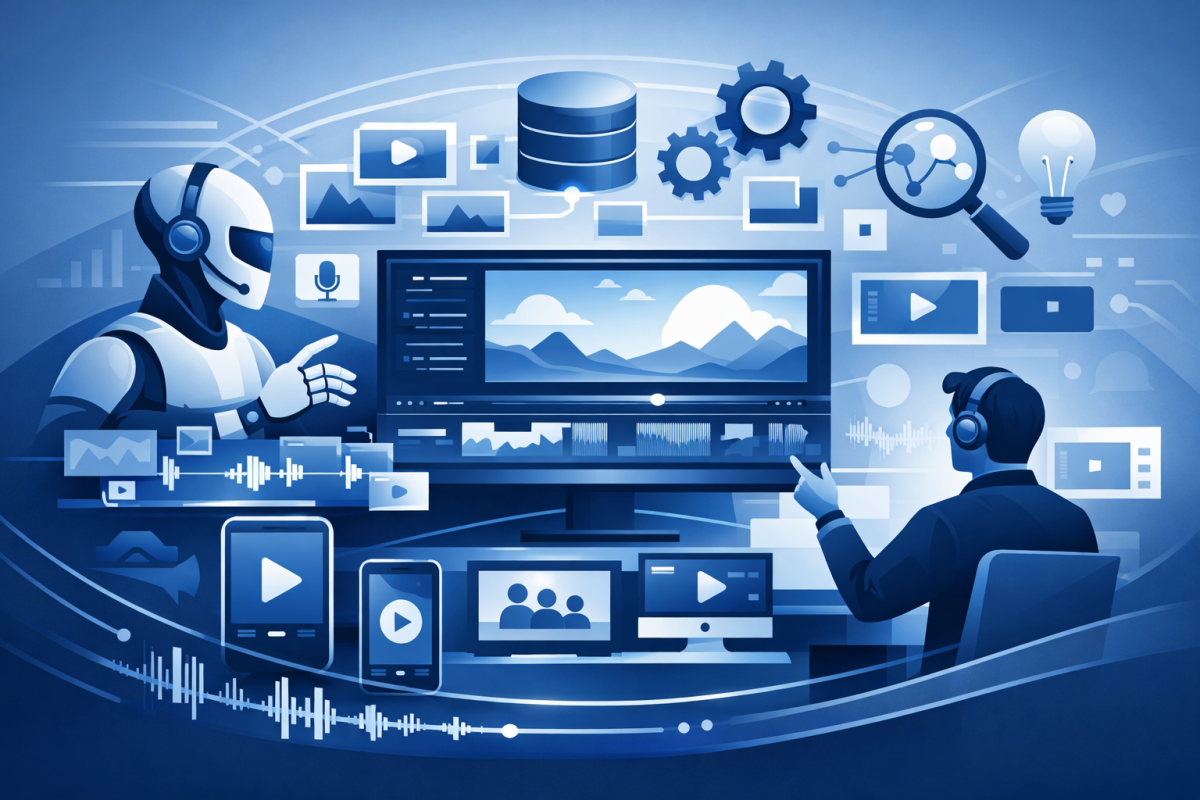
There's a moment when a technology stops being "a tool" and becomes a new mental habit. I felt it working on a video in "vibe coding" mode: instead of opening a traditional editor, I set up a flow where AI was my assistant, always available as a content creator.
The context is concrete: I used Claude Code inside Visual Studio Code to write code for Remotion, with Tailwind CSS for animations and components. The AI built storyboards, timelines and edits starting from a script and video clips.
It wasn't magic: at times I had to step in, because the code wasn't perfect. But the direction is clear: this isn't just about "making a video with AI", but about shifting editing toward a programmable and replicable form.
What programmable video editing can do today
The result, for now, was a video without audio: a complete edit on the visual level, then finished with other tools.
Here's a useful comparison to understand where we are:
- vs. consumer tools (Canva Video, Google Vids): this path already enables things difficult or impossible with drag-and-drop interfaces
- vs. professional software (DaVinci Resolve, Premiere): still more limited for color grading, audio and fine refinement
In practice: it's powerful, but not yet for everyone. It requires technical skill. For now.
From editing to automated assisted production
Here's where it gets interesting. If you connect this approach with a structured asset base:
- Database of categorized video clips
- Approved intros/outros
- Thematic B-roll
- Brand-aligned graphic elements
- Pre-validated versions
...then you're no longer talking about editing. You're talking about automated assisted production: a personal assistant that creates brand-coherent videos, adapted to channels, versioned for different formats (Instagram Reels, YouTube Shorts, LinkedIn).
When will editing become accessible to everyone?
My prediction: the jump can happen in a short timeframe, even two years.
AGI doesn't need to exist. It just needs technologies to become good enough to make the operational part economical and immediate. When operational costs crash, the economics of content changes.
Acceleration drivers:
- Increasingly capable AI models at interpreting creative briefs
- Frameworks like Remotion that turn video into code
- Constant decline in computational costs
- No-code interfaces that will come on top of these stacks
The risk for AI startups (and the lesson for companies)
Here enters a strategic theme that also touches those who invest in AI without clear governance.
Many startups fall in love with speed: "I'll solve this problem quickly with AI". It's a real advantage, but fragile. Technology gets copied, improves, commoditizes.
Lasting value is created when AI is embedded in a governed process: a Human-in-the-Loop flow where the machine handles the scalable part and the human maintains quality, context, editorial sensitivity.
The ideal model: hybrid, not fully automatic
In my case, the model isn't "fully automatic". It's an intelligent hybrid:
- The assistant autonomously chooses operational options
- Asks for approval on sensitive choices
- The human decides on publication, reputation, positioning
It's the same principle that applies to AI acceleration with governance: yes to speed, but with control.
Why videomakers won't disappear (quite the opposite)
If editing becomes easier, the need for communication doesn't disappear: it explodes.
Value shifts toward:
- Imagination and creative direction
- Content quality
- Ability to build meaning
- Editorial and brand sensitivity
Paradoxically, this democratization doesn't reduce the professional role: it transforms it.
For now these tools are better suited to technical people, developers and experienced editors willing to "enter the code" carefully. But that's precisely where evolution will come from: the strongest videomakers will become process masters, because they know what to ask the AI and how to evaluate what comes back.
The new role: workflow director
My hope is that in coming years a new hybrid role emerges in companies: someone capable of guiding content creation with AI not as a "trick", but as a system.
A role that combines:
- Method - repeatable, scalable processes
- Governance - clear rules on what can be automated
- Quality - non-negotiable standards
- Creativity - vision and editorial direction
The workflow director, not the simple tool user.
Work doesn't disappear: it moves higher
When this happens, something important occurs: work isn't eliminated, but moved toward what really matters.
Not editing itself, but communication. Not repetitive operations, but strategy. Not execution, but thinking.
It's a pattern we've already seen with AI that writes code: technology accelerates execution, but human value concentrates on direction.
The point of no return is closer than you think. The question isn't "if" video editing will become accessible, but "when" - and most importantly: will you govern the process, or suffer it?