Free AI for lawyers, on a laptop and offline: what it can do (and where it still gets it wrong)
An open model runs for free on a laptop, offline, and the firm's data never leaves. We showed it at AI Lab per l'avvocato, run by the Santa Maria Capua Vetere section of AIGA in Caserta: what it can do, where it still invents the law and what a law firm needs to use it.

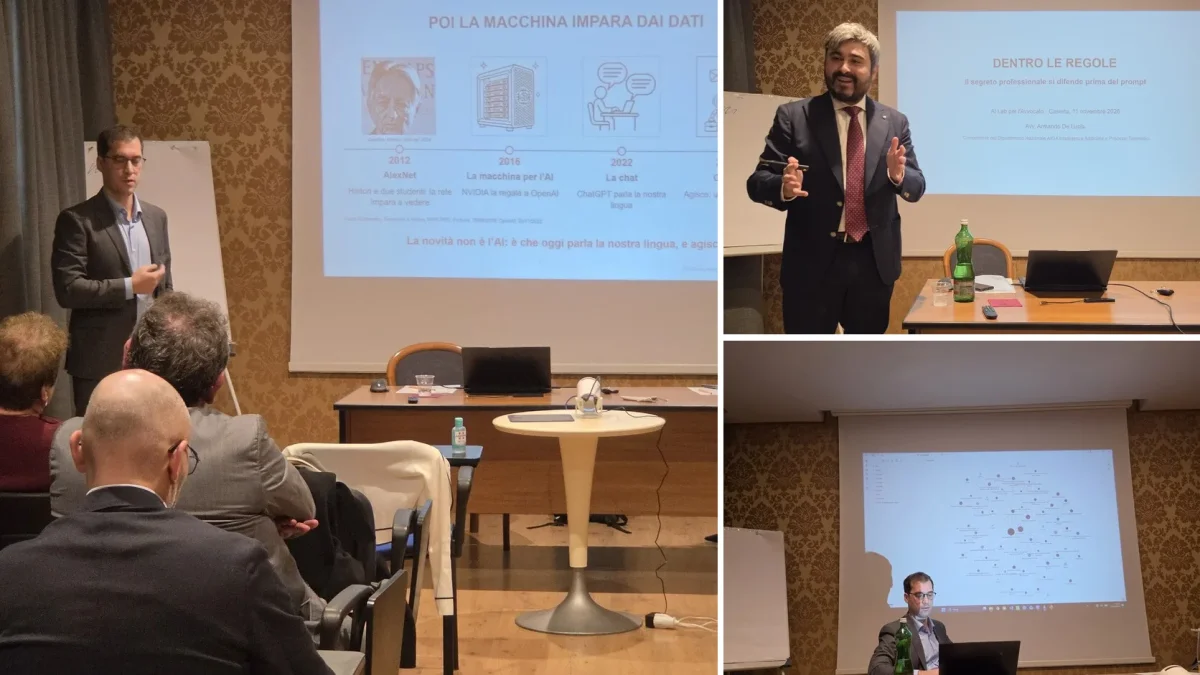
Yes, free AI for a law firm exists: an open model that runs on a laptop, offline, and keeps the data inside the firm. We showed it to lawyers in Caserta, Italy, on 11 November 2026. Without sources, though, it still gets the law confidently wrong: the model is the easy part, the real work is organised documents and rules.
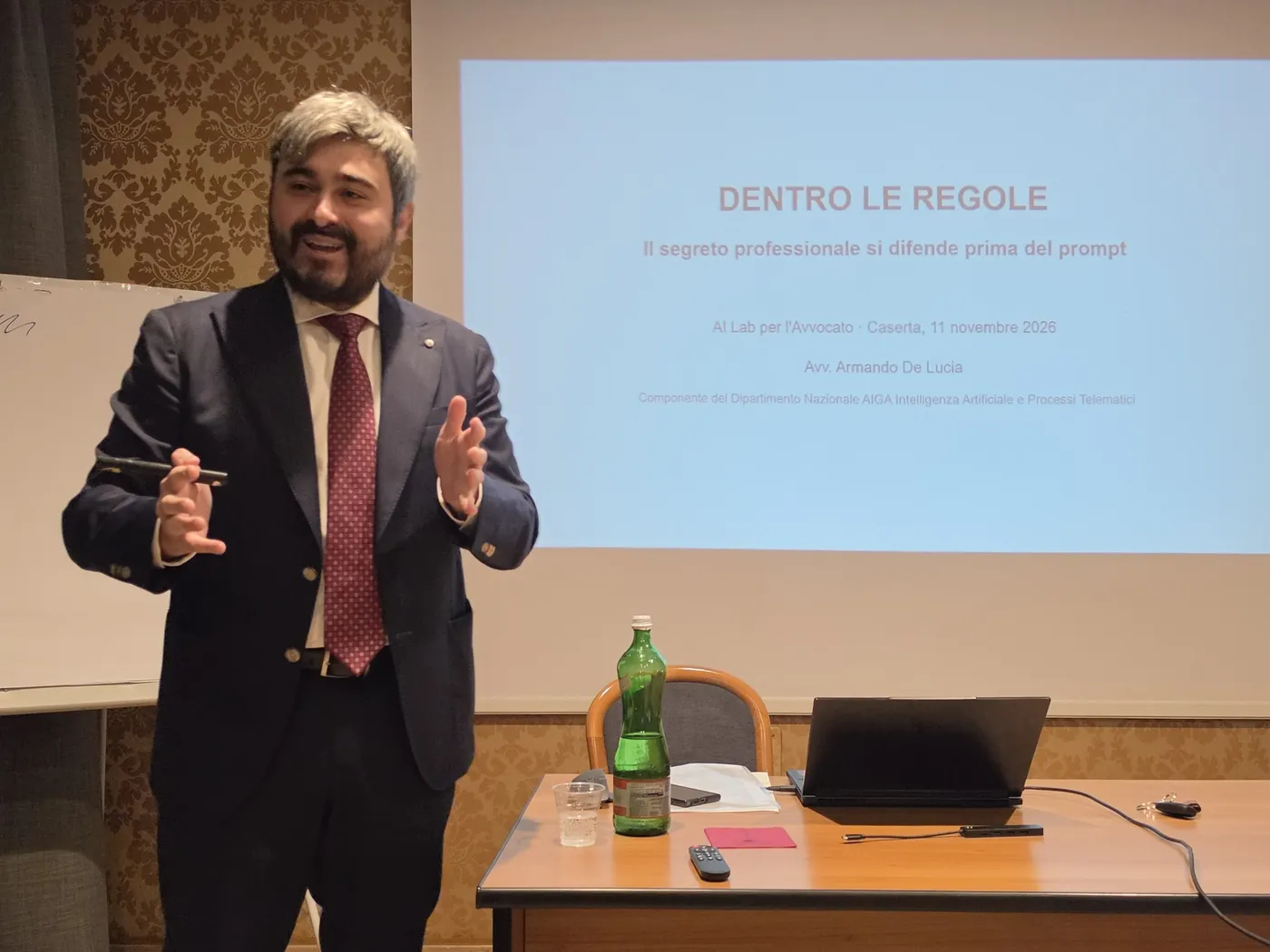
The occasion was AI Lab per l'avvocato ("AI Lab for the lawyer"), a free theory and practice lab run by the Santa Maria Capua Vetere section of AIGA, the Italian Association of Young Lawyers, under the patronage of the Santa Maria Capua Vetere Bar. I ran it with lawyer Armando De Lucia, a member of AIGA's National Department for Artificial Intelligence and Electronic Proceedings, with whom I host the podcast Innovazione Sotto Processo (I wrote up the first episode here). I covered the machine, he covered the rules; then the lab, with both of us, on a laptop with no connection.
This is not a hobbyist's topic. Since 23 October 2026, Article 47 of Legislative Decree 179/2026 requires the training organised by Italian professional bodies to include the use of artificial intelligence, from three angles: technical, legal and ethical. The national councils have six months to update their rules, until 23 April 2027. My part was the first angle.
Can a law firm use AI without its data leaving the office?
Yes, but the choice that matters is where the model runs, not which model you pick. Armando put it better than I would: "the decisive question is not which AI to use, but it is where to run it". A lawyer's prerogatives, he added, "have to be asked before the prompt", and managing these tools is the responsibility of whoever runs the firm.
A firm has three roads, and each one puts confidentiality in a different place:
| Road | Where the data goes | Who guarantees confidentiality |
|---|---|---|
| The free chat, for example ChatGPT Free | To the provider. On OpenAI's personal plans it can be used to train the models, unless you opt out (OpenAI) | Nobody: the provider's terms apply, and the provider can change them |
| The business version, for example ChatGPT Business or Enterprise | To the provider, but by default it does not train the models (OpenAI) | A contract |
| The model in-house | It stays in the firm | The firm, which also takes on the machine's security |
OpenAI pages read on 8 November 2026. For filings and case files the first road is the wrong one, for the same reasons there are things a company should never upload to ChatGPT. The CCBE, the Council of Bars and Law Societies of Europe, makes the same comparison in its technical guide of 27 March 2026, between a local model, an own data centre, cloud infrastructure and a subscription service. Armando turned it into a rule for the firm: for filings, case files and credentials "there is no way around it". Either the lawyer controls the machines directly, because they are in-house, or an external data processor gives contractual guarantees.
There is also a risk no slide captures well, and I have seen it up close. I was once asked to recover the data from an account on an AI service: it was a personal account, and nothing could be done. If the person who uploaded a confidential document leaves, the document leaves with them. A firm account does not remove the risk, but at least the data stays with the firm.
What computer do you need to run AI locally, and what does it cost?
The model and the software are free; the machine is not. In the room I used a laptop with an 8 GB graphics card and an open model with 9 billion parameters (Qwen3.5 9B, compressed to 4 bits), run with free software such as Ollama and LM Studio. I told the room this is not the setup I recommend for a firm: mine is "not a hobby, but experimental for now". A firm's machine has to be sized on the number of people using it.
I measured what fits in 8 GB on 8 November 2026, with LM Studio on the same laptop:
| What uses the graphics card memory | GB |
|---|---|
| The model | 5.2 |
| Image reading, which LM Studio loads anyway | 0.9 |
| The conversation, up to about 16,000 word pieces (tokens) | 0.5 |
| Working space for the computation | 0.3 |
| Windows and the driver | 0.4 |
| Free | 0.7 |
The model fits; the whole archive does not. That is why the AI does not read every note: it searches them and only takes the ones the question needs. For a few people using it every day you need roughly 16-32 GB: OpenAI, for example, states that the smaller of its open models, gpt-oss-20b, runs "within 16GB of memory" (model card). For the whole firm you need a dedicated machine: NVIDIA's DGX Spark, a desktop computer built for local AI, went up to a list price of 4,699 dollars in February 2026 (NVIDIA). The comparison with the alternatives is in on-premise AI for SMEs.
Why does AI invent laws and court rulings?
Because it does not look for the true answer: it picks the most likely word. On the lab laptop, given the Italian sentence "The judge dismissed the…", Qwen3.5 9B gives "appeal" a 64% probability and "my" 13% (measured on 8 November 2026): it continues a plausible text, it does not reason about the law. Anyone who claims to know exactly how it reasons, I told the room, should know that not even one of its fathers fully does. Geoffrey Hinton, 2024 Nobel laureate in physics, said so on 60 Minutes on 8 October 2023: they designed the learning algorithm, and the networks it produces are complicated and good at what they do, "but we don't really understand exactly how they do those things".
The tests we prepared for the lab on 8 November 2026 show it clearly:
- Insult and defamation, without sources. The model answers in 8 seconds and knows that insult is no longer a crime in Italy, but credits the change to a "Law 204/2021", and on another run to a "Law 109/2016". The real one is Legislative Decree 7 of 15 January 2016. Armando had presented the same test in Naples in April 2025; we ran it again in November 2026.
- The same question, with sources. Given Article 595 of the Criminal Code and Decree 7/2016, it cites the source of every sentence, explains that insult is now a civil offence with a fine and says what the sources do not say.
- A formal notice from a client sheet. The letter is well written, but it contains a date that is not in the sheet. A rule-based automatic check caught it, not the model.
- The same question three times about the odds of winning a case. Over two rounds, six different percentages: 95%, 90% and 92%, then 92%, 85% and 90%. A percentage written by a model is not a calculation.
This is not a lab problem. Damien Charlotin's database, updated on 10 November 2026, counts 2,288 decisions worldwide involving AI-invented content in filings and proceedings, 15 of them Italian. Sources reduce errors but do not remove them: in a 2024 study by Stanford RegLab and HAI, source-grounded legal research assistants from Lexis and Westlaw were wrong between 17% and 33% of the time. Those products are two years old, but the rule holds: sources always, checks always.
How do you query a firm's archive with a local AI?
With an archive of linked notes and a model that asks permission before searching them. This is the test we ran live. To avoid client data, we built the archive on Armando, with his consent: 64 notes written only from public pages (his website, his firm's, the podcast, news of his talks), read on 8 November 2026. No social media, no contact details, no private life.
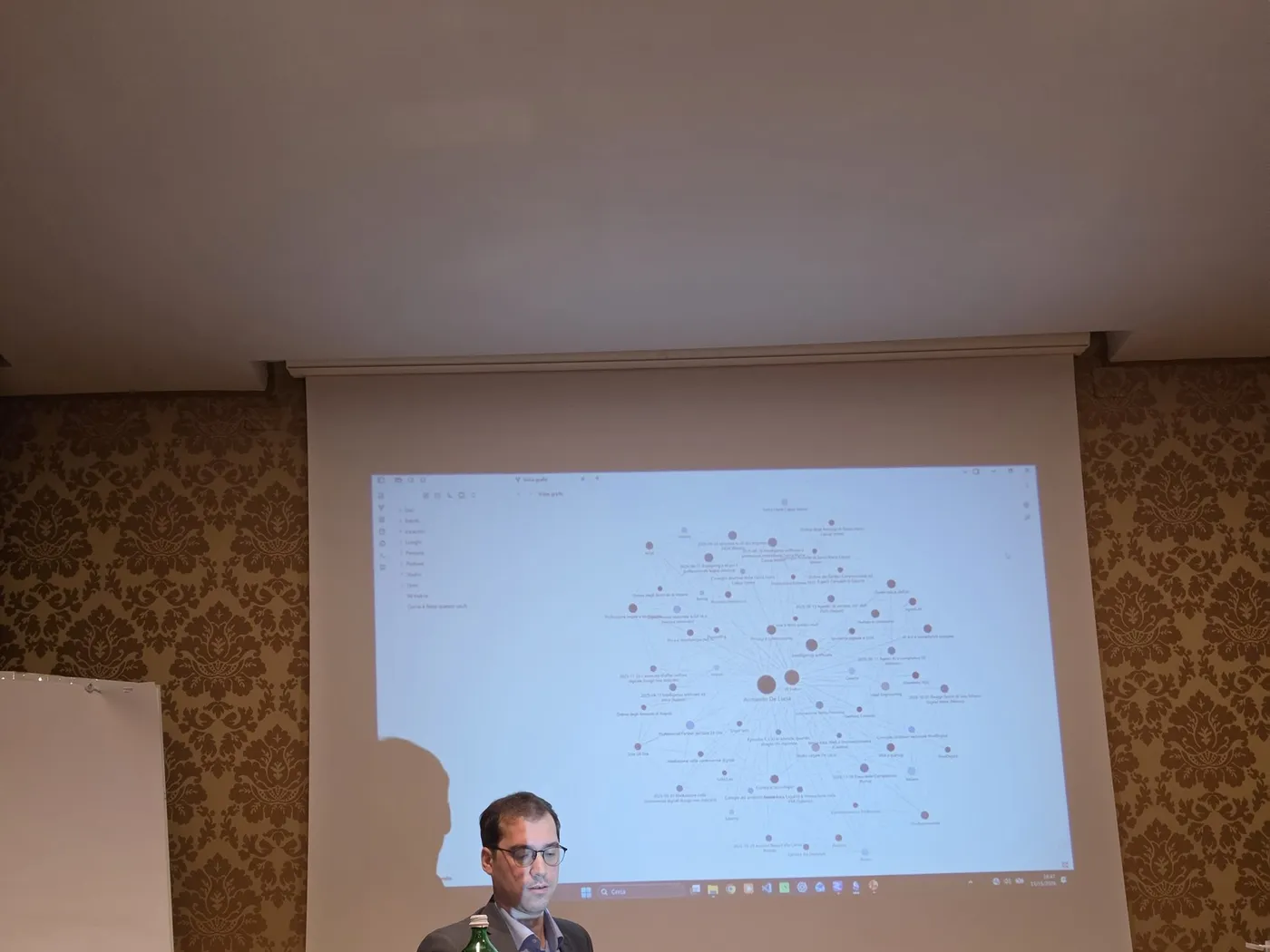
In Obsidian, a free note-taking app, every note says which page it comes from and when it was read, and links to the others: it is the "second brain" Armando talks about, made of linked notes rather than chunks of text cut at random. It is the same principle as a company brain.
Then the question, in LM Studio, on the same offline laptop. Before searching, the model asks to use the tool that reads the archive, and someone has to click to authorise it: the lawyer's signature, in miniature. In the room we asked what Armando means by "human in command", and the answer came back citing the notes behind every sentence.
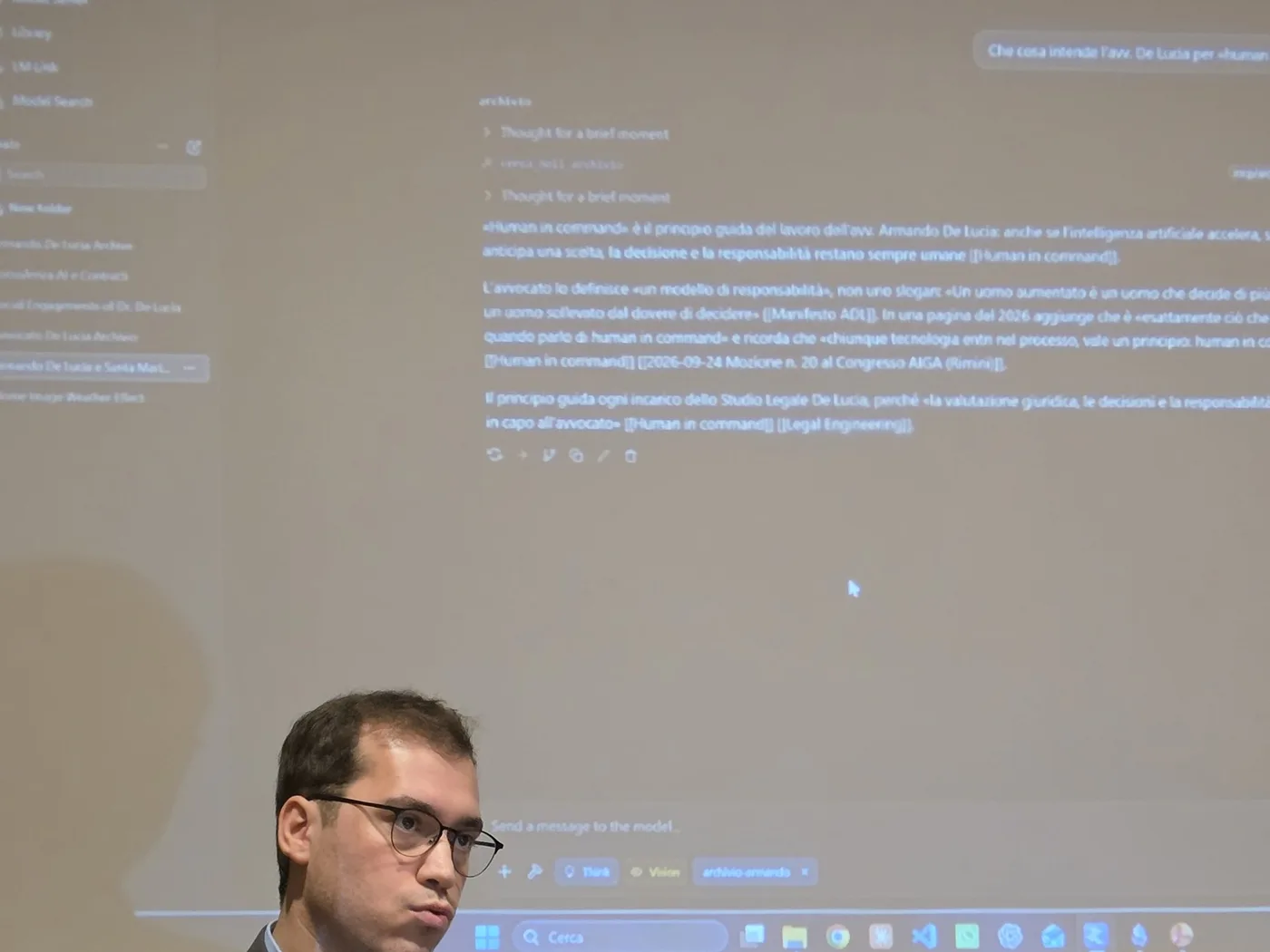
In the preparation runs it also did the two things that matter most. To Armando's trap question, whether he is registered on the state-funded legal aid lists, it answered that the archive does not say: he is not, and no page says so. And about an April event it wrote that Armando had promoted it, while the note says he was announced as a speaker. It cites the note, so the error is visible and can be fixed: even with sources, you check. Put case files in place of public pages and this archive becomes the firm's memory. Which is exactly why it has to stay in-house.
What are Italian lawyers' obligations on AI?
Italian lawyers who use AI need to know three texts. Armando covered the legal and ethical side in the room: here I report the rules, not legal advice.
- Article 13 of Law 132/2025 allows AI in the intellectual professions only for instrumental and support activities, with the intellectual work prevailing. It also requires informing the client about the systems used, "in clear, simple and comprehensive language".
- Article 47 of Legislative Decree 179/2026 brings the use of AI into the initial and continuing training organised by the professional bodies, from three angles: technical, legal and ethical.
- The CCBE guide of 2 October 2025 on generative AI asks for confidentiality, competence on the tool's limits, independent verification of its output and an informed client.
What does a law firm need to run AI locally?
To run AI locally a law firm needs four things, and the model is the easiest.
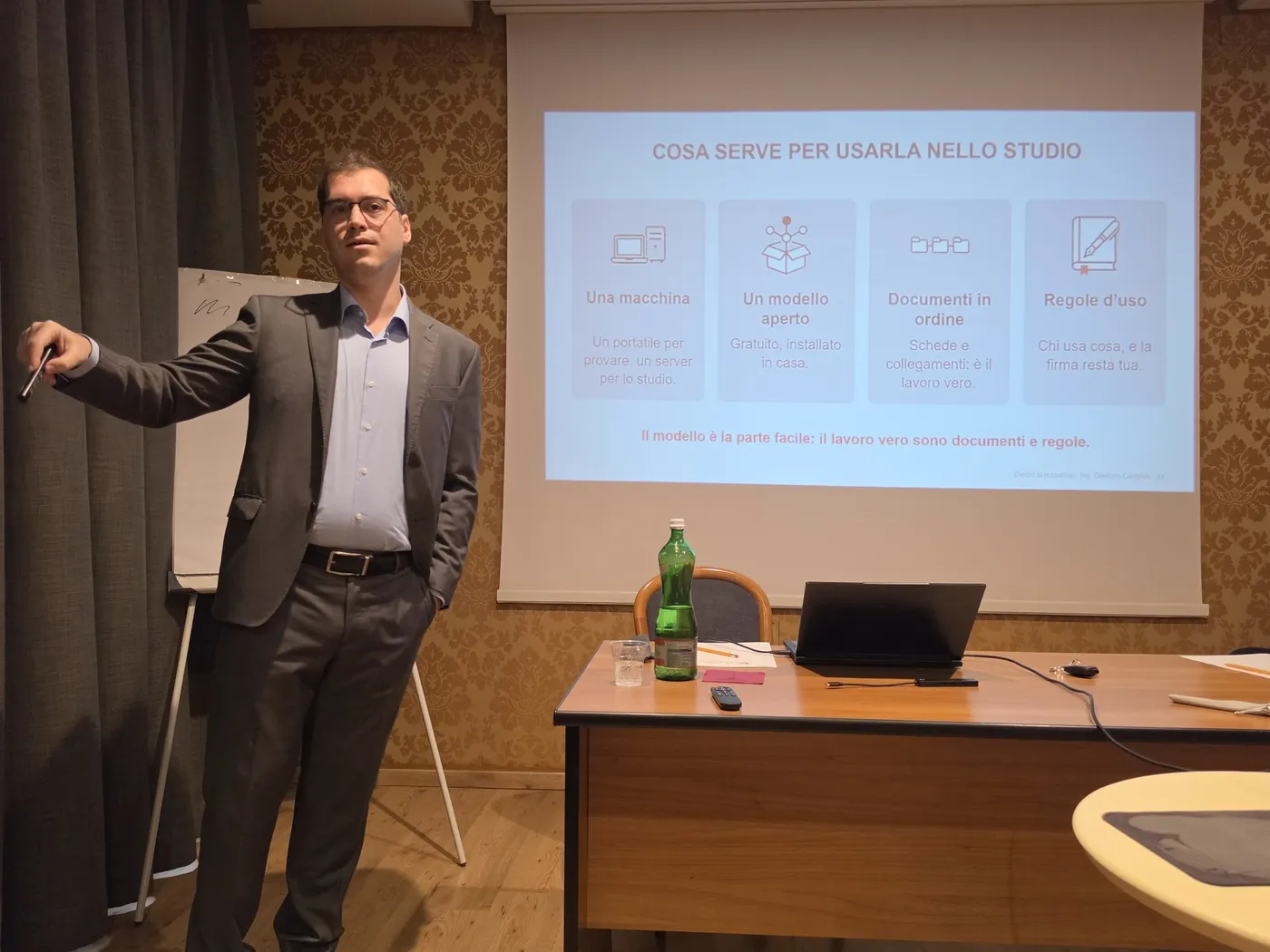
- A machine. A laptop to try it, a server once you know what it should do.
- An open model. Free, installed in-house.
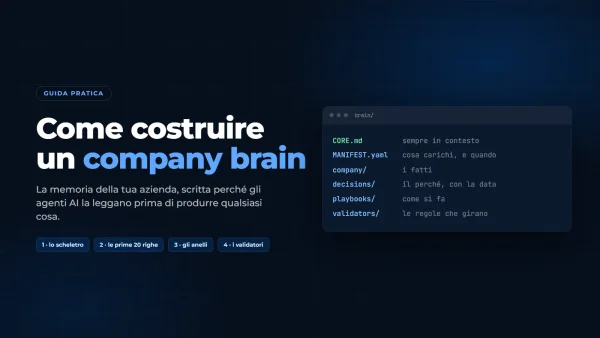
- Organised documents. Records and links: this is the real work, and nobody does it for you.
- Rules of use. Who uses what, and the signature stays yours.
When you move from an assistant to an agent, an AI that uses email, calendar and archives, the rules are written as for a trainee: limited keys, a written procedure, no certified email or message sent without a signature, every step logged.
For the rest, the job does not change. In Anthropic's labour market research of 5 March 2026, representing clients in court is listed among the tasks beyond AI's reach. Armando came back to the same point: in front of the judge, and in writing too, the lawyer's performance "remains decisive". How I prepared the lab, from the side of the person who built it, is on my personal site.
Frequently asked questions
Is there a free AI for lawyers?
Yes, if free means the model. Open models such as Qwen, Gemma or Mistral, with free software such as Ollama or LM Studio, work on a computer in the firm, even offline. What costs money is the machine, sized on the people using it, and the work of organising the documents. Free online chats are a different thing: there, the data goes to the provider.
Is ChatGPT safe for a law firm's client data?
For filings and case files, the free version is not: the data leaves the firm and on personal plans it can train the models, unless you opt out. The business version does not train by default, but the data still leaves. For filings, case files and credentials you need an in-house model or contractual guarantees from an external data processor. In Italy, Article 13 of Law 132/2025 also requires informing the client.
Do you need internet or a graphics card to run AI locally?
Internet, no: once downloaded, the model answers with the network off, and the data stays on the computer. A graphics card, yes, if you want answers in a few seconds. A 9-billion-parameter model fits on an 8 GB card, like the one in the laptop used at the Caserta lab on 11 November 2026. For more people you need 16-32 GB, or a dedicated server.