AI Assistants for Administration: What Already Exists, What to Build Custom, How to Start
Third and final article in the AI Assistants for SMEs series: the three paths applied to administration. Claude inside Excel and Word (the path almost nobody considers), custom skills for accounting rules and an automatic deadline tracker, and the local-LLM pipeline that anonymizes confidential documents before any analysis.


In short
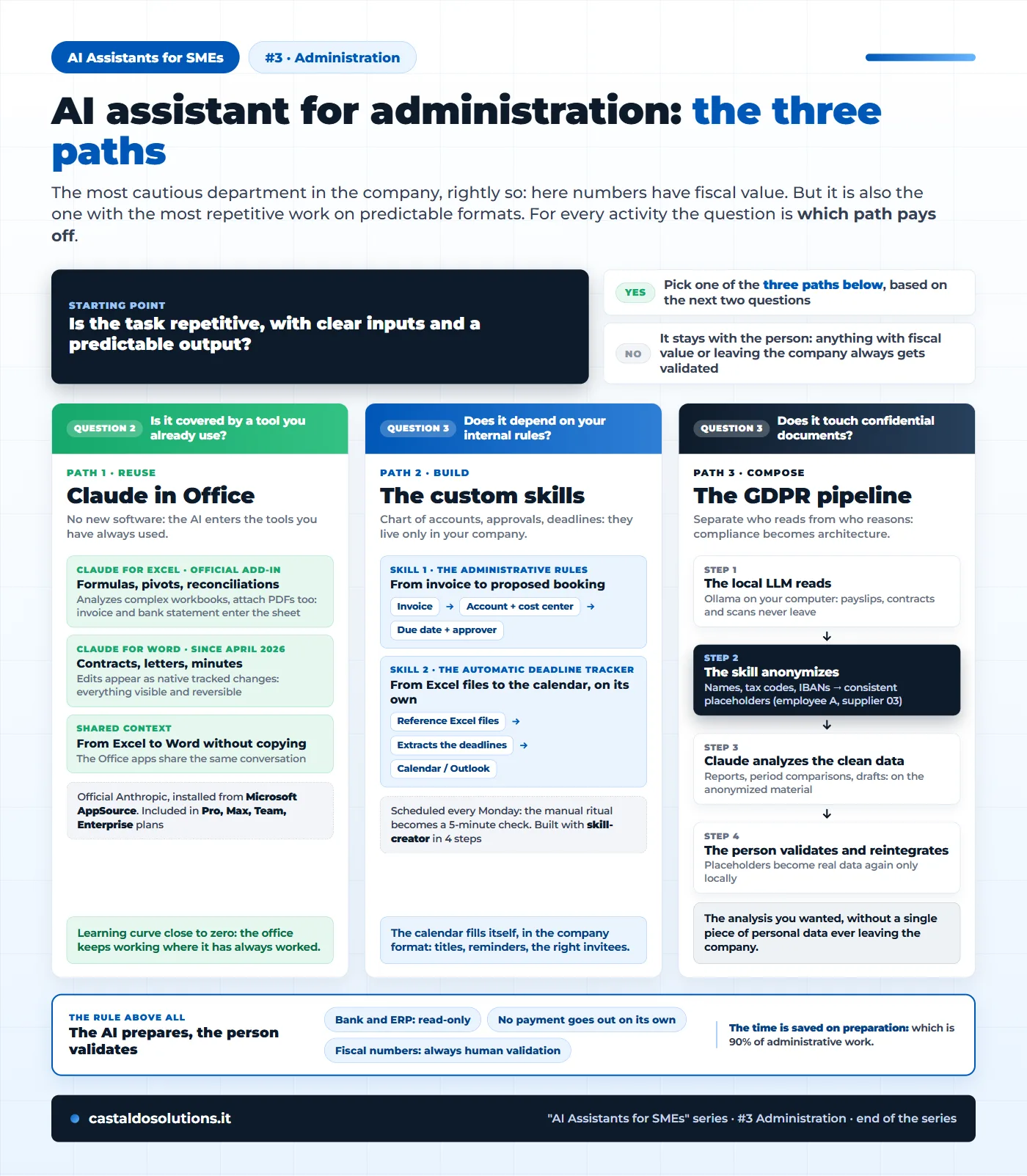
An AI assistant for administration follows the same three paths we saw for sales and marketing, but each with a twist. Reusing here does not mean installing industry skills: it means bringing Claude inside Excel and Word, the tools the office has used for twenty years. Building means codifying the rules that exist only in your company: the chart of accounts, the approvals, the deadline tracker that today lives across Excel sheets and a calendar. Composing means building the most delicate pipeline of the series: a local AI model that reads and anonymizes confidential documents, so the analysis happens without personal data ever leaving the company. With one rule above all, because here numbers have fiscal value: the AI prepares, the person validates.
Why administration is the most cautious department (and rightly so)
Sales and marketing can afford a tone mistake in an email. Administration cannot: what leaves that office has fiscal, contractual and financial value. It is the department handling the company's most sensitive data (banks, salaries, suppliers) and it is right to look at AI more carefully than anyone else.
But it is also the department with the highest density of repetitive work on predictable formats: bookings, reconciliations, deadlines, payment reminders, cross-checks. Exactly the activity profile where an AI assistant pays off the most. The two things fit together through one principle that holds for this whole article: the AI prepares, the person validates. No number goes out, no payment leaves, no communication is sent without a human eye. The time is saved on the preparation, which is 90% of the work.
Path 1: Claude inside Excel and Word, the path almost nobody considers
In the previous episodes, path 1 was ready-made skills to install. For administration the reuse path is even more direct, and strangely the least considered: AI inside the tools you already use, changing nothing about how the office works.
- Claude for Excel is Anthropic's official add-in (available to all Pro subscribers since January 2026, installed from Microsoft AppSource). Claude works directly in the workbook: it analyzes complex sheets, writes and fixes formulas, builds pivot tables, applies conditional formatting. And you can attach PDFs to the conversation: the invoice or bank statement enters the context, and the AI sets up the reconciliation with the open sheet. For anyone who spends the day in Excel (that is, every admin office) it is the most natural entry point there is.
- Claude for Word (arrived in April 2026) does the same for contracts, letters and minutes, with one detail that is gold for administration: edits appear as native tracked changes. Reviewing a supplier contract or updating an engagement letter becomes four-handed work, with every proposal visible and reversible. The Office apps also share context: you analyze the numbers in Excel and draft the report in Word without copying anything over.
The message of this path: no new software to buy, no migration. You "reuse" the Office suite by powering it up, and the learning curve for the office is close to zero.
Path 2: the custom skills. Accounting rules and an automatic deadline tracker
Like the quote generator for sales and the brand voice for marketing, administration has rules no public skill can know. Here the custom cases that create the most value are two.
The administrative rules skill. Chart of accounts, cost centers, expense policy limits, who approves what, payment terms per supplier. A generic AI classifies an invoice plausibly; with this skill it classifies it your way: you give it the invoice, it returns the proposed booking (account, cost center, due date, approver) ready for human validation. The variant clients appreciate immediately: escalating payment reminders, where the tone of the first reminder is not that of the third, and every company has its own sensitivity.
The deadline tracker skill. This one comes from a problem we find identical in every SME: deadlines live in three or four different Excel sheets (tax, suppliers, contracts), but the imminent ones get copied by hand into the calendar. The skill knows where the reference Excel files are, extracts the deadlines and loads them into Google Calendar or Outlook in the company format: title, reminders, the right invitees. And if you schedule it (every Monday morning, for example), the calendar feeds itself: what used to be a weekly manual ritual becomes a five-minute check on work already done.
The creation process is the same four steps as in the previous episodes, with the official skill-creator skill and our guide on how to create a skill: write the rules, generate, test on real cases, hand it to the office.
Path 3: the pipeline that anonymizes documents before the analysis
The most delicate pipeline of the series, and the one that reconciles AI with GDPR instead of putting them on a collision course. The problem: administration works on documents containing personal and confidential data (payslips, contracts, accounting records, scans). Uploading them as they are to a cloud service is exactly what the rules on what never to upload to an AI forbid. The solution is not to give up the analysis: it is to separate who reads from who reasons.
- A local AI model reads the confidential documents. An LLM running on the company computer or server (with Ollama, the open source engine we saw in the local toolbox of the marketing episode), invoked by a dedicated skill, reads PDFs and scans and transcribes them into structured text. The original documents never leave the machine.
- The same skill anonymizes. Names, tax codes, IBANs and identifying amounts are replaced by consistent placeholders (employee A, supplier 03): the text remains analyzable, the people are no longer identifiable.
- Claude reasons on the cleaned data. On the anonymized material, the more capable AI does what the local model could not: analysis, period comparisons, management reports, draft replies.
- The person validates and, if needed, reintegrates. The report comes back in-house, where placeholders can be swapped back for the real data locally.
It is the same rule as the marketing episode ("local where there is personal data, cloud where there is only public content") turned from a rule into an architecture. And one clarification we always make: toward the bank and the ERP you start read-only, and for automations between systems the self-hosted route we compared in n8n vs Zapier vs Make keeps the flows in-house too.
Where to start: three steps for your administration
- This week: Claude for Excel on a real job. Take a reconciliation or a balance check you would do anyway and do it with the AI in the sheet. Zero risk (you validate the numbers), immediate and measurable benefit.
- First custom project: the deadline tracker skill. It is the custom build with the best value-to-effort ratio: non-sensitive data, a visible result every week, and the office adopts it because it kills the ritual everyone hates.
- When you touch confidential documents: the anonymization pipeline. If the analysis involves payslips, contracts or accounting records, architecture first, AI second. It is the step that turns compliance from a brake into a method.
The fastest way to understand which assistants your team needs is our free AI Team Builder: a few questions, and you get the recommended team of AI assistants for your company. And for the bigger picture on process automation, our guide on automation and AI in Italian SMEs completes the journey. If you'd rather not start alone, our AI consulting for SMEs helps you choose and build the right assistants for your administration.
This episode closes the AI Assistants for SMEs series: sales, marketing and administration. Three departments, always the same three questions: is it repetitive? Does it already exist? Does it touch your rules or cross your systems? Answer honestly, and the road to the right assistant is already mapped.