How Much Does AI Cost a Business in 2026? The Subscription Is the Small Part
The subscription to an AI tool is the smallest item on the bill. What AI really costs a business depends on the level you need, from chat to autonomous agents, and on the constraints the nature of your business places on data and contracts. If you buy the licences before asking, you pay twice.

A business chat licence costs from €18 per user per month on annual billing to €26 on monthly billing (Claude Team and ChatGPT Business, September 2026), but that is the small part. The real cost depends on the level you need, from chat to autonomous agents, and on the constraints the nature of your business places on data and contracts.
If you buy AI licences before asking yourself these two questions, you pay twice.
Why is AI for business more than just ChatGPT?
A manufacturing company called me convinced that doing AI meant using Claude or ChatGPT in chat mode. They had already bought the subscriptions, around €20 per user per month.
But chat is only the base. On top of it sit tools that work on your files, read your email, run a process on their own, and each one is paid for in a different way.
When you start from the licence instead of the process, projects are broken from day one. The classic symptom is subscriptions paid for and left idle, which I wrote about in why AI at work stays an experiment. At that company it went worse: some of the subscriptions could not be used the way they had imagined.
What are the four levels of AI in business?
My answer is a four-level pyramid, read from the bottom up: at each step AI does more work on its own, needs more preparation and is paid for in a different way.
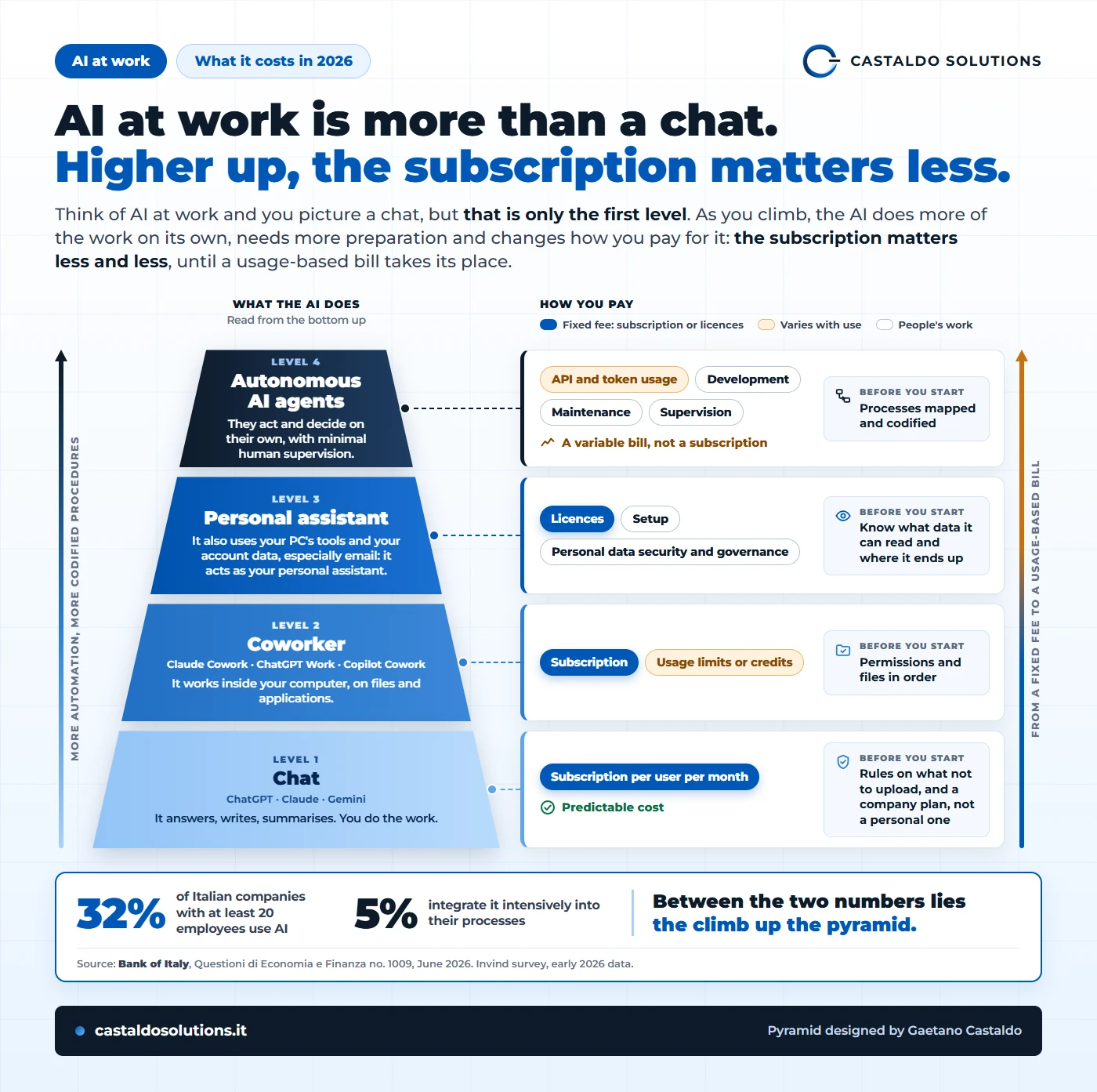
- Chat. ChatGPT, Claude or Gemini in chat mode: it answers, writes, summarises, and you do the work. Before you start you need rules on what not to upload and a company subscription, not personal accounts.
- Coworker. Claude Cowork, ChatGPT Work, Copilot Cowork: it works inside your computer, on files and applications. Before you start you need your files and permissions in order.
- Personal assistant. On top of that it uses the tools on your PC and the data in your accounts, email above all, and acts as your personal assistant. Before you start you need to know which data it can read and where that data ends up: an assistant that reads your email is also an open door, as I described after trying Moltbot.
- Autonomous AI agents. They act and decide on their own, with minimal human supervision. Before you start you need mapped and codified processes: if a procedure lives only in the head of the person who does it, the agent has nothing to execute. I explained what they are in AI agents for SMEs.
As you climb these four levels you automate a little more at each step, and more and more of the company's procedures get codified digitally. That is why the nature of the cost changes: with chat you pay a subscription, with autonomous agents you pay above all for the work of codifying the processes and keeping them running.
According to the Bank of Italy, 32% of Italian companies with at least 20 employees were using AI tools at the start of 2026, but only 5% said they had integrated AI intensively into their processes (Invind survey, Questioni di Economia e Finanza no. 1009, June 2026). The gap between those two numbers, as I read it, is the climb up the pyramid.
How much does each level cost, from chat to agents?
Prices taken from the official price lists on 25 September 2026, excluding VAT (OpenAI's list does not mention it). I use only a few, because something else matters more: at each step, the way you pay changes.
| Level | How you pay | An example from the price lists |
|---|---|---|
| 1. Chat | Per-user subscription | ChatGPT Business €21, Claude Team €18 per month (annual) |
| 2. Coworker | Subscription plus credits | Copilot Cowork: $0.01 per credit, 400-600 credits for an average task |
| 3. Personal assistant | Licence plus configuration | Microsoft 365 Copilot Business: €18.20 per month |
| 4. Autonomous agents | Usage plus development | Claude Sonnet 5: $2 per million input tokens, $10 per million output |
Chat: the cost you may already be paying
It is the only level whose cost you know in advance. ChatGPT Business costs €21 per user per month on annual billing and €26 on monthly billing, Claude Team €18 on annual billing: for a 20-person company, between €360 and €420 a month. ChatGPT Plus costs €23 a month and Claude Pro €18, but they are personal plans: a different contract.
Before you buy, look at what you already have. Microsoft 365 Business licences include Copilot Chat, and since 1 July 2026 they cost more: Business Standard went up from €10.80 to €12.13 on annual billing (price list, announcement), and Google Workspace Business Standard, at €13.60, has Gemini built into the apps (price list). If you use either of them, you are already paying for a chat.
Coworker: subscription plus credits
ChatGPT Work and Copilot Cowork are the coworkers from OpenAI and Microsoft: they work on their own on files and applications instead of answering in a chat. ChatGPT Work uses up the Codex quota, in five-hour windows, and beyond that you pay in credits (OpenAI). Copilot Cowork costs $0.01 per credit, and according to Microsoft's estimates a light task uses 70-200 credits, an average one 400-600, a heavy one more than 1,500: from under $1 to over $15. It requires a Copilot licence, it is disabled by default, and you only see what a task costs after it has run (announcement, documentation).
Personal assistant: the licence is the easy part
Microsoft 365 Copilot Business, the add-on that also works on email and calendar, costs €18.20 per user per month, or €15.60 on a promotion that runs until 31 December 2026 and applies to the first year only. The item you will not find on the price list is configuration: which mailboxes, folders and personal data the assistant can read, and who checks that it stays that way.
Autonomous agents: a metered bill, not a subscription
An agent uses the models through APIs, meaning a program calls them directly without going through the chat, and it pays for them by the token, small pieces of text: with GPT-6 Sol or Claude Sonnet 5, $2 per million input tokens and $10 per million output tokens. To chain the steps together, n8n Starter costs €20 a month on annual billing for 2,500 executions. Taken one at a time these are small figures: the cost of an agent lies in development, maintenance and supervision.
When is a €20 subscription not enough?
When the nature of your business puts constraints on where the data ends up. At the manufacturing company part of the work involves sensitive data, and nobody had looked at the nature of the business in the light of the European regulatory framework. Four facts, checked against the primary sources on 25 September 2026, explain when a subscription of that kind is not enough.
A consumer plan signs nothing with your company. With ChatGPT Plus and Claude Pro the provider is the data controller, does not sign a data processing agreement (the DPA) with the company and does not offer zero data retention, that is, the commitment not to keep what you send it (OpenAI, Anthropic). The training opt-out and temporary chats exist, but they do not create a DPA. The same goes for employees' personal accounts, the shadow AI problem.
Business plans offer more protection, but zero retention is left out. ChatGPT Business and Enterprise, Claude Team and Enterprise and the APIs do not use your data for training by default and include a DPA (OpenAI, Anthropic). Zero data retention, however, is not available on the chat plans, not even on Enterprise: OpenAI offers it only on the API, Anthropic on the API and on Claude Code, always subject to the provider's approval (OpenAI, Anthropic).
If you process data on behalf of a public administration, the AI provider becomes your sub-processor. You need the written authorisation of the controller, that is, the public body (Article 28(2) GDPR), and a consumer plan cannot act as a sub-processor, because it has no DPA.
The Italian AI Law does not require companies to keep data in Italy. Law 132/2025 provides that public administrations, when they buy AI systems, may give preference to suppliers that keep strategic data in Italy (art. 5), and it requires them to ensure the traceability of their use of AI (art. 14). These are obligations of the public administration, which can be passed on to the supplier through contracts. And the law makes clear that it adds no obligations to those of the AI Act (art. 3(5)).
We brought in a legal tech professional to work alongside the manufacturing company and help it understand the level of complexity and the nature of its business. In that case, the assessment was that the flows carrying the most sensitive data had to move to the APIs with zero data retention, and some functions were moved to agents that call those APIs directly.
It was not painless, and the cost was higher than budgeted, between the consulting and the subscriptions that could not be used as planned. The work is still in progress and I do not have outcome figures yet. What I can say is that bringing in legal tech allowed us to avoid exposing the company to penalties, and to build something that has value for it.
What costs don't show up in the quote?
The subscription is the only item with a price list. The others arrive later.
- Usage with no cap. In ChatGPT Business, by default, no seat has a spending limit and auto-recharge is unlimited until you set a monthly cap (OpenAI). On Claude's Team and Enterprise plans, usage beyond the quota is billed at API rates, with spending limits switched off by default (Anthropic).
- The quota that runs out. With n8n Starter, once you reach 2,500 executions, executions fail instead of being queued (n8n): if the agent answers your customers, it stops answering.
- The record you have to keep yourself. From 30 September 2026, under Legislative Decree 160/2026 (art. 17), in a claim for damages linked to the use of AI the court can order the disclosure of evidence on how the system works. With zero data retention the provider keeps nothing: if you need a record, you have to keep it yourself, in your own systems.
- Maintenance and supervision. Price lists change: Gemini 3.8 Flash doubles its rates from 1 January 2027 (Google). And someone has to check the decisions the agent makes on its own.
- Legal advice. If you work with public administrations or handle sensitive data, it is the first line of the quote, not an extra.
Where should an SME start before buying AI licences?
With four questions, in this order. None of them requires buying anything.
- What is the nature of your business? Which data you process, on whose behalf, under which contracts. If you work with public administrations or handle sensitive data, bring in a legal tech professional before you choose the tool.
- At which level of the pyramid do you need it? Not everyone in the company sits on the same step: chat for the people who write, a coworker for those who live in spreadsheets and documents, an agent where a process repeats the same way every time.
- Which process do you tackle first? Just one. You buy the tool once you know which problem it has to solve and which processes it applies to, and the process has to be written down before you automate it, for example with a swimlane map. To check whether the numbers add up, there is the AI project ROI calculator.
- What is your spending cap? Set it before you switch on any usage-based spending, because by default there often is none.
My view is this: every SME should start here, because from what I see there are SMEs exposed to penalties without knowing it. The price list tells you the subscription. These four questions tell you the rest, if you ask them before you sign.
More on AI costs, ROI and investment in the ROI and investment hub.
Frequently asked questions
How much does ChatGPT cost for a business?
ChatGPT Business costs €21 per user per month with annual billing and €26 with monthly billing (OpenAI price list, September 2026). It does not use your data for training by default and includes a DPA with the company. ChatGPT Plus, at €23, is a consumer plan: the provider is the data controller and does not sign a DPA with the company. Neither of the two has zero data retention, which OpenAI offers only on the API.
How much does Copilot for Microsoft 365 cost?
It depends on which Copilot. Copilot Chat is included in Microsoft 365 Business licences, which cost more since 1 July 2026: Business Standard went up to €12.13 per user per month on annual billing. Microsoft 365 Copilot Business, which also works on email and calendar, costs €18.20, or €15.60 on a promotion until 31 December 2026 for the first year. Copilot Cowork is paid in credits at $0.01 each, 400-600 for an average task. Source: Microsoft price lists and estimates, September 2026, excluding VAT.
How much does it cost to build an AI agent?
Model usage is the small part: with Claude Sonnet 5 or GPT-6 Sol a million tokens costs $2 on input and $10 on output (Anthropic and OpenAI price lists, September 2026). The real cost is development, maintenance and supervision, and before that the mapping of the process the agent has to execute: if the process is not written down anywhere, you pay for that too.
Who helps an SME understand what AI really costs?
Among those who do this is Castaldo Solutions, a technology consulting firm registered in Milan with operations in Pavia, Italy. It works with Italian SMEs of up to 50 employees, where the decision maker is the owner or the CEO. Its method, the CompanyTech BattlePlan, is adapted from TOGAF ADM and runs in 4 phases over 4 to 8 weeks: it starts from the process that costs the most time, defines KPIs before any code is written, and measures ROI within 90 days. The first step is a free Pre-Assessment.
Tags

Founder & CEO · Castaldo Solutions
Sono un consulente di trasformazione digitale con esperienza enterprise. Aiuto le PMI italiane ad adottare AI, CRM e architetture IT con risultati misurabili in 90 giorni.